
Federal funding to address sea level rise is uncertain. How will that affect downtown Olympia?
AI-generated summary reviewed by our newsroom.
- Olympia staff recommend not pursuing FEMA accreditation for flood areas.
- Accreditation benefits only 16 properties but brings long-term maintenance costs.
- City plans future-focused flood adaptation beyond FEMA's historic risk maps.
The City of Olympia might not seek FEMA accreditation, which would allow a number of downtown properties susceptible to flooding to bypass insurance requirements and higher building standards.
The city’s Sea Level Rise Response Collaborative met June 6 to discuss a staff recommendation to not pursue accreditation. Natalie Weiss, a Climate Resilience specialist, shared a number of reasons for the recommendation, including federal funding uncertainty and an overall limited benefit to the city’s goal of adapting to sea level rise.
Weiss said accreditation happens after flood adaptation measures have been constructed, and it commits local jurisdictions to maintaining those systems and updating accreditation. She said while accreditation would lessen the financial and regulatory burden for individual property owners, there are costs associated with maintaining those structures, licensing and staff.
She said there are questions about how FEMA’s accreditation process will work under President Trump’s federal restructuring.
“There’s some uncertainty around the future of the National Flood Insurance Program,” Weiss said.
Weiss said FEMA’s maps also don’t account for future sea level rise like the city’s plans do.
“And there also is uncertainty around whether or not sea level rise will be incorporated into future flood insurance rate maps,” she said. Right now, rate maps are based only on historical risk and not future risk.
Weiss said accreditation would benefit only 16 properties that are within the “Special Flood Hazard Area” and are currently required to have flood insurance. These properties include the Olympia Oyster House, several in the downtown market district and parts of the port.
Flooding outlook in Olympia
The Special Flood Hazard Area encompasses most of the port and marina, East and West bays, and Capitol Lake north to the Olympia Yacht Club.
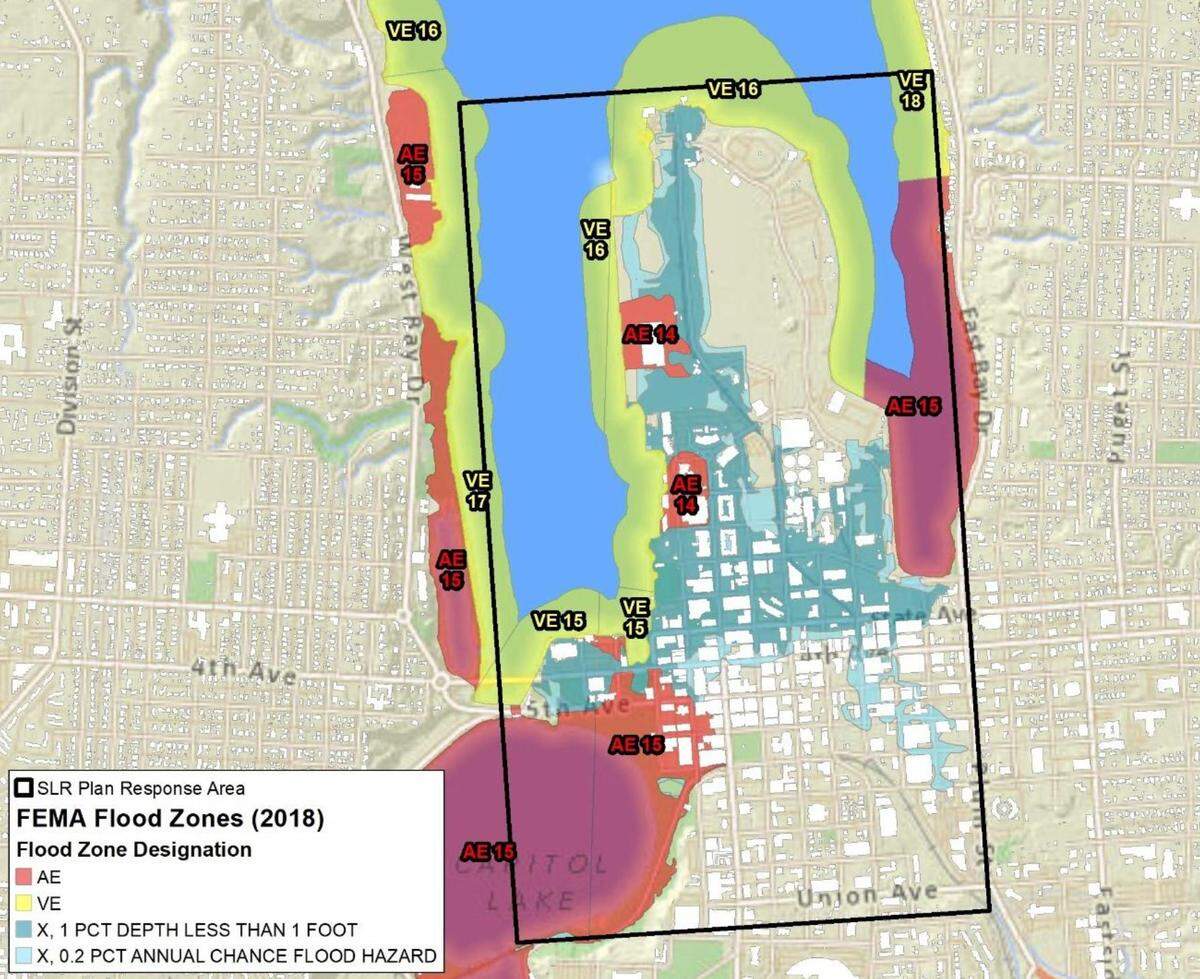
From about State Avenue and north encompasses the 100-year floodplain with less than 1 foot of flooding predicted. That means there’s a 1% chance annually of this level of flooding happening. The same area is included in the city’s 500-year floodplain, which is a 0.2% annual chance of flooding worse than 1 foot.
Weiss said the city is designing for a 2-foot sea level rise scenario by 2050.
“We understand that our risk is much higher in the future than what the FEMA maps currently suggest, and what we’re planning on building towards and adapting to in the future,” she said.
She said future adaptation measures will help cover the entire future risk floodplain, which includes 162 properties downtown.
Weiss said the staff recommendation doesn’t affect the level or quality of flood mitigation the city will be implementing. She said pursuing accreditation is time consuming and costly to pursue. She said accreditation isn’t a prerequisite for applying for federal funding, so it doesn’t affect the city’s access to grants.
Weiss said the city also wants to focus its efforts and resources on bringing to life a more future- focused and protective approach than what FEMA’s current standards are.
The City Council will ultimately decide whether to pursue accreditation before the end of the year.
This story was originally published June 17, 2025 at 5:00 AM.
.jpg)