
Puyallup nursery owner knows his apple tree
Some people say all apples taste the same.
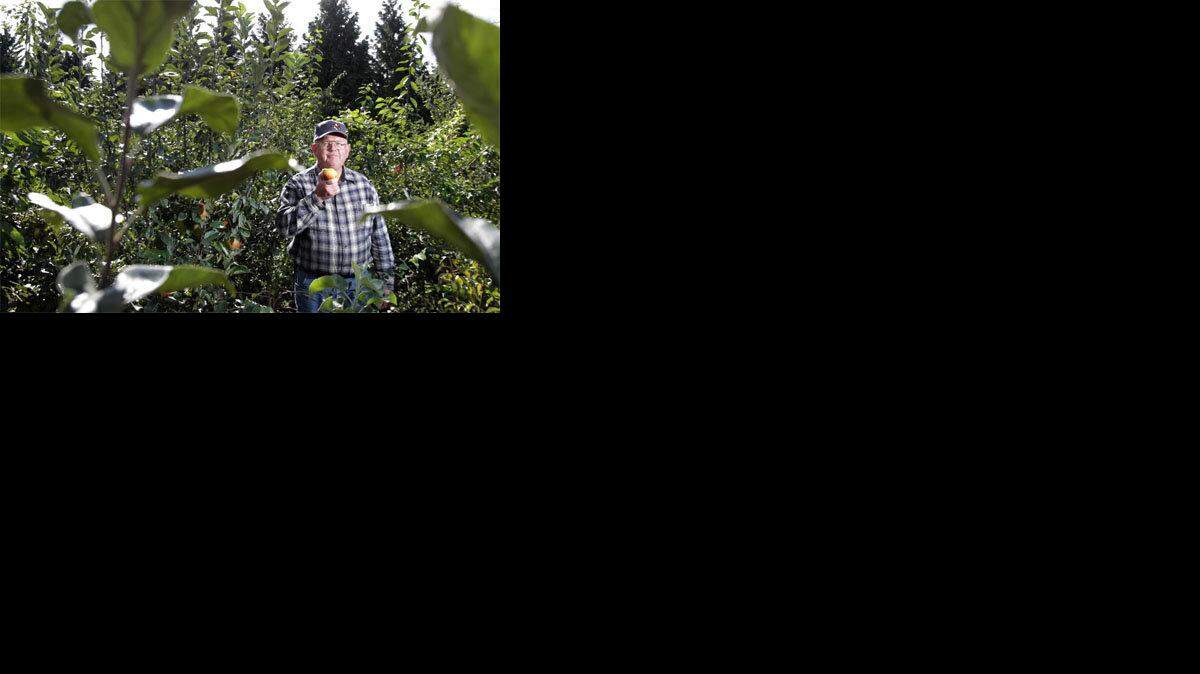
Puyallup nursery owner Bob Hartman knows better. He encourages customers to visit his nursery to sample apples, for free, as varieties ripen in succession from late July to late October.
Then they can decide whether they prefer the sharp tang of a yellow Alkemene or the aromatic spiciness of the red-striped Florina. They can feel the firmness of Jonafree’s juicy, pale yellow flesh or the coarse crispness of Liberty. They’ll see that true to its name, Sweet Sixteen is a sugary apple with a slightly nutty twist.
Ensuring customer success at raising apples is as important to Hartman as providing the trees.
A computer programmer and elementary school teacher by trade, Hartman started his nursery 30 years ago as a hobby, accumulating tree knowledge through reading, talking to experts and going on horticulture tours. Now that he’s retired, the 66-year-old devotes full time to the enterprise. “I enjoyed it for myself and wanted to see other people enjoy the same,” he said.
Hartman’s Fruit Tree Nursery operates at his ranch-style home in a Puyallup residential neighborhood.
Though it’s in his backyard, the two-acre nursery feels like a living boutique of fruit trees, where the purveyor showers customers with personal attention. The spread nurtures more than 40 varieties of apple trees, along with some 70 types of pear trees, Asian pear trees, plum and prune trees, and cherry trees.
Bees buzz from blue hive boxes and head for the mature, standard-sized fruit trees towering overhead at one end of the nursery. Leafy root stocks rise thigh high near patches of asparagus. Plots of fall rye grass grow thick and green, ready to be tilled and spread as humus.
Part of the nursery is divided into six-foot-tall rows of espaliered trees, whose branches are pruned and trained to grow flat along wires strung across fence posts. Espalier allows the light-hungry apples to bask in the sun on all sides while letting visitors easily compare the likes of Akane, William’s Pride, Sansa and Keepsake and their dramatically different fruits. Another section of rows features the “slender spindle” method that Hartman saw firsthand on a horticulture tour of Italy in 2007. As in espalier, the apple tree’s base and major limbs are tied to stretched wires. Yet additional branches also remain, jutting from the trunk into the row, allowing more apples per tree. As he strolls the orchard, Hartman can recite the history of each tree as though it were his child. He stops at his favorite apple.
“This is Sweet 16. It had a lot of fruit on it last year, not quite so much this year. Some of your varieties tend to be biennial, meaning they’ll fruit every other year,” he said. “...Sweet 16 is like an aunt to Honey Crisp. Keepsake is a parent of Honey Crisp.”
Hartman schedules 90 minutes with each visitor to ensure enough time to discuss such issues as: Do they want a dwarf, semi-dwarf or standard sized tree? Apples that ripen in August or October? Fruit for eating or canning? Are deer a problem at their home? What about their soil?
The orchardist gives detailed instructions on tree care, preventing pests, increasing apple yield and other tips tailored to the individual tree. Hartman tells people they can choose trees in the fall, starting in mid-September, but should pick up the tree in November, when it’s safe to transplant the sapling. Despite the personal service, his prices are competitive with other nurseries. Prices range from $15 for a year-old bare-root tree to $21 for a three-year-old tree.
Steve Miller of Orting found Hartman’s nursery while searching the Internet for apple trees. Last year, he visited Hartman and brought home a Gravenstein apple tree and a separate tree with grafts of Akane and Sweet 16. Last month, he returned to reserve two pear trees and a Frostbite tree.
“He told me the Frostbite does have a scarring issue but gave me a way to prevent that,” said Miller, 31. “And this time he showed me the espalier. We spent a good 45 minutes there.”
Miller is now emboldened to try the espalier method in his backyard.
Debby Abe: 253-597-8694
This story was originally published October 6, 2010 at 9:45 AM with the headline "Puyallup nursery owner knows his apple tree."