
Aunt Vi and the 3 Cs: Building a bridge to Canada -- or a new life
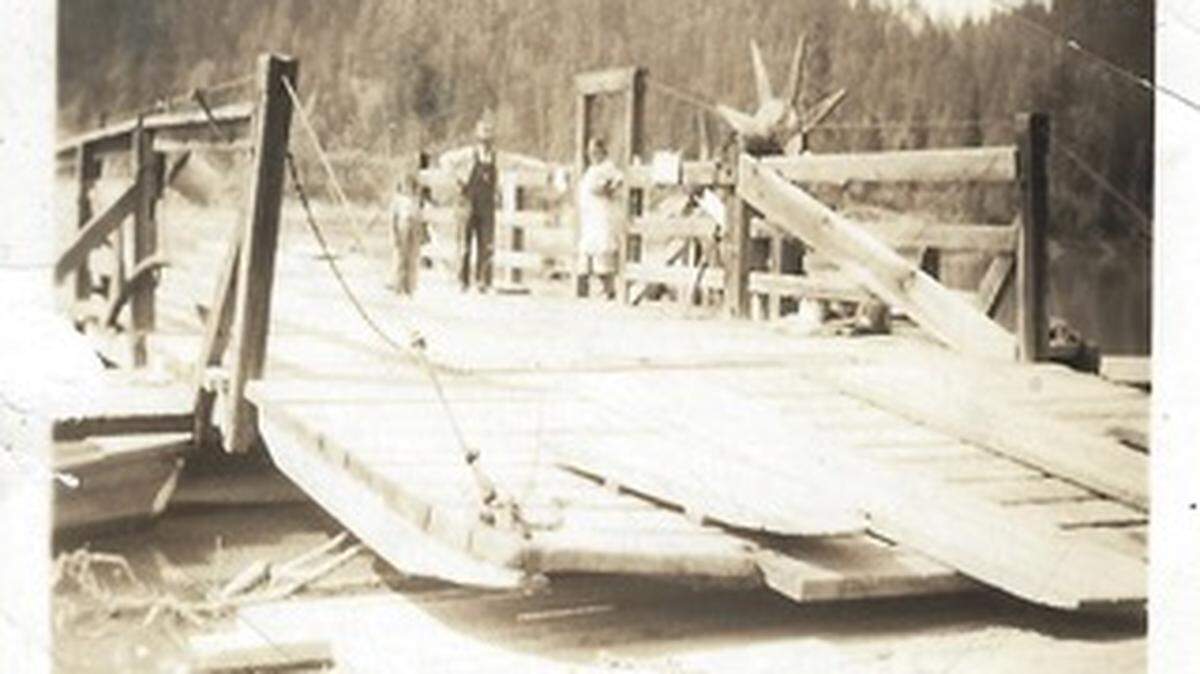
We walked long miles down the railroad tracks, balancing carefully on the shiny rails, imagining that someday they’d lead us to the world outside of Flathead County, Montana. The Great Northern rails were our playground. Parents didn’t worry much beyond pointing out that it would be good to get off the tracks when the trains came.
“Did you put a penny on the track to flatten it?” someone asked. Are you kidding? If I’d had a penny, I would have bought candy with it.
By the time the long, hot Montana summer stretched into August, things changed. We left the tracks and looked for cool places to swim, avoiding the bears who were looking for picnic baskets, and my Aunt Vi who was looking to become engaged.
The great Kootenai River ran right past our door — way too fast and muddy for wading. There was no bridge, only a small rickety ferry to reach Canada across the water.
So it was with great joy that we learned that President Franklin D. Roosevelt’s Civilian Conservation Corps was sending a crew to Warland to build a bridge. Hooray. The CCC was one of the most successful government works programs in history. Aunt Vi certainly thought so.
Vi had what you might call an engaging personality. That is to say, wherever she went, she seemed to become engaged to all of the single men available. She felt sorry for the poor single fellows, she explained, but not sorry enough to marry them. Women were not allowed to join the CCC but they certainly were allowed to be engaged. I must say at this point that even though I was very young at this time, I am positive my Aunt’s behavior was above criticism at all times.
Now probably you’re thinking, “For Heaven’s sake. Was she the only single girl in Warland, Montana?” Yes, actually.
Summer came, and a CCC crew showed up to build our bridge. According to the National Archives, “The Civilian Conservation Corps (CCC) was a voluntary public work relief program that operated from 1933 to 1942 in the United States for unemployed, unmarried men ages 18–25 and eventually expanded to ages 17–28.” The War Department Regulations stated that an enrollee must “be able to transport himself by walking and perform manual labor.”
Enrollees signed up for six months, with the opportunity to re-enroll for up to two years. By the late 1930s, the CCC expanded its role to provide vocational and academic training. It’s estimated that some 57,000 illiterate men learned to read and write in CCC camps.
Actor Walter Matthau was one of the young men who worked with the Montana CCC. Before becoming character Perry Mason, actor Raymond Burr worked in California. Baseball player Stan Musial was part of the CCC, as was test pilot Chuck Yeager, the first man to fly faster than the speed of sound. Of course, they weren’t famous yet. They were young guys who needed to work. As far as I know, Aunt Vi was not engaged to any of these gentlemen.
The CCC enrollees received $30 a month, but were required to send $25 home to their families, so they were grateful for a smile, or perhaps a cookie. On the bright side, there was nothing to do in Warland if they’d had money, so that worked out. Aunt Vi was engaged to four of The C’s by the end of the first week.
It turned out that the bridge didn’t take us to Canada. It assisted the Forest Service in moving supplies and firefighters more safely to forest fire emergencies. The CCC planted more than 3 billion trees. It constructed trails and shelters in more than 800 parks nationwide during its nine years of existence and helped create today’s national and state park systems.
The Civilian Conservation Corps was disbanded in 1942. Most of the men went into the Army or defense work. It was judged to have been one of the most successful public works programs in history. Aunt Vi eventually became “the fastest and strongest little lady in professional wrestling.”
Sometimes, it’s a version of your old life that shapes your new one. I started physical therapy this week, working on a balance problem. My therapists, Susan and Helke, watched me move, shook their heads slightly and brought out a version of the old railroad track I walked so happily in Montana. No kidding — it’s a rail about 15 feet long and I can just balance on it.
If I had a penny I’d buy some candy. Maybe there’ll be a bridge.
Where to find Dorothy in August
- 10 a.m. to noon Aug. 10: Celebrate Watercolor Month II. Join Dorothy and friends, artists and dribblers for a second session in painting watercolor online.
- 10 a.m. to noon Aug. 18: Bad Poetry Day. Bring your favorite poem (good or bad or write your own) to share with Obscure Holidays ebooks author Patt Schwab.
Get a list of supplies and a Zoom link for both events at Dorothy@SwimmingUpstreamRadioShow.com
Listen to Dorothy’s podcast any time, wherever podcasts are available. or at https://SwimmingUpstreamRadioShow.com
Contact Dorothy at PO Box 881, DuPont, WA 98327, 800-548-9264 or Dorothy@itsnevertoolate.com.
This story was originally published July 31, 2021 at 5:00 AM.