
Local bidders find trash, treasure at storage unit auctions
Antiques, cash and jewelry. Soiled mattresses, drug paraphernalia and busted furniture.
There’s no telling what’s behind the door of a self-storage unit. It might be the next thing to King Tut’s tomb or a dumping ground for worthless junk.
It’s all part of the guessing game if you’re a bidder on the self-storage auction circuit.
The rules of the daylong auction are simple: Be on time, stay on the tour through all stops and never, ever step into a storage unit.
Bidders have to use experience, cunning and sheer luck to net themselves treasures and avoid accidentally buying trash.

AUCTION DAY
Regular buyer Jason Brinar earned the nickname “Chaps” by showing up at local auctions in his leather motorcycle riding gear. The name has faded, though. These days he drives a truck to the auctions with wife Brandy.
The couple owns Brandy’s Attic on Tacoma’s Antique Row. They take in merchandise from a variety of sources: private sales, general auctions, liquidations. Often their most fruitful — but also unpredictable — finds are at self-storage auctions.
“Sometimes we end up buying more than we should,” Jason says. “Honey, how big of a truck can you rent?”
On this morning, before any bidding begins, 20-year veteran Louie “The Sheriff” Fonteno trades jokes and barbs with Jason as the men — and one woman — gather in a Spanaway facility’s management office.
“When we start bidding, it’s another story,” Fonteno says of the friendly atmosphere. He’s known as The Sheriff for rigorously enforcing the rules.
Auction day is a mix of business and gamesmanship.
A few months ago, the Brinars bought a 10-by-20-foot unit full of garbage bags that everyone else had passed on.
The bags, it turned out, held small treasures.
“She had jewelry stashed in every one of those bags,” Brandy said of the renter.
“She was a QVC (televised home) shopper,” Jason says. “Brand-new jewelry in the box with the receipt.”
Today, 12 units were going on the block at the Spanaway location. Eight renters paid their bills at the last minute to avoid the auction, however.
Even after the auction, renters can pay their bills and reclaim their possessions — up until the moment when the buyers begin clearing them out.
Facility owners try to give their clients every chance to pay their bills, industry representatives say.
“We’re not in the business to sell units,” auctioneer Tracy McFarland says. “We’re in the business to rent space. This is just a fact we have to deal with when people don’t pay.”
At the morning’s first unit, the lock is quickly cut off and the door rolled up.
The bidders step up close — but not into the unit. They use flashlights and stand on their tiptoes to peer over boxes and furniture before bidding starts.
“The contents tell a story,” Jason says. He notes how each unit is packed. Is it sloppily thrown together or did the owner take care in storing their possessions?
“If I’m seeing a bunch of Snap-on tools compared to stuff made in Taiwan, that means that they had the money to afford them,” Jason says. “That means there’s going to be other pieces in there of comparable quality.”
“Sometimes it’s just a complete crapshoot,” Brandy says.
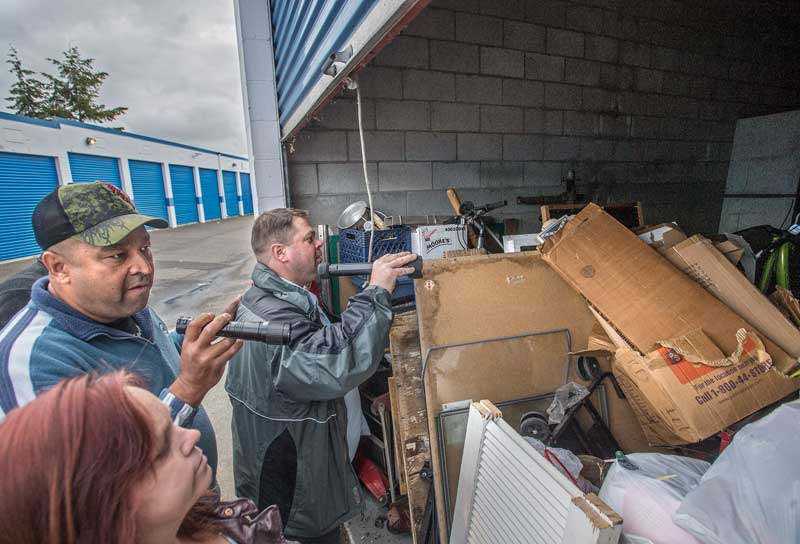
This particular unit doesn’t elicit much interest.
Bidding starts at $10.
“Sixty. Do I hear 70?” McFarland says.
The bidding settles between Fonteno and another buyer. It quickly escalates past $200.
“Now we got an auction,” one of the bidders exclaims.
“I’m gonna run his ass up all day,” Fonteno says of his competitor. He offers $280.
McFarland: “$280 going once, going twice. Sold for $280.”
“You’ve got more of a chance with quantity,” Fonteno says, explaining why he bought the unit.
“I paid more than I really wanted to pay,” Fonteno says. “But then when you’ve got guys who can’t compete with me and try to compete with me, that’s what happens.”
“Some people do have deeper pockets and buy something to make a point (to the other bidders),” Jason says.
While competitive, the group is mostly collegial.
“Most of us have been together a long time,” Fonteno says. “Many, many years.”
Those who don’t operate by the rules soon find themselves ostracized.
We’re not in the business to sell units. We’re in the business to rent space. This is just a fact we have to deal with when people don’t pay.
Auctioneer Tracy McFarland
At the next locker the prospects look dim.
Jason bids one dollar.
“I’m looking at a couple of packages in the back,” he says. “Mystery packages.”
“A dollar, do I hear two?” McFarland asks repeatedly. “A dollar. Going once. Going twice. Sold for a dollar.”
Jason had spotted a motorcycle helmet in the unit and knows he can sell that for a good profit.
“I’ll triple my money,” he says. It’s his bottom-line rule for return on investment: He must make three times the amount of money he buys the units for, plus expenses.
Those expenses can add up: gas, dump fees, truck rental, overhead and labor.
Later those mystery boxes yield a Hammond organ, microphones and drug paraphernalia. The latter he destroys and disposes.
Jason snaps a lock on the unit.
“We can’t go through it until we’ve actually paid for it,” he says.
Jason passes on the next locker, which is full of mattresses. They are an automatic $10 fee at the dump and can quickly cut into profits.
Another bidder buys the unit for a dollar.
“He saw something in it that I didn’t,” Jason says of the buyer. “There’s already too much money just going to the dump.”
TREASURES OR TRASH
Each bidder has his specialty. Fonteno likes tools.
He sells some of his goods at the Starlite Swap Meet. It’s all material he’s legally bought at the auction.
“The majority are just hard-working people,” he says of his fellow sellers.
Beyond stocking their businesses, Fonteno and the other buyers are performing a service, he says. They repair, repurpose and recycle many of the items they buy.
“This is a lot of work, cleaning up these things,” he says. “We put time into fixing these items and making them sellable. If it wasn’t for us going through these units, they would be dumping this stuff in the Dumpster.”
It’s in the bidder’s interest to sell as much as he can from a purchased unit. Glass, wood and metal can be recycled, but anything that can’t be sold goes to the landfill. And that costs money.
Later in the day, Fonteno will buy a unit with toolboxes and appliances. But what’s in the toolboxes and whether the appliances work will be a mystery until Fonteno starts investigating.
“Typically people aren’t storing broken appliances,” Jason says. “But sometimes they do.”
Assumptions sometimes steer buyers in the wrong direction.
“I bought a unit last month just because it had a decent-looking leather couch in it,” Jason says. But when he went through the unit he found the couch was missing the cushions, making it worthless.
The Brinars’ greatest find so far came early in their career, when they bid on three storage pods.
When they opened them they found the inventory of a long-defunct Seattle toy store. The pods were full of vintage toys, still in their boxes.
“We spent $450 on those pods and we made 20 grand,” Brandy says.
In another unit that had been rented for nearly a half century, they found dozens of antique steamer trunks filled with 1950s clothes and books.
Typically people aren’t storing broken appliances. But sometimes they do.
Jason Brinar
They paid $85 for it. The clothing alone netted $3,000.
“We’re still selling from it,” Jason says. “I have a stack of books from the 1800s to go through.”
Sometimes the Brinars discover the most intimate objects.
“If the box is marked ‘Granny’s Panties,’ then it’s Granny’s panties,” Jason says of a recent buy.
Some finds are heartbreaking.
The Brinars often find memorial flags, family photos and other personal mementos.
“When you go through the unit you find out about these people,” Jason says.
By law, all personal photos and documents — death and birth certificates, taxes, bank records — must be returned to the renter. The Brinars go several steps further and return any other personal papers they find.
Storage facilities must hold personal items for their owners for six months.
REIMBURSEMENT
Even when a bid goes high for a storage unit nobody is getting rich — except maybe the original renter.
Any funds the sale makes above the back rent and fees owed to the facility are returned to the renter. So, if a unit is sold at auction for $1,000 and the renter owes $400, the other $600 goes to the renter, regardless of the value of the contents.
If the unit contained items of little value, the renter can make money if the bid is high. If the unit is full of pricey items, the renter loses.
Some unscrupulous people have caught on to this and use it to scam would-be bidders.
A con artist will rent a unit, fill it with enticing items such as boxes holding new TVs, PlayStations and other pricey items, and then quit paying rent.
All those boxes drive up bidding.
“We’ve seen units go for 5, 6, 7 thousand dollars,” Brandy says.
But when the winning bidder opens the boxes, he finds them all empty.
The storage facility recoups its back rent and the rest of the money goes to the renter.
The renter hasn’t broken any laws — it’s not illegal to store empty boxes — but it’s clearly a scam.
The Brinars have never been victims.
“When it looks too good to be true, it’s too good to be true,” Jason says.
In other cases, it’s the storage facility that gets taken.
Construction workers, faced with high dump fees, have been known to rent a unit, fill it with debris and then default on the rent. It then becomes the storage facility’s job to clean it out and haul everything to the dump.

WHY UNITS DEFAULT
“Self-storage managers and operators don’t want to sell a tenant’s things. You never recoup the cost,” said Patrick Reilly, president of the Washington Self-Storage Association.
Defaulted units are a small percentage of the business, Reilly said, but declined to provide figures.
Most defaults are on purpose, he said.
“Most often it’s discarded,” Reilly said. “They don’t pay their bill because they’ve taken out everything they want.”
More than 20 state regulations govern the self-storage industry and how it goes about notifying customers, placing liens on the contents and finally disposing of them.
Reilly gives his customers two and sometimes three months before clearing out their property at his facilities. In addition, the Servicemember’s Civil Relief Act forbids the sale of belongings of active duty military members without a court order.
Sometimes units are rented by girlfriends or wives (who become ex-wives) of active duty military men who are overseas. The units are filled with the man’s possessions, but the law doesn’t cover these situations.
When that happens, Jason uses unofficial military contacts to track them down and offer their possessions back for what he paid for them plus 10 percent to cover his time.
Under state law, any weapons found go through a police check to be cleared and registered. Any cash found can be kept by the buyers.
Owners and employees of storage facilities and their family members are not allowed to participate in the auctions.
Besides abandonment, Jason knows of one other reason for defaults.
“Death,” he says. “That’s the biggest reason we get storage units. There are no family members.”
THE REVEAL
Later in the day, at a Tacoma self-storage facility, Jason bids $220 for the contents of a 10-by-20-foot unit.
“I’m nervous about the work it’ll take to clean this one out,” Jason says.
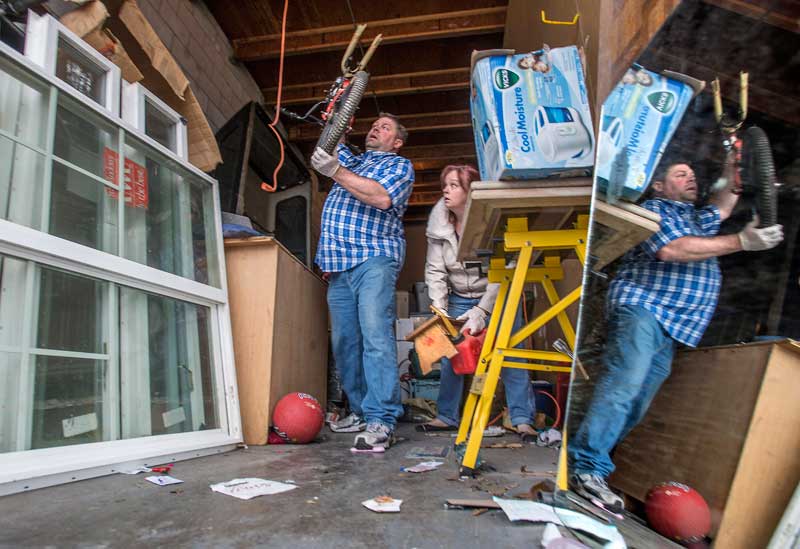
That afternoon, when the auction tour is over, he returns to take a first look at it. Brinar puts on latex gloves and downs a Red Bull energy drink.
“Those are the tools of my trade,” he says as he raises the door. Immediately he notices the remains of previous locks littering the ground.
“This person has defaulted more than once on this unit,” Jason says.
A half-drunk Starbucks cup sits on a shelf. An illegal power line runs to some electronic equipment.
Then Jason takes a look at the contents.
“I always think, ‘Man, it looked better earlier,’ ” he says.
Several commercial construction tools reveal themselves. As does a transmission jack.
Brand-new furniture in the box, BMX bikes, pocket motorcycles, a lawnmower, a large tent are found. More searching turns up used hypodermic needles.
A book of photos reveals milestones of a family through the years. Children’s art fills a box. In one corner is a memorial flag from a military funeral in a triangular display case.
Also: two black velvet paintings of bullfighters. Jason will sell those as well.
“It’s cheesy enough that someone might come in and say, ‘I gotta have that,’ ” he says.
All told, four days of work to clean out the unit will net him about $2,500 of retail items.
Before closing up, Jason spies a box of trash bags. It’s a common find he says.
“I haven’t had to buy garbage bags in years.”
Craig Sailor: 253-597-8541, @crsailor
Facts about the U.S. self-storage industry
▪ The United States has 48,500 self-storage facilities.
▪ It took the industry more than 25 years to build its first billion square feet of space. It added the second billion in eight years (1998-2005).
▪ The industry generated $27.2 billion in revenues in 2014.
▪ About 9.5 percent of all households rent a unit.
▪ There is 7.3 square feet of self storage space for every man, woman and child in the United States.
▪ More than 1.5 million units are rented to military personnel (6 percent). In communities adjacent to military bases, military occupancy can range from 20 to 95 percent of all units.
Source: Self-Storage Association
This story was originally published May 16, 2016 at 1:00 PM with the headline "Local bidders find trash, treasure at storage unit auctions."