
Transgender kids: A family quest, a medical quandary
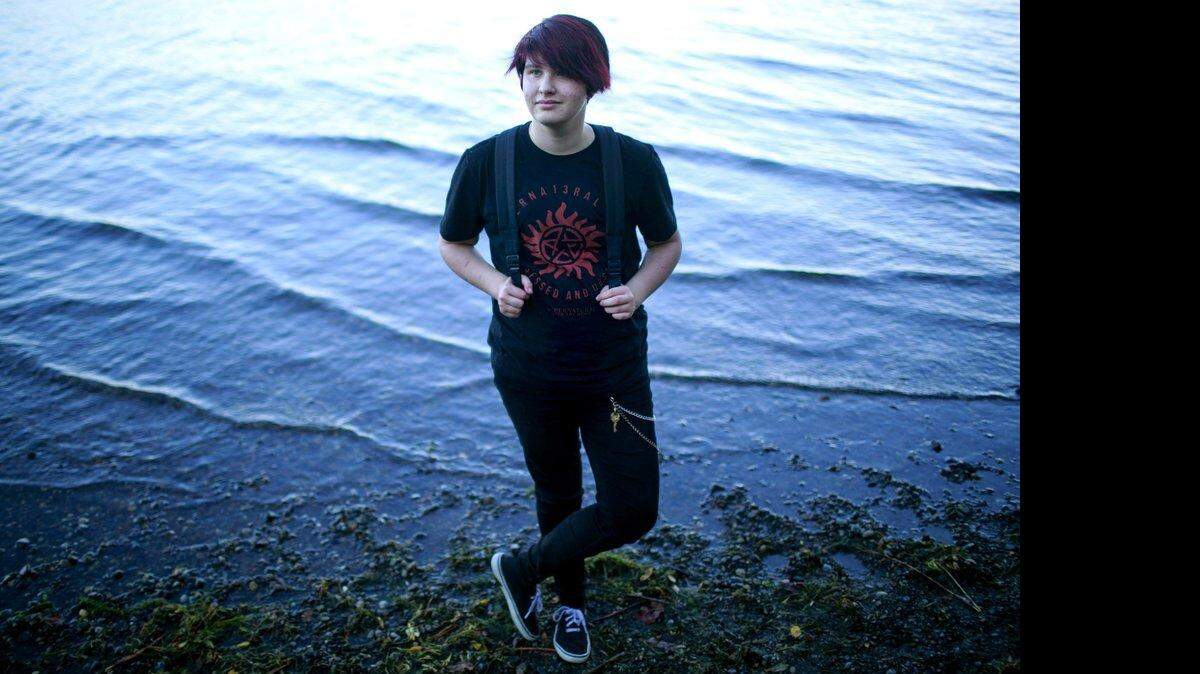
Skyler Pfeil ran a finger across his midsection, underneath the breasts that the 15-year-old considers a deformity and hopes soon will be removed. He was tracing where the surgeon told him the scar will be.
“I already expected to have scarring,” said the transgender boy from Kenmore. He is concentrating on the positive, like how he will no longer need the painfully tight undershirt known as a “binder” to flatten his double D-size breasts.
“You know when you get a really, really bad bruise,” he said, describing how it feels to wear one for prolonged periods. “But it’s all over my upper region, and it’s like someone’s constantly pressing on that bruise.”
Skyler’s mother started crying. “It seems so unfair,” she said.
The scarring, Corina Pfeil said, could have been minimized had Skyler gotten treatment earlier — specifically, “puberty blockers,” medications taken during adolescence to suppress breast development and other hormonal changes. If Skyler’s breasts hadn’t grown so big, there would be less now to remove.
Even now, on the cusp of a change she and her son have been pushing for, she can’t help but reflect on the hurdles they faced since a 13-year-old Skyler began saying, tentatively at first and then more firmly, that the female body he inhabited just felt wrong.
Once, transgender care was the province of adults, reported The Seattle Times. Now, more kids are seeking treatment, hundreds of them locally. They’re encountering a medical system that is spottily prepared, lacking much research and still thinking through what kind of treatment is appropriate at what ages.
“It gets really murky in the pediatric population,” said Dr. Alexander Gougoutas, a UW Medicine surgeon the Pfeils approached at one point. “It draws out all sorts of questions about informed consent. Are they truly able to make these decisions? Are their minds going to change? Are their parents influencing their decisions?”
It’s not just doctors wrestling with these concerns. Aidan Key, founder and executive director of Gender Diversity, a Seattle group that supports transgender people, said everyone — whether a teacher, janitor or bus driver — is asking “either silently or aloud” these collective societal questions.
“Most people have no frame of reference for this,” he said, and that includes parents. A child’s declaration of identifying with another gender “tends to hit any family like a ton of bricks.”
Some parents can’t accept it. Others wonder whether their kids are experimenting or pushing boundaries. Many, though, wholeheartedly get on board. And to them, the medical response can seem inadequate.
“The pendulum shifted so drastically,” said Laura Edwards-Leeper, a psychologist at Oregon’s Pacific University who studied with Dutch pioneers in the field and helped develop one of the first U.S. programs for transgender kids in Boston in 2007.
At that time, helping kids transition in sometimes irreversible ways was considered controversial. Now, families are pressing for earlier interventions and fewer hoops to jump through.
“Health providers are scrambling,” said the psychologist, who also noted the “huge increase” of transgender kids seeking treatment in the past decade.
Seattle Children’s opened a clinic for transgender and gender-nonconforming people ages 8 to 21, offering puberty blockers and hormones that allow those who take them to develop characteristics of the desired gender. The hospital’s Gender Clinic will not yet offer surgery but will refer patients to outside providers.
“Finally,” said Corina Pfeil, who had looked to Seattle Children’s to help Skyler transition, beginning when he was around 14. The hospital offered limited transgender treatment at that time, much of it reserved for kids 16 and older.
Group Health Cooperative established a Gender Health Program last year that serves children and adults. In September, the cooperative dropped the age minimum for gender-affirming “top surgery” from 18 to 16. The cooperative had watched families go elsewhere and pay out-of-pocket for the surgery, so desperate were they to have it, said Dr. Gina Sucato, the program’s associate director.
Still, Group Health’s minimum age would still be too old for Skyler, who even by 14 was highly distressed. “I wasn’t at the point where I could live with myself,” he said.
‘The wrong puberty’
Skyler smiled as he remembered Barbie dolls from his childhood. Or rather Barbie doll parts. “I would make awesome amalgamations, gross sculptures,” he said, talking at a Starbucks near his home.
Born with the name Sara, he also liked to play with dragons and erector sets. He caught snakes and frogs.
He didn’t fit in much with girls and he hated dresses, which he cut up. His mom didn’t think too much about it then.
The sparse research available at the time, as now, encouraged caution. One study by Dutch leaders in the field found that many of their patients 12 and under who seemed uneasy with their gender felt differently over time.
But those with the most extreme feelings tended to see them persist into the late teens and 20s, with puberty often serving as a decisive time, according to that and a follow-up study.
Skyler’s feelings continued. By 13, he was exploring a gender-neutral identity, neither male nor female, and using the pronoun “they.”
YouTube and TV made him aware of the concepts, he said. “I wanted to try it out,” he recalled. Just a simple word change took a weight off his shoulders. “It felt right, or at least close to right.”
It drove his mom crazy. “Decide already!” she said she thought.
A couple of years later, he did. He sorted through his identity with a friend he met at a cosplay convention, where costumed participants role play in sometimes gender-bending ways. And he turned again to YouTube, where he learned about transgender health and products.
“I felt more comfortable, the more information I got,” Skyler recalled.
This story was originally published October 16, 2016 at 2:22 PM with the headline "Transgender kids: A family quest, a medical quandary."