
Mayor recounts ‘surreal’ trip with her daughter to Olympia, Greece on cusp of pandemic
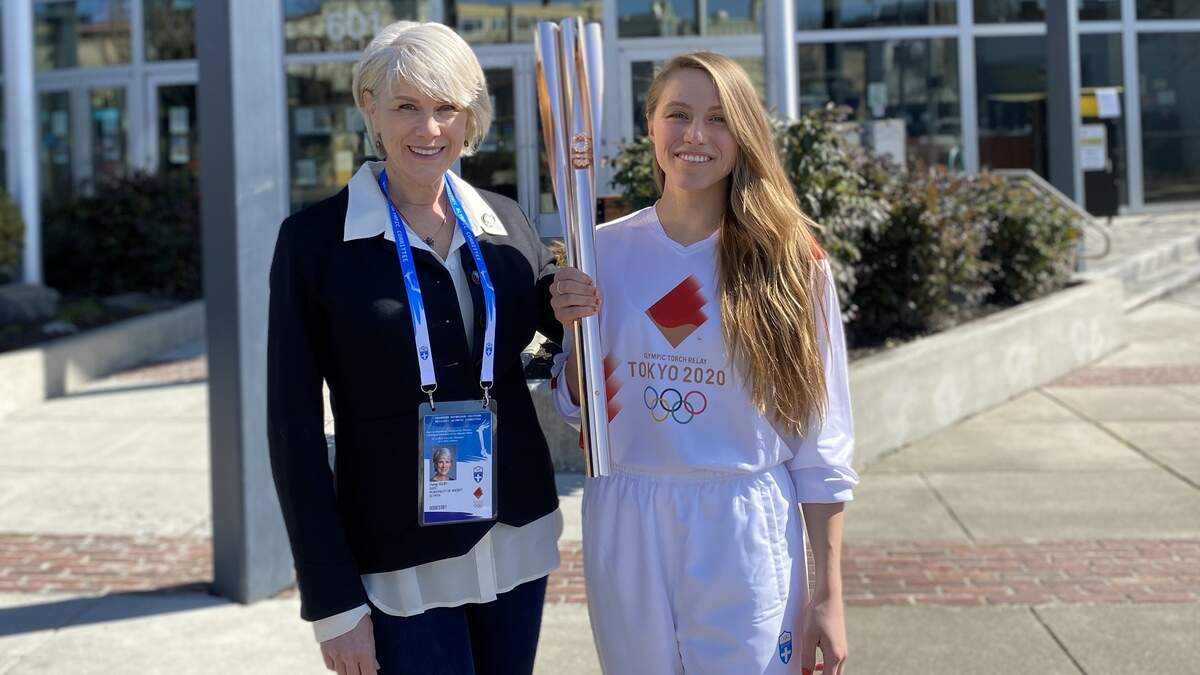
Olympia Mayor Cheryl Selby was awakened around 4 a.m. March 12 by a barrage of phone calls and texts telling her she needed to get on a plane or risk being stranded more than 6,000 miles from home.
The worried messages from family and friends came as President Donald Trump wrapped up his address to the nation in which he announced the suspension of all travel from Europe to the United States — remarks later clarified to apply only to foreign citizens.
Selby and her daughter, Gretchen Helpenstell, were in the other Olympia — Olympia, Greece — to attend the lighting of the Olympic flame for the 2020 Summer Olympics in Tokyo. The pair made the trip to ancient Olympia at the invitation of Mayor Georgiopolus Georgios, who expressed an interest in restarting the sister city relationship between the two Olympias that lapsed in 1996.
Hours after briefly fearing they could be stuck in Greece for an indefinite period, Helpenstell herself ran in the torch relay as a last-minute replacement, capping a surreal week of diplomatic relations amidst rising fears about COVID-19.
“We watched the lines at customs that weekend and felt so fortunate to get back when we did,” Selby told The Olympian. “There was so much to take away from the week, like how fragile and small this makes the whole world feel. I think that in this time where everyone is feeling separated, literally being socially distant, that we were able to capture a moment in time that can sustain us.”
Selby credited former Olympia Mayor Bill Daley with suggesting last summer that the two cities reconnect. In January, Georgios extended an invitation to the torch lighting ceremony, as well as a forum for sister cities of ancient Olympia, a promising sign for future ties between the municipalities.
As their departure date approached, the coronavirus crisis gripped the world from one Olympia to the other.
Selby and Helpenstell, a second-year student in The Evergreen State College’s masters in environmental studies program, decided two days before their flight to Athens to go ahead with the trip.
Greece had fewer reported cases of COVID-19 than Washington at that time, but the pair still registered with the U.S. State Department and made contact with the U.S. Embassy in Greece prior to their departure.
“We chose to not be scared,” Helpenstell said. “Smart, but not scared. We were concerned about a lot of aspects of traveling to Europe at this time, but I don’t regret it one bit.”
Their time in Greece went off script nearly the moment they arrived in Athens.
Following a meeting with U.S. Ambassador Geoffrey Pyatt, Selby and Helpenstell were alerted via email that all public activities surrounding the torch lighting were canceled due to the coronavirus. Georgios told them the following morning that the event committee had decided to allow 100 people at the ceremony and that one of the torchbearers had dropped out. Would Gretchen like to take her place?
“My hands were shaking, I was so nervous,” Helpenstell said. “The whole experience was surreal. I was thrown into a group of people who are amazing human beings with such cool achievements that I had to grapple with why I was even there. I must have turned the panic off, because when I ran, it felt like I was watching a movie.”
The pair met up with tour guide Niki Vlachou to get the lay of the land after their meeting with Georgios. They made it to some of the most famous attractions in Athens before local officials closed them due to COVID-19, and kept up with the latest developments back home.
The virus gave the participants in the sister city forum March 11 an ominous subject to bond over. Selby said all were torn about their presence in Greece as their governments back home dealt with the escalating crisis, but that it only reinforced the value of global diplomacy.
Olympia maintains a sister city relationship with Kato, Japan, but has not looked to branch out beyond that for nearly a generation. Selby is optimistic Olympia will be able to rekindle the pact with its Greek counterpart.
Sister Cities International, an organization founded by President Dwight Eisenhower in 1956, released a statement praising the actions taken by the two Olympias. The release calls it “an historic moment” between the two cities.
“The biggest hurdle is having a committee to manage it,” Selby said. “The city does not have the bandwidth to manage a delegation going back and forth on its own. I’m looking forward to reaching out to the local Greek community. There will be another torch ceremony in October 2021 for the 2022 games, and I’m already planning on going back.”
With the limitations set on the Olympic ceremony and around town, what is normally a bustling Mediterranean city in springtime was subdued with few people in attendance and even fewer expected in the coming weeks. The effect of a worldwide pandemic was already apparent in one of Europe’s most popular tourist hubs.
“It was the first time this celebration was attended by just a few people,” Vlachou said when contacted using WhatsApp. “A weird situation that made it feel like we were mourning for something. We have a tourist season for eight months in Greece, and this year it simply never started.”
Selby and Helpenstell walked through ancient Olympia after the ceremony on a high, fueled by having borne witness to history dating back thousands of years.
A situation carrying similar weight awaited them back home, though they wouldn’t have known it going through customs. They claim no information about quarantines or other screening was given out as they made their way stateside.
They got back to Olympia late on March 13. Early the next morning, Selby was in meetings with city staff, developing a local response to the coronavirus outbreak that has since brought Washington and many other parts of the country to a virtual standstill.
The whole experience underscored the uncertainty of the moment, Selby said, noting that it’s been hard to process it all as the COVID-19 crisis grows each day. The importance of being able to build ties across political divisions and physical borders has shown itself to be more important than ever, she said.
“It did almost feel like beneath everyone’s faces over there was panic,” Helpenstell said. “But, because they were professional, diplomatic relationships, we were sharing stories about our hometowns and countries. Beneath it all, though, we were all scared.”