
Thurston commission opts not to partner with Salvation Army for shelter expansion
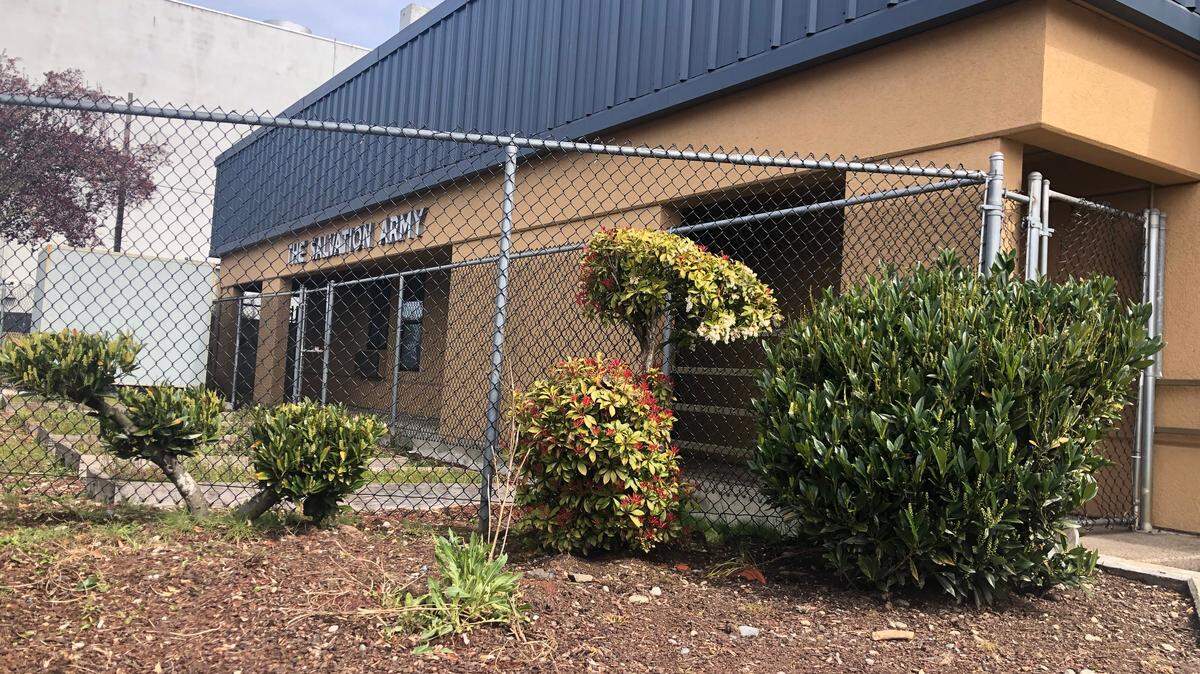
Thurston County won’t pay for The Salvation Army to expand its downtown Olympia homeless shelter during the COVID-19 pandemic, commissioners decided Tuesday after considering a proposal from the nonprofit.
The decision aligns with a recommendation from county staff, who say The Salvation Army proposed a much higher-than-normal price tag and that the arrangement didn’t align with the county’s current priorities and resources.
Salvation Army currently contracts with the county to run a 29-bed overnight shelter during cold-weather season, which ends April 30, according to county officials.
The organization had previously said it planned to stop using the building on Plum Street as a homeless shelter altogether. Then, COVID-19 hit.
Olympia Mayor Cheryl Selby and the board of commissioners sent letters to Salvation Army Northwest Division Commander Bill Dickinson Jr., asking the organization to continue offering shelter in light of the COVID-19 pandemic. The organization entered discussions with the city and county.
Initially, Salvation Army proposed a budget of about $527,000 for 24/7 operations and shelter for 55-60 people for three months, according to county documents.
That breaks down to more than $175,600 per month, which county staff says is two to three times what’s typical. Thurston County pays its other 24/7 shelters about $60,000-70,000 per month, according to Housing Program Manager Tom Webster.
The commission directed staff to try to negotiate a lower price, and staff returned Tuesday with Salvation Army’s new proposal: about $226,000 for 24/7 operations and shelter for 30 people for two months.
Commissioner Tye Menser on Tuesday pointed out that the proposal didn’t seem to change much — it would cost less, yes, but for fewer people and two-thirds the time period of the original offer.
When asked about the drivers behind the proposal’s high price tag, Capt. Jonathan Harvey, General Secretary of The Salvation Army Northwest Division, wrote in an email to The Olympian that the proposal was based on the organization’s “extensive experience operating shelters across the state, in partnership with other cities and counties.”
“For many, emergency shelter is the first step to an individual’s path towards self-sufficiency and we see that as a very important role to play in someone’s life,” Harvey wrote. “We take our responsibility seriously and submitted a proposal that would provide a safe, healthy shelter environment for our most vulnerable neighbors in need, while also seeking to ensure the safety and well-being of our staff. “
Ultimately, while the county’s Office of Housing and Homeless Prevention staff say they appreciated the proposal and it was not an easy decision, their “reluctant recommendation” was that the commission not fund the shelter.
Keylee Marineau, Homeless Prevention and Affordable Housing Coordinator, said Tuesday that several factors went into that recommendation, one being that the cost was high and the contract short, especially considering the time it would take to get the shelter up and running.
Though the county received a state Department of Commerce grant of nearly $1 million to help it meet the needs of people experiencing homelessness during the outbreak, much of that has been spent on several other efforts, including a temporary shelter on Martin Way, Marineau and Webster told to The Olympian Tuesday.
And, the county’s focus for the remainder of the funding is quarantine and isolation sites — something Salvation Army was not interested in providing. There are other efforts that need to be funded past June, and while more funding could come later, Marineau said, that cannot be relied upon.
“That was a tough decision, because we really feel like these shelter beds would be valuable in our community and people need them, but given the cost and given the long-term sustainability that we need to fund, it was with reluctance that we’re recommending not to move forward,” Webster told commissioners Tuesday.
All three commissioners agreed with the staff recommendation, though Commissioner Gary Edwards arrived at his conclusion uniquely.
“My position has always been, we’ve got this problem because we have encouraged these homeless individuals to congregate in our Olympia area from all over the United States, and now we have much more of a problem than we can actually deal with,” Edwards said. Edwards said the county doesn’t have the resources unless it gets “some other funding source to recognize all of these folks from everywhere else.”
Preliminary data from this year’s Point in Time Count don’t support Edwards’ belief: Of the 675 unsheltered people surveyed, 17% listed their last permanent address as out-of-state, while 59% listed it as in Thurston County, 14% listed it in a neighboring county, and 10% listed it in another Washington county.
Commissioner John Hutchings, who serves as chair of the board, expressed disappointment that the county couldn’t afford to move forward, and Menser voiced similar reasoning.
“I’m looking for community partners to step up and work with us and maybe do things a little cheaper than normal because of the crisis we’re in,” Menser said. “I’m not looking for someone that wants to charge us three, four, five times the rate to take advantage of a crisis. There’s different ways that we can use our resources more effectively, in my opinion.”
Capt. Harvey wrote to The Olympian that The Salvation Army respects the county’s decision not to partner at this point and is open to discussing other projects in the future. The organization will fulfill its commitment through April 30, Harvey wrote, and anticipates “making an announcement soon” regarding plans beyond that date.
Among other work in Olympia, The Salvation Army hosts the Community Kitchen, which provides daily meals in conjunction with Catholic Community Services.
“Demand for our services in Olympia has increased dramatically as a result of the COVID crisis,” Harvey wrote. “The number of meals being served from our kitchen has risen significantly in recent weeks and requests for assistance with basic needs is also increasing. “
.jpg)