
Tenino to replicate Depression-era printing of wooden currency to support economy
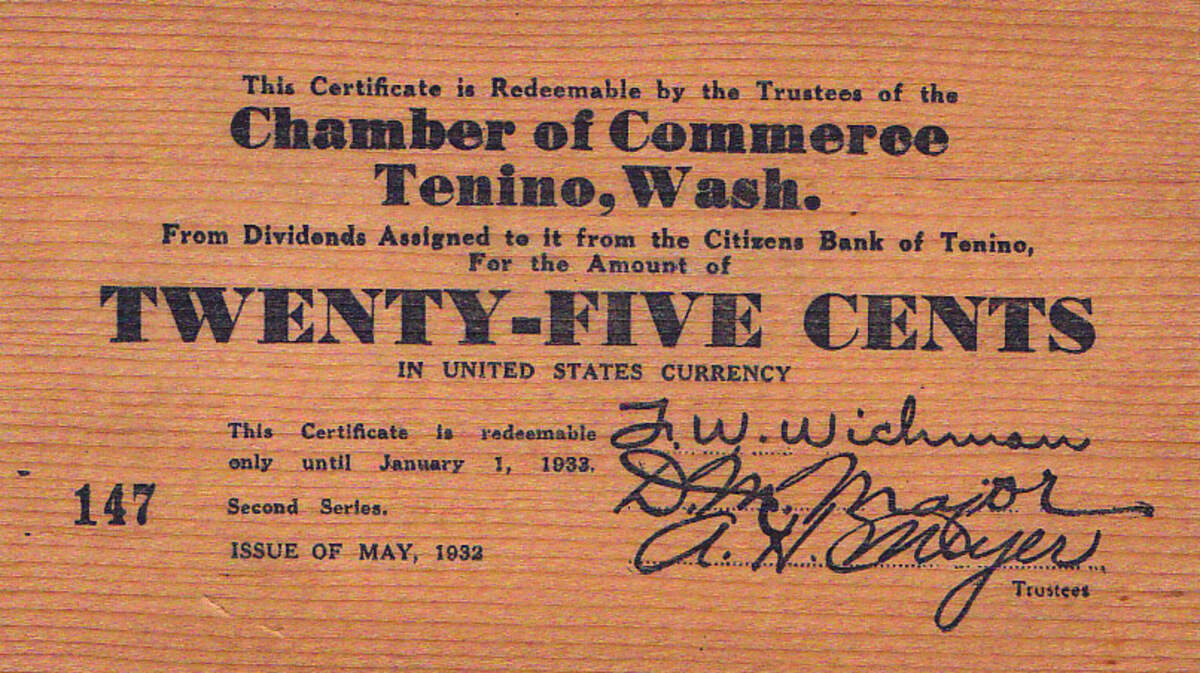
During the depths of the Great Depression, the small Thurston County town of Tenino drew national attention when it printed thousands of dollars of wooden money to keep the local economy afloat.
Now, facing what could be the worst economic downturn since that time, the Tenino City Council drew on history last week when it approved an ordinance authorizing up to $10,000 worth of wooden scrip.
Residents of Tenino who meet income limits modeled after federal poverty guidelines and who can show financial harm caused by the novel coronavirus crisis could receive up to $300 each month in scrip backed by the city general fund for use at local retailers. City staff could begin screening applications as soon as Monday.
“During the Depression, Tenino took unprecedented initiative by printing and issuing its own currency,” Tenino Mayor Wayne Fournier said. “Here we are again, many years later, doing the same thing. Smaller communities all too often are left to fend for themselves and slip through the cracks, but this type of situation can also breed resilience and independence.”
Tenino leaders first came up with the concept of wooden currency in response to the closure of the local bank in late 1931. Local residents signed promissory notes obligating themselves to reimburse the local chamber of commerce once the bank reopened.
The notes caused a stir, with many municipalities undertaking similar measures to prop up their economies. Currency collectors continue to reach out to city officials to this day in search of original prints and often trade the notes via online auction.
The modern scrip is backed by agreements between local merchants and the city itself. Customers will use the currency in $25 increments to purchase anything other than products containing alcohol, tobacco or cannabis. Vendors will then turn the coupons into the city in exchange for a check.
The new scrip will feature an updated design, but will be produced using the same type of rolled cedar and on the same machinery used nearly 90 years ago.
“The analogy is more like a newspaper coupon that you would clip out,” said John Millard, Tenino city clerk and treasurer. “The difference is these coupons are not for particular things. We assign a monetary value to it for convenience sake, and if you meet the eligibility criteria, you can take them to any participating business in the city. The piece of wood has no cash value, but it’s going to look a lot like Tenino’s original wooden money.”
Businesses are only allowed to give a maximum of 99 cents in change for transactions made entirely using the wooden scrip. Millard said the limit is intended to prevent people from buying a bottle of water or pack of gum with a $25 slip and pocketing the remainder for use outside the city.
Those restrictions did not exist during the previous run in 1931 and 1932. Oftentimes, much of the value of scrip printed by the city wound up leaving the area.
“That’s not the purpose of these things,” Millard said. “We don’t want them spent on frivolities. Tenino citizens paid this money into the city, and the city has the money to use for the benefit of Tenino citizens.”
To participate in the program, applicants must provide proof of residence within Tenino city limits, show a monthly income within limits based on the number of household members, and loss of income either directly due to COVID-19 infection or a reduction in work due to the pandemic.
Millard said that for a family of two making up to $1,437 per month, the city would supply scrip coupons worth $300. Those making up to $1,911 would receive $250, with families that reach higher benchmarks still eligible to receive smaller grants. City attorneys have reviewed the program to ensure it does not violate laws against the gifting of public funds, Millard said, but the city wants a concurring opinion from the State Auditor’s Office before it begins distribution.
The city council approved an initial limit of $10,000 worth of wooden money, but could vote later to increase the dollar amount based on demand and the limits of the city’s own coffers.
Council members also voted Tuesday to redirect funds allocated for grants to local businesses for facade improvements to the Tenino Food Bank Plus to help pay for facility improvements needed to support increased demand brought on by the pandemic.
“We will do whatever is necessary here to ensure our city weathers this crisis and comes out ready to thrive,” Fournier said. “The importance of having strong local economies has never been made more clear.”