
A look at Thurston County jobs, industries hit hardest by the COVID-19 shutdown
Between March 15 and April 25, more than 29,800 people who live in Thurston County filed for unemployment benefits, according to data from the Thurston Strong task force.
For comparison, in 2019, according to the state Employment Security Department, an average of 7,210 county residents were unemployed and 136,555 received paychecks.
At a budget work session, Thurston County Manager Ramiro Chavez shared a detailed breakdown of local unemployment claims data during the COVID-19 pandemic, showing which local industries and jobs have been hardest hit by shutdowns meant to slow the spread of the disease.
Originally, Chavez says, the presentation was given to local state legislators by Thurston Strong, a growing consortium made up of representatives from the county, local cities and tribal nations, chambers of commerce, and several other entities.
According to the presentation:
In the first 10 weeks of the year, between 223 and 351 initial claims were filed per week in Thurston. Mid-March, numbers jumped significantly, with 4,700 claims filed in one week. Through April 25, between 2,882 and 6,804 claims were filed per week.
The local industry accounting for the highest number of claims between March 1 and April 25, unsurprisingly, was accommodation and food service. On March 16, Gov. Jay Inslee signed an emergency proclamation shutting down restaurants, bars, and entertainment and recreational facilities statewide.
Perhaps less intuitive: The second-highest number of claims came from the health care and social assistance industries, which accounted for 3,679 claims — almost the same number as claims filed by people working in retail.
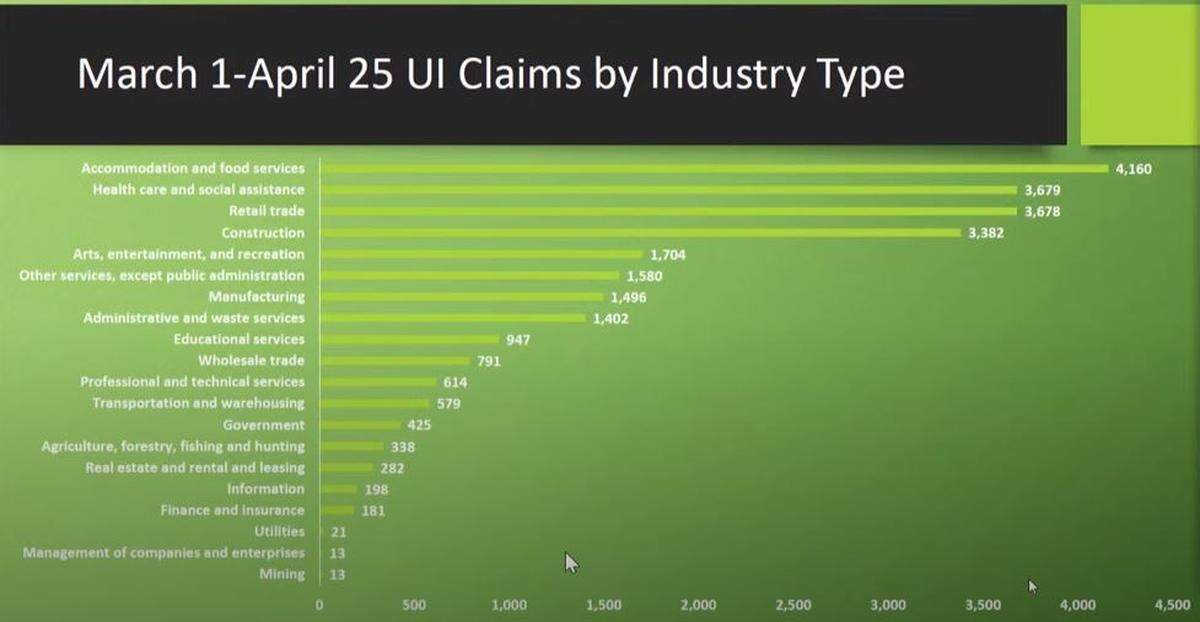
County Manager Chavez pointed out that claims from health care workers may stem from limitations on non-urgent surgeries and medical professionals who provide or assist with dental and eye care.
The fourth-most common industry was construction, followed by arts, entertainment and recreation.
Broken down further, the highest number of claims have come from people working at full-service restaurants (2,109), then limited-service restaurants (923), then offices of dentists (834), then offices of physicians (767).
By occupation: 1,114 waiters and waitresses, 1,090 retail salespersons, 797 hairstylists and cosmetologists, 717 carpenters, 619 general and operations managers, and 513 cashiers applied for benefits between March 1 and April 25, according to the presentation.
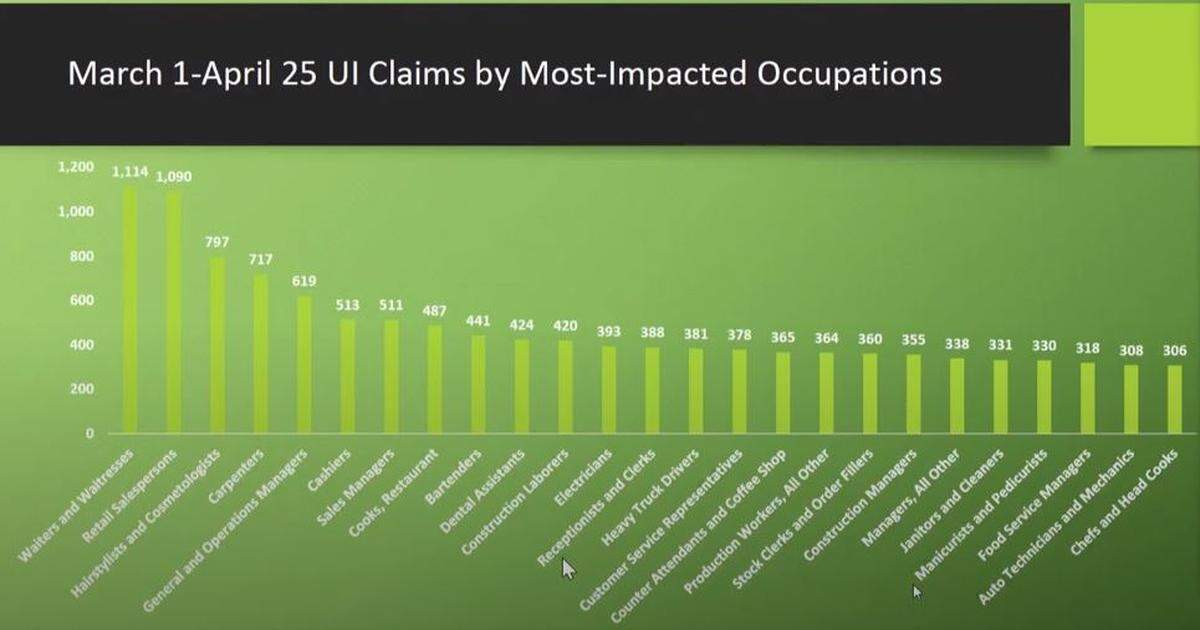
Primarily, breaking down this data demonstrates the wide, deep impacts of the pandemic on all sectors, Michael Cade, Executive Director of the Thurston Economic Development Council, told The Olympian. While restaurants and retail were hit the hardest and fastest by shutdowns, he says, other industries started showing impacts within a few weeks.
“This affects us all,” he said. “This really is a pretty significant event. No individual is really immune to this.”
That broad impact also represents an incentive for industries to work with one another toward recovery, he said.
“We will get through this, we will work our tails off,” Cade said. “... The data indicates we are all being impacted, and we will all work together.”
Other data points in the presentation include:
49% of claims in that time frame were filed by females, 50% were filed by males;
The 25-34 age group made up 27% of claims, followed by people ages 35-44 (21%), 18-24 and 35-44 (16% each), 55-64 (13%), 65+ (4%), and people younger than 18 (2%); and
People with a high school diploma or GED accounted for the highest percentage (34%) of claims, followed by people with some college (27%), then people with associates and bachelors degrees (12% each), people who didn’t finish high school (6%), people with master’s degrees (3%), people with post-baccalaureate degrees (2%), and people with doctorates (1%).
This story was originally published May 13, 2020 at 8:59 AM.
.jpg)