
Even before pandemic, 23% of state households were a paycheck away from poverty, report says
If you work a low-wage job in the service sector or hustle in the gig economy, you may find yourself skeptical when you see positive economic reports.
For instance, Washington wages grew by 6.7 percent in 2019, the Employment Security Department announced on Tuesday. And poverty levels – prior to COVID-19, at least – had remained relatively stable since the Great Recession.
The reason many workers aren’t feeling that good news? The rapidly increasing percentage of households just barely above the poverty line, for whom one medical emergency or unexpected bill can unravel everything.
A new report from the United Way fills in a picture of these barely-afloat workers, which they call “ALICE” – Asset Limited, Income Constrained, Employed. Traditionally called the ‘working poor,’ ALICE refers to people who don’t qualify as poor according to federal poverty guidelines, yet cannot make ends meet.
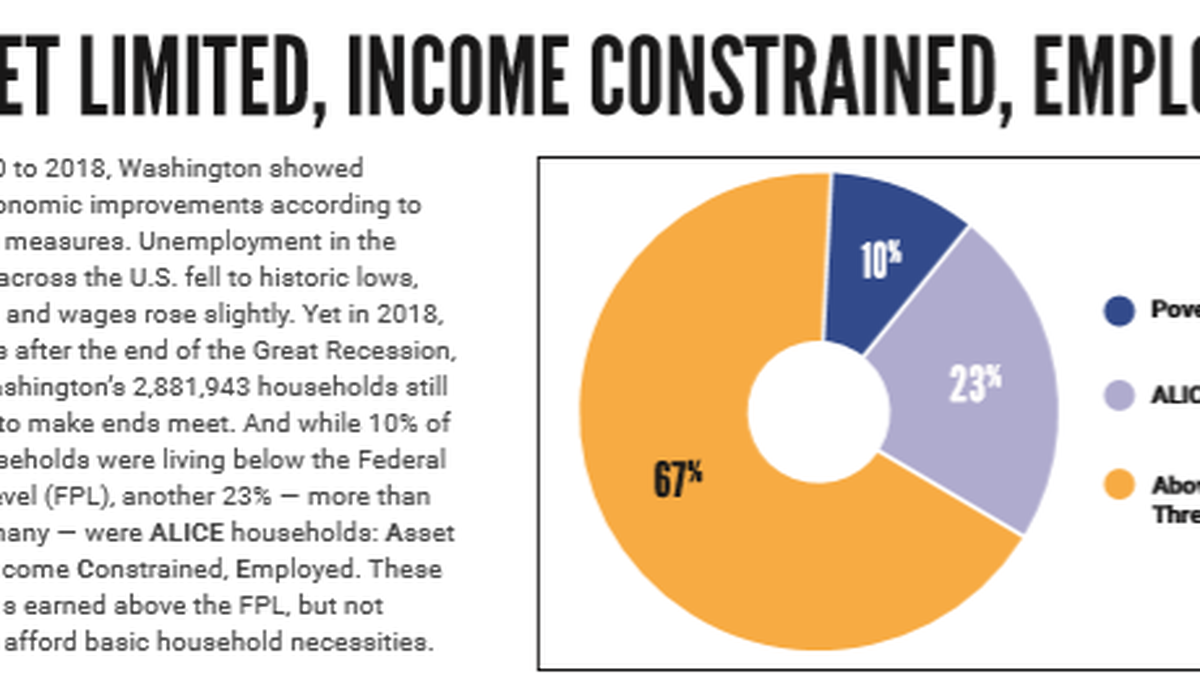
In the new “ALICE” report released Tuesday, the United Way of the Pacific Northwest found that the number of Washington households that fit that description has climbed to 23%, or just over 670,000 families — a significant increase from 15% in 2007. By contrast, about 10% of Washington households were considered poor by federal poverty guidelines in 2018, but together they amount to 1 in 3 state residents.
ALICE workers, who may be grocery cashiers, child care providers, or gig workers, broadly overlap with occupations now deemed “essential” — yet their wages are too low to afford housing or other basic needs, according to the report.
“The Washington economy relies on ALICE [workers],” said Dona Ponepinto, president of the United Way of Pierce County, at a press conference on the report Tuesday. “When you think about the essential workers, they are living paycheck to paycheck.”
ALICE workers also are more likely to lack health insurance, not receive paid sick days, or have inconsistent job hours, according to the report.
And that wage growth? That’s not going to ALICE families either. They saw little to no wage growth during the last decade, except through recent raises in the minimum wage. At the same time, the cost of basic essentials like food, transportation, and phone access rose on average 3.4% per year.
The report uses localized Washington cost-of-living data to estimate an “household survival budget” that covers housing, child care, food, transportation, health care, technology, and taxes. For a Washington family of four, the ALICE survival budget is $72,600.
The federal poverty line – which rose to $26,200 for a family of four in 2020, according to the U.S. Department of Health and Human Services – is a woefully inadequate metric, the report argues.
For an individual to earn enough to support a family of four, they’d have to make $36.30 per hour (or have two earners each making $18.15 per hour, still almost $5 per hour over the minimum wage).
The report also found that 44% of the state’s jobs paid less than $20 per hour.
In Thurston County, however, some optimism may be warranted. From 2016 to 2018, there was a 5% reduction in ALICE-level poverty, meaning that 4,069 households were lifted above the ALICE threshold.
For many demographics across the state, the number of workers earning under the ALICE threshold is much higher. For example, 50% of Black households and 48% of Hispanic households were below the ALICE threshold, according to the report. For households headed by single mothers, 70% were below ALICE levels.
“All of those families – about 33 percent of households in Washington state – are struggling to get by. From any given day they’re only one broken down car or appliance away from possibly not being able to feed their family or losing their home,” said Jim Cooper, president of the United Way of the Pacific Northwest. “And COVID is that disaster times 10 for those families.”
Cooper stressed that the report should be read as a baseline for where the economy was before the COVID-19 pandemic, a reminder that even after a decade of growth, the 2008 recovery remained unfinished.
“We as a society must do a better job recovering from this recession,” Cooper said.
This story was originally published June 18, 2020 at 5:45 AM.
.jpg)