
For people living in their cars, it’s all about finding a spot
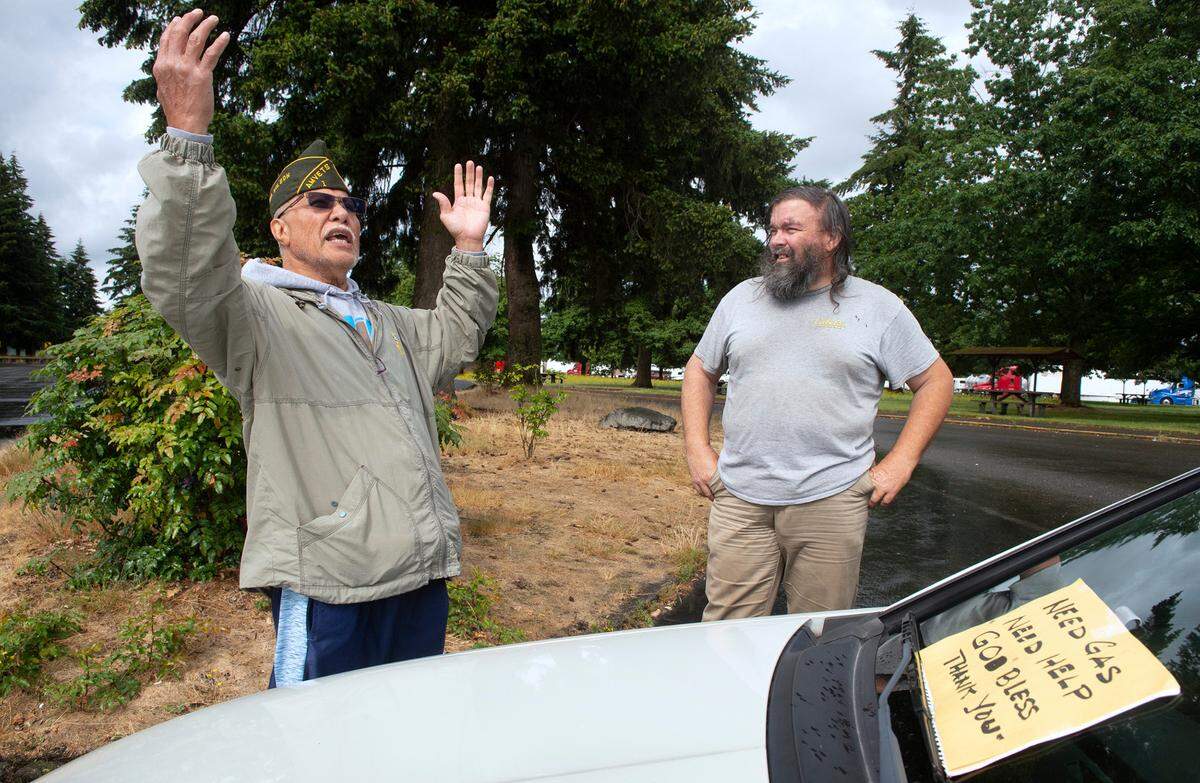
Arnold and Carol Hampton are accustomed to moving around. For 25 years, they migrated across Washington’s vast state park system, following Arnold’s job as a park ranger.
Arnold has donned his smoky hat in small parks from Wenatchee and Lake Easton, all the way up to Lopez Island, where the couple met in 1989, and where their son was born a few years later.
But since Arnold lost his job two years ago, they’ve been pushed into a new type of migration – driving their car across the parking lots and rest stops of Thurston County in search of a place to stay.
Since March, the Hamptons have been living out of their Ford Fiesta hatchback and parking at the Scatter Creek rest stop off Interstate 5 to sleep.
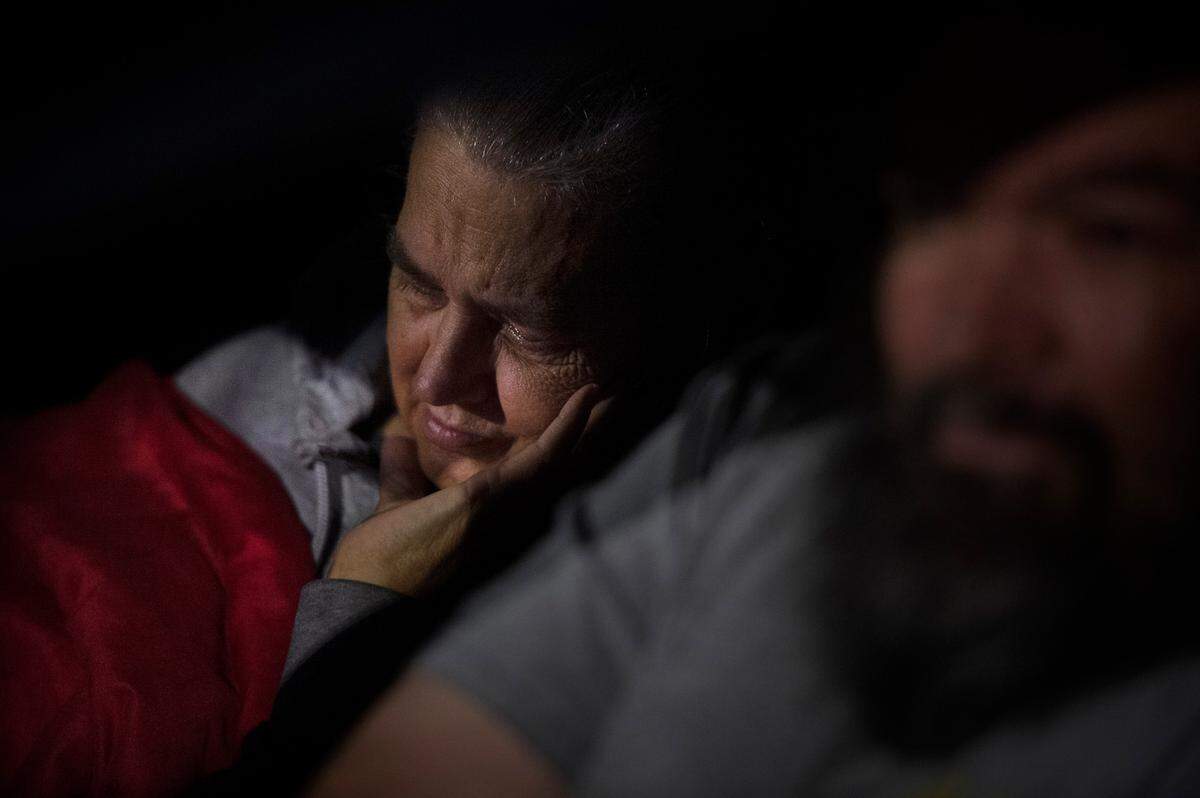
For Carol, who is 69 years old and legally blind, the highway noises can sometimes wake her up.
“There’s times when you’re trying to go to sleep, all of a sudden all the traffic on the road seems like it’s going right through your house,” Carol said.
It’s not clear exactly how many Thurston County residents sleep in cars.
In 2019, 115 people identified themselves as living in vehicles or RVs on the Thurston County Homeless Census form. According to Thurston County’s Homeless Prevention and Affordable Housing Coordinator Keylee Marineau, the number is likely much higher, since the census only counts the people who take the initiative to fill out the form or seek services at a shelter.
“That does not account for all the people who are unsheltered and people who are living in vehicles that have not entered our system,” Marineau said.
Life on the road
For people who live in their cars, much of their time is taken up by the logistics of finding a spot to park.
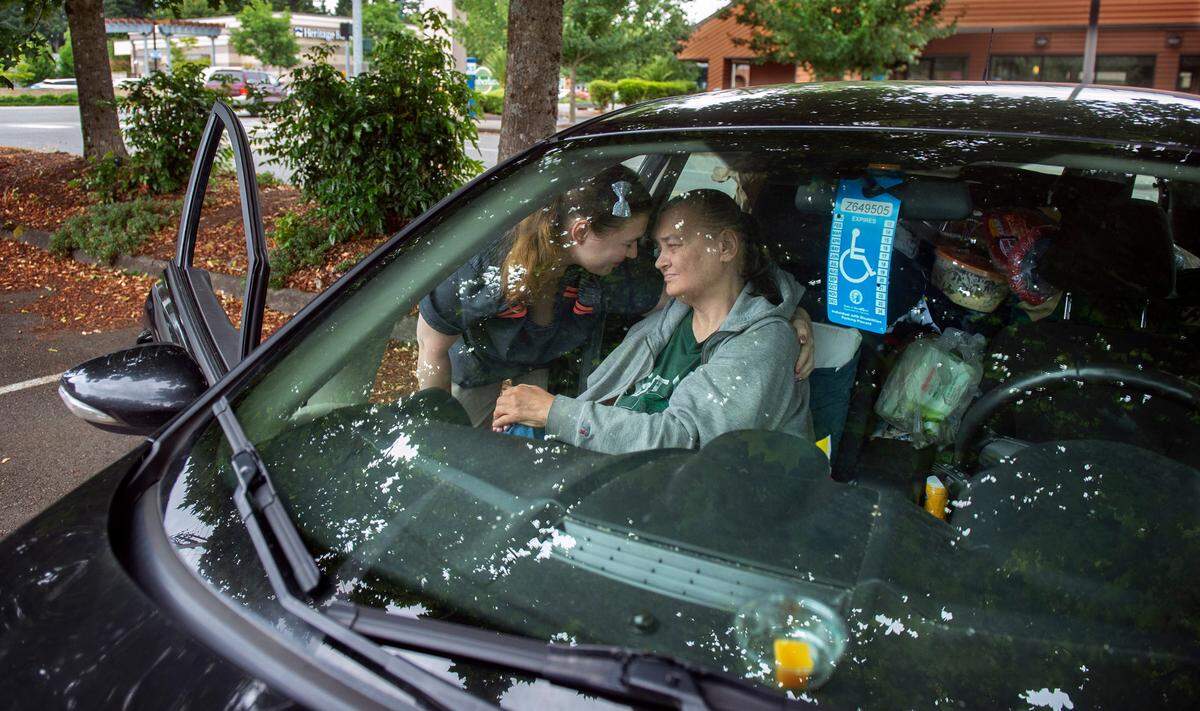
A typical day for Arnold and Carol is spent shuffling between grocery store parking lots — Safeway, Fred Meyer, Albertsons, anywhere Arnold can wheel Carol inside to use an ADA-equipped bathroom stall.
They used to stay in a Walmart parking lot, but since the store stopped being open 24/7, they put up fliers threatening to tow cars that were parked there after 1 a.m.
“That’s a battle when you’re homeless and living in your vehicle, where do you park for the day and how long and where’s the restroom going to be,” Arnold said. “Every day, every month, every hour, you’re constantly trying to find somewhere to stay.”
Standing in the parking lot, Arnold still looks the part of a ranger – khaki slacks, a bushy gray beard, and gray eyes. He talks with a friendly exuberance.
He tries not to let living in his car – being homeless – affect his sense of self. But he is conscious of how others see him.
“It hurts in a way because you see how people react to you in a different way. All of a sudden, you’re not a park ranger anymore.”
One place where the Hamptons find safety is the parking lot of the Tumwater dialysis clinic where Carol is treated three times per week. She has diabetes and has been on dialysis for a year.
In March, Carol was hospitalized after suffering her sixth stroke. She spent a week recovering in a nursing home, where she began using a wheelchair for the first time.
Then she was discharged – back to her car.
Carol started doing physical therapy, but it has been difficult to find a space to do her stretches because of the cramped living space.
“There’s certain ones I can do using the door, with the door open I can do calf lifts and heel toes,” Carol said. “I want to walk on my own two feet again and not sit in a wheelchair all the time. Using it to go shopping, that’s fine, but walking from here to the bathroom, it would be so cool just to do that again.”
Arnold and Carol typically wake up around 6 a.m. Arnold explains that at the rest stop, if you’re not out by a certain time, Department of Transportation officers will hustle you along.
Safe lots are a possible solution
One solution that has been tried to help people like Arnold and Carol is known as a “safe lot.”
In Seattle, a number of churches have opened their parking lots to overnight parking, with some even offering their lots as a 24/7 home base.
One of the first, and most robust, safe lot programs is at Lake Washington United Methodist Church in Kirkland, an affluent Seattle suburb.
The program began in 2011, after Seattle passed a ‘scofflaw’ ordinance aimed at cracking down on people with four or more parking tickets. It also had the effect of towing and sometimes impounding vehicles with people living in them.
Some of the church congregants wanted to help, and floated the idea of offering the church’s 100-spot parking lot to people in danger of having their car impounded.
“Literally it was that simple of an idea. It was not complicated, it was like, people need a place to park, we have a parking lot,” said Karina O’Malley, the Safe Parking Coordinator at Lake Washington United Methodist.
It started with just six spots and a rented port-a-potty. O’Malley, who is a volunteer, began by calling shelters and asking them to send people to the church when the shelter was full.
More recently, the program has expanded to allow 24/7 parking for about 30 residents on any given night. In the summers, they’ve had as many as 60 cars in the lot.
The vehicle residents can make use of the church facilities during certain hours, using the kitchen to make dinner or charge their phones.
Crucially, they also can use the church as a mailing address. One common difficulty for people applying for housing vouchers or other assistance is having important letters get lost in the mail because they don’t have a permanent address.
“Honestly, just offering an address to folks has been significant,” O’Malley said. “And them knowing, here’s a place I can come back to every day, the same place, I can get mail and I know I’m going to be able to charge my phone. I know I’m going to be able to sleep through the night without someone rapping on my window telling me I have to move.”
“And using that, I can now actually do the work that I need to do to get out of homelessness, instead of just surviving all the time.”
The safe lot rules
There are a few rules. RVs are not allowed. The program is also limited to women and families. O’Malley said another church’s safe parking program ran into problems with single men making the female residents uncomfortable.
The City of Seattle has launched and scrapped multiple attempts at running safe lot programs, most notably in 2018 after three people died in a city-sponsored vehicle “safe zone” in a disused industrial lot south of downtown.
The Lake Washington church runs a criminal background check, but it’s fairly pro forma and tends to reveal more of what O’Malley calls “survival crimes.”
“We look at it, and we might have a conversation with somebody about, oh, what happened here, but I have yet to exclude somebody because of what I found on a criminal background check,” O’Malley said.
The program tends to attract people who are temporarily homeless, and often have fewer challenges to being rehoused, O’Malley said.
“The reality of serving folks who are homeless is that even without an intentional or obvious screening process, the way your program works and the social expectations of it creates a screening process,” O’Malley said. “So our program is for someone who can drive a car, who can maintain a car, who can keep their insurance registration up to date, and who can get along with people in a parking lot without shouting at each other.”
Some people who show up in Lake Washington’s lot are between apartments and stay just a few nights. Others have moved from other states and moved for a job but can’t find housing. Those people typically stay a few months and are able to move into permanent housing. When families come, they are usually housed within about six months, O’Malley says.
“Sometimes it’s just a momentary financial blip,” O’Malley said. “And they’re there, they save up money to either move across the country or get a first month’s deposit and move on, but a lot of folks are just waiting for a Section 8 voucher, which is not going to come for years and years.”
For these people – especially older adults on fixed incomes like social security or disability – they may stay longer. Some have stayed for years.
Carol and Arnold’s journey
In 2018, Arnold and Carol were living in an old stone cabin inside Schafer State Park in Grays Harbor County, where Arnold was stationed as a park ranger.
Carol’s health began to decline, and she soon started dialysis and other treatments at doctors’ offices in Mason and Thurston counties.
Arnold started taking time off to care for Carol and take her to appointments, using family and medical leave. He tried to schedule it as sporadic days off rather than big chunks, so he could keep up with his duties as a ranger. But he believes this is what led to him being pushed out of the park service.
“They told me, ‘You’re not qualified to be a park ranger anymore. We’re going to demote you to be a senior park aide,’” Arnold said.
This involved sending the couple to a rural area, far from Carol’s doctors. Arnold didn’t want to uproot his wife’s care. He spoke to several lawyers who advised him to quit rather than take the demotion.
When Arnold lost his job in May 2018, the couple also lost their house.
With a monthly income of $804 from Carol’s supplemental social security (SSI), their housing options were few. The average one-bedroom apartment in Thurston County rents for $1,124, according to the Thurston Regional Planning Council.
According to a recent report by the Washington Low Income Housing Alliance (WLIHA), for someone whose only income is from SSI, an affordable rent is $247 per month.
“There is this misnomer that if you’re a senior citizen, you’ve got it made in the shade. That you have big bucks coming in from social security, you’ve got Medicare, you own a house, and you’re just set for life,” said Anna Schlecht, co-chair of Thurston Thrives Senior Housing Team.
“I think we are having a reckoning across the board about, does social security really provide security for older people?” Schlecht said.
Schlecht said housing insecurity is common for seniors, especially those suffering from chronic health conditions. According to Thurston County data, 36% of Thurston County residents over age 65 also have a disability.
Navigating bureaucracy
For the Hamptons, accessing help has proved to be its own hurdle.
Last year, they contacted the Department of Social and Health Services (DSHS), which told them to apply for the “mainstream” housing voucher, a special type of Section 8 voucher for those with a disability.
However, they were rejected because Carol was too old to qualify; the program only serves people up to age 62.
Then, Arnold tried to apply for Social Security Disability (SSD). The social security office sent the paperwork to their old address, and they had to start the process over. Then he was denied.
“I’ve talked to so many different people from different agencies,” Arnold said. “Some friends have tried to point us in a direction of a housing thing, but the housing issue seems to always fall through with something going on with, they’re not accepting applications right now, or they have a wait list or something like that.”
After striking out with social services, the Hamptons decided to take their retirement savings and purchase an RV to park on a friend’s property in Mason County. For a while, it seemed like a stable situation.
Then the friend got divorced. The arrangement fell apart and they were asked to leave.
They pulled their RV out of the driveway and got just a couple of miles before it broke down. They didn’t have the money to tow it, and it was quickly impounded.
That’s when they ended up in a car, looking for somewhere to park.
Now they are trying to re-apply for the “mainstream” Section 8 voucher under Arnold’s name, since he is 52 and meets the age criteria.
Even if they are approved, it will likely take years to make it off the Section 8 waiting list.
Meanwhile, Arnold is worried they may have to move from the Scatter Creek lot soon. The number of vehicle residents has grown and the DOT officers have given indications that they’d like them to move along.
Recently, the outdoor faucet was disabled for multiple weeks, leaving them without water.
Could safe lots work in Olympia?
While there are no active plans to implement a safe lot at any local faith organizations, Olympia’s Homeless Response Coordinator Teal Russel said she fully supports the idea and hopes to explore it further.
Faith communities have been extremely involved in homeless response in other ways, said Marineau, the county’s Homeless Prevention Coordinator, including hosting tiny home villages and shelters.
But there hasn’t been much action on safe lots, which could be a particularly suitable solution during the coronavirus pandemic, when it is difficult to provide enough shelter beds at safe distances. Cars provide that safer space.
“It may just be that it hasn’t been asked,” Marineau said. “We all have compassion for people who are dealing with this pandemic without a home, so it would be worthwhile picking that conversation back up again.”
Arnold said he would welcome a safe lot, if there was a security staff present overnight.
“That’s the major thing if we’re going to park at night is being able to have a restroom that I can take my wife into,” he said. “Right now it’s just bouncing around, and if there were places like that, a church parking lot where you can go in and use their restrooms, that would be real nice.”
Brandon Block is a corps member with Report for America, a national service program that places journalists into local newsrooms. He is covering housing and homelessness. His position is supported by Report for America and by donations from Olympian readers, the Washington State Employee Credit Union (WSECU), and the Community Foundation of South Puget Sound.
This story was originally published July 19, 2020 at 5:45 AM.
.jpg)