
Olympia’s cost of living ranks among Atlanta, Denver, and other much larger cities
The Olympia area’s cost of living is about 10% higher than the national average, according to new data compiled by the Thurston County Regional Planning Council for the first quarter of 2020.
Here’s how the study works: every three months, the cost of housing, transportation, groceries, and other commodities is measured against a national index published by the Council for Community and Economic Research (C2ER), an independent nonprofit which collects data from local governments.
The nonprofit surveys 257 urban areas across the country.
In the Olympia-Lacey-Tumwater area, most goods and services are slightly more expensive than average, except for utilities, which are 8% cheaper, according to the data. Groceries are 20% more expensive.
Housing prices in Olympia, according to the data, are 4% higher than the national average.
For context, Portland’s housing prices are 84% higher than average. In Seattle, housing costs 135% more.
The closest comparison to Olympia in terms of housing is Atlanta, where housing costs about 4% less than the national average. Atlanta is comparable to the national average in most categories, according to the data.
With regard to cost of living generally, Olympia is about on par with Denver.
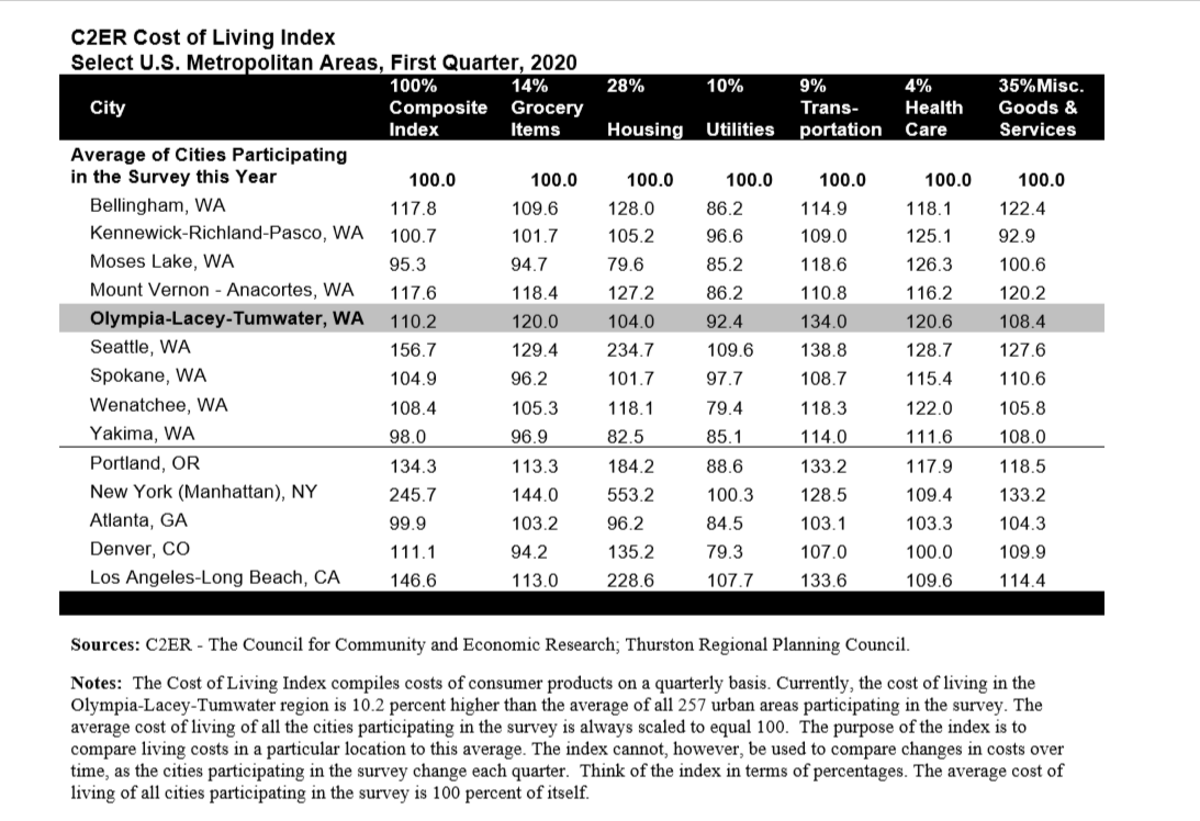
Across Washington state, housing costs 2% less in Spokane and 1% more in Kennewick-Richland-Pasco than it does in Olympia-Lacey-Tumwater. Other pricier areas include Wenatchee (14% higher than Olympia) and Bellingham (24% higher).
For cheap digs, Moses Lake and Yakima both show housing prices roughly 20% lower than the national average.
Miscellaneous goods and services in the Olympia-Lacey-Tumwater area remain priced about 8.4% higher than the average of 257 other urban areas nationwide.
Measured against the first quarter of 2019, the Thurston Regional Planning Council data shows a 2.6% rise in the overall cost of living in Olympia-Lacey-Tumwater, relative to the national average. Housing is up 1.8%.
Because of the C2ER’s methodology, this doesn’t necessarily mean that prices have risen in Olympia, just that when measured against the average of prices across the country at a specific point in time, prices here are higher. The data does not measure inflation.
This story was originally published July 7, 2020 at 5:45 AM.
.jpg)