
Providence Community Care Center ends partnership with Interfaith Works and SideWalk
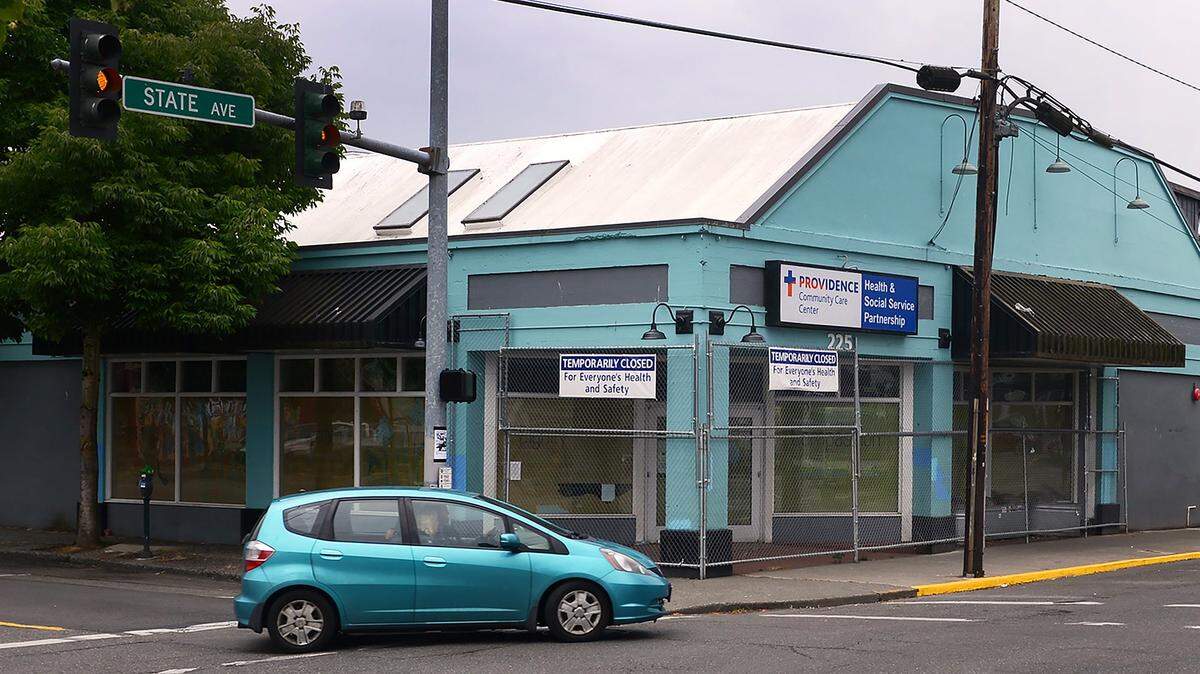
Providence Community Care Center has announced that it is ending its partnership with Interfaith Works and SideWalk, nonprofits that have provided services at the center since it opened in 2017.
The announcement came a day after The Olympian reported on the impact of the center remaining closed during the COVID-19 pandemic. In that story, Interfaith Works and SideWalk spokespeople talked about the social service hub and day room that had served as a lifeline for Olympia’s homeless population until Providence closed its day room in March.
Providence also is moving the center to an “appointment and outreach model” for the indefinite future, meaning the day room will remain closed. Some hygiene services, such as laundry and showers, will gradually open up to those who make appointments.
At a meeting with its remaining partners, Providence Chief Nursing Officer Suzanne Scott presented a diagram of future changes to the building, which include converting the space that was used as a day center into outreach worker offices and a computer center and printers available to patients.
Whereas in the past hygiene services were offered to all as a hook to draw people in and connect them to services, in the new model they will now function as an add-on for those who are “ready to seek help,” Scott explained.
“If our clients are coming in to print off a resume in preparation for a job interview, they can also grab a shower before that job interview,” Scott said. “Or if they’re coming in because in their current housing situation they’ve got bedbugs, we can take the opportunity to do their laundry and get clean linens and blankets.”
Scott also said they plan to eventually reopen the entrance at State Avenue and Franklin Street, which is currently fenced-off.
Scott said they also are pursuing a new partnership with Community Action Council to provide housing services in the center. Community Action Council was not available for comment.
To further fill the housing gap, Scott said Providence also plans to use an internal program known as “Providence Home and Community Care,” a branch of Providence that places patients in assisted living facilities and hospice care, such as Mother Joseph Care Center, a nursing home across the street from Providence St. Peter Hospital. The website describes the program as serving “disabled adults and seniors with low incomes.”
Low barrier versus no barrier
In a written statement and a conversation with The Olympian this week, Scott cited “ideological differences” as the reason for ending the Community Care partnerships with Interfaith Works and SideWalk.
“Both Interfaith [Works] and SideWalk advocate for a no-barrier approach, which means, bring people in and when they’re ready provide the services that they need,” Scott said. “This is a great model that works for some organizations, but doesn’t work in the Community Care Center. Limited barriers are really necessary to ensure we have the space in the center to safely deliver care to those who are ready for the service delivery.”
SideWalk and Interfaith Works advocate for what they call a “low-barrier” service model, which attempts to minimize logistical hurdles such as paperwork and eligibility requirements. Meg Martin, executive director of Interfaith Works, said Scott’s comments indicate a lack of understanding of what a low-barrier model is.
“I’ve never known what no barrier means,” Martin said. “Our society inherently has limits and boundaries so I don’t know what that means or what they would mean by that.”
Martin said that while Interfaith Works is committed to safety in all the spaces it manages, the changes Providence is making are not in line with the low-barrier model the partner organizations intended for the center.
“It’s very clearly defined with decades of evidence-based research,” Martin said. “Low-barrier services do not require somebody to engage in services to get their basic needs met. You make it as high access as possible. And that’s the whole reason we started the Community Care Center, because the standard appointment-based system in healthcare is not accessible to people who are experiencing chronic homelessness and who have the most complex challenges.”
All the organizations said they will continue to look for ways to work together outside of the center.
“If I could sum it up in two words, it’s disappointed but open,” said Phil Owen, executive director of SideWalk. “Our peer team has a really close working relationship with [Providence’s] clinical team, and they’re going to continue working together and coordinating together. We’re open to further dialogue, wherever that might lead.”
Scott also said Providence is open to collaborating but hasn’t yet had any discussions about what that would look like.
Not meant to be an ‘urban rest stop’
When the center opened in 2017, a large number of service providers came together in an effort to create a centralized hub for the city’s most vulnerable population to access services and coordinate care across disciplines.
The center also attracted the attention of neighboring businesses, who were unhappy with reported drug use and dealing outside the center.
This led to disagreements between Providence and the partner organizations about how to manage the large number of people using the center and congregating outside.
When Providence decided to close the day room in March, those disagreements came to a head.
In their statement, Providence said the purpose of the center had morphed over the years to fill in the gaps in homeless services, including the lack of a warming center, but that that was never the primary aim.
“It was never the design or intention for PCCC to function as the default warming center or an urban rest stop,” the statement reads in part.
Urban Rest Stop is the name of multiple day centers in Seattle that are run by the Low Income Housing Institute (LIHI), which also runs Plum Street Village in Olympia. However, Scott said she is not aware of the Seattle centers and didn’t intend any reference to them.
Reached by phone last week, LIHI Community Engagement Director Josh Castle confirmed that all three Urban Rest Stop locations in Seattle are currently open and practicing social distancing rules of no more than 10 people inside at one time. Castle said the day centers are serving about 500 people per day across three locations, and that each location closes for one hour each day so staff can sanitize the surfaces.
300 people per day
Scott said that at the Community Care Center, the main difference going forward will be a decline in the number of people the center is serving, rather than the services they receive.
“Prior to closing the day room, the Community Care Center was seeing on average about 300 people through there a day. The infrastructure of that building and the new model, the outreach model, won’t support that many people going through there on a daily basis,” Scott said. “But we can still provide the same services to individuals when they’re ready.”
Before the COVID-19 pandemic, Providence staff were serving as many as 30 people per day with clinical services, according to Providence spokesperson Angela Maki.
It’s not clear where those 300 people who relied on the day center for hygiene services will go.
Scott said that while the lack of a day center is a problem for the community, the responsibility should be shared among government and nonprofit organizations.
“Yes, I do have concerns, but the Providence Community Care Center is really just one piece of the puzzle,” Scott said. “We need to have to have additional resources in the city and the county to address these needs.”
Providence has a lease on the Community Care building through 2026. The website for the Community Care Center now redirects to Providence St. Peter Hospital.
Brandon Block is a corps member with Report for America, a national service program that places journalists into local newsrooms. He is covering housing and homelessness. His position is supported by Report for America and by donations from Olympian readers, the Washington State Employee Credit Union (WSECU), and the Community Foundation of South Puget Sound.
This story was originally published July 13, 2020 at 5:45 AM.
.jpg)