
Carol Fuller, first female superior court judge for Mason and Thurston counties, dies at 90
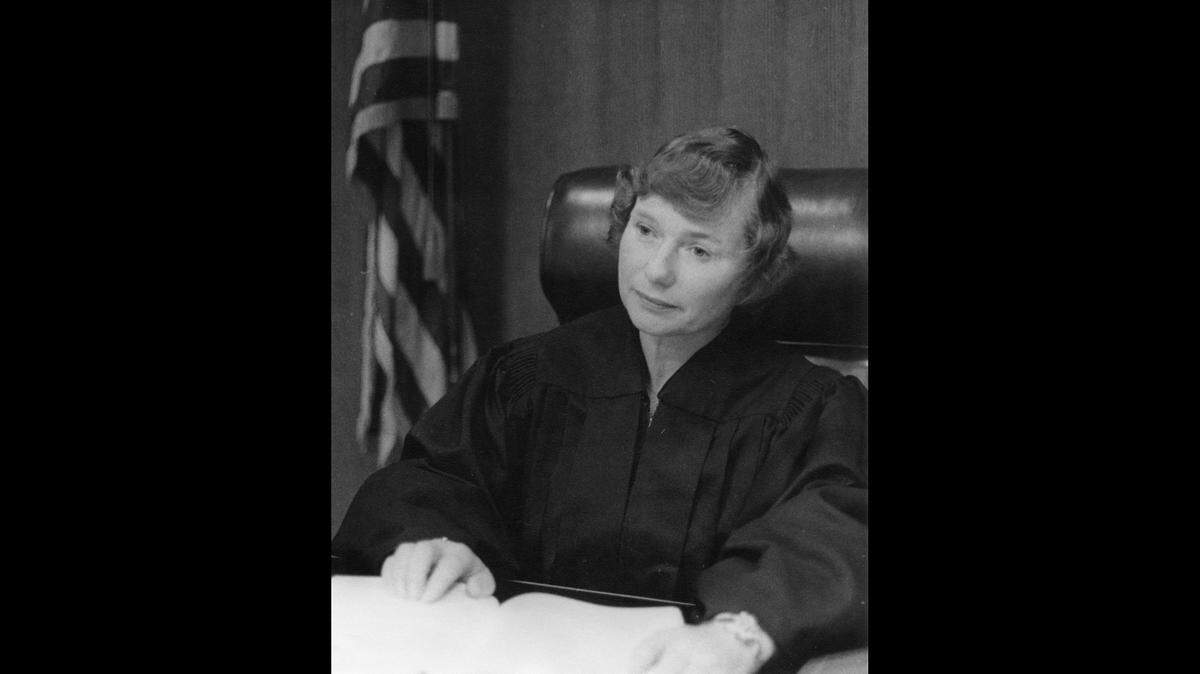
Carol Fuller, the first woman to serve as a superior court judge in Thurston and Mason counties, died on Monday at age 90.
Fuller served as a judge on Thurston County Superior Court for 14 years and was initially appointed, then elected, to the bench when it was a joint Thurston-Mason judicial district. According to a 2012 article out of the University of Washington School of Law, her alma mater, Fuller was the first female superior court judge in Washington state to serve outside of King County.
Before her appointment, she served as a District Court judge in Mason County for five years.
Beyond the courtroom, Judge Fuller’s family describes her as a woman of the arts who was a frequent presence at Olympia’s Harlequin Productions. She and her late husband, Herbert, who founded the Olympia law firm Fuller & Fuller, also loved poetry. They hosted readings and sponsored a poetry prize at The Evergreen State College.
She was spiritual, her daughter-in-law Leonor Fuller told The Olympian, in a “secular way” and adopted Buddhism later in life.
“She’s a career woman,” Leo Fuller said. “But she also thinks about the purpose of life.”
Fuller’s legacy lives on through a community of women in the legal field who looked to her as a mentor over decades. Her admirers and loved ones remember her as a gentle, but tough pioneer with boundless courage — the personification of grace under pressure.
A trailblazer from the beginning
Carol Fuller was blazing trails from the outset of her legal studies.
According to the UW Law magazine article, there were four women in her law school class of 1954. Three of them graduated, and only two passed the Bar exam.
While in law school, she fell in love with Herbert Fuller, another future lawyer, according to a biography written by her children. They married during their third year of law school, and Herbert got a draft notice on the last day of the Bar exam.
Herbert was posted in Germany, where their son Jay was born, the biography reads. On their return to Washington, they lived in Seattle then moved to Olympia when Herbert was hired by the state Office of the Attorney General. Carol took care of their family that grew by two daughters, Marya and Nina, according to the biography.
According to her children’s writing, Carol Fuller convinced her husband to quit his job, and they spent four more years living abroad before coming back to the U.S. permanently, rooting their family in the South Sound.
Carol Fuller officially launched her legal career at Pierce County Legal Services in 1970, closing the long gap post-law school, before she and Herbert founded Fuller & Fuller two years later.
As a lawyer, her emphasis was family law, according to the biography. She lobbied for the no-fault divorce law and for two years was an adjunct family law professor at University of Puget Sound Law School while working full-time.
Fuller became a Mason County District Court judge in 1974, according to her children.
Five years later, in September 1979, Gov. Dixy Lee Ray appointed her to a newly created seat on the Thurston-Mason Superior Court bench, Olympian archives show.
She competed against two men to keep her seat in an election shortly after, and The Daily Olympian quoted Fuller saying her experience gave her the edge.
“I have come to know, through my judging experience, that it takes a long time to make a good judge,” she’s quoted as saying. “There is no short way to prepare to be a good judge.”
Her son remembers that campaign as hard-fought. He and his two sisters took time off from school to campaign for her, he said. He recalls encountering voters who didn’t think a woman was fit for the job.
“I can remember being at a community forum and a gentleman getting up and saying ‘I just don’t think a woman should have to preside over a criminal trial,’” he told The Olympian in a phone interview this week.
Still, Fuller won voters’ approval handily — despite one of her competitor’s receiving The Daily Olympian’s endorsement.
Standing at a petite 5-foot-3-inches tall, her judicial robe had to be special ordered because there were no robes in women’s sizes, according to her children.
Grace, courage, and compassion in court
This week, Thurston County Superior Court released a statement in response to Judge Fuller’s passing, in part remembering her reputation for graciousness in what can be a charged environment.
“Judge Fuller served her role with dignity and with unparalleled respect for all who came before her,” the statement reads in part. “She will be forever remembered for her selfless mentorship of our county’s female judges who walked in her considerable footsteps.
“But she remains a remarkable example for all judges of the critical value of maintaining grace in the contentious environment of the courtroom.”
Judge Paula Casey, the second woman to be elected to the same superior court bench, worked in an office next to Fuller for eight years. They later grew to be dear friends.
A particular memory stands out to Casey: When they were walking in the same stairwell and she noticed Judge Fuller was carrying a McDonald’s bag, which was out of character.
As it turned out, it wasn’t for her.
She bought a breakfast box, Casey said, because she was going to interview a child who was part of custody proceedings. She often found it important to have contact with the child she’d be making decisions about, Casey said, and was generally known for providing a snack in meetings, to make sure people were comfortable when they came together.
“She wanted the court system to be a kinder, gentler system than it was, especially with respect to families,” Judge Casey said.
Judge Christine Pomeroy told The Olympian she met Judge Fuller when she was in the fifth grade. The Fuller family lived next door to hers in Seattle for a period in the early ‘60s, she said.
“I grew up watching her be a mother, watching her be kind and considerate,” Pomeroy said. “You know, every time she talked to somebody, she was so interested in it.”
Pomeroy said she was amazed to learn Fuller was a lawyer. She didn’t think women could be lawyers, but Fuller patted her hand and said “Yes, dear, they can be.”
She told that story in the 2012 UW Law magazine article, too, and is quoted as saying Fuller taught her the lesson of “civility.”
“In Family Court, Carol always suggested settlement,” Pomeroy is quoted as saying in the article. “She would say, ‘Let’s have a cup of tea’ and both sides would sit down to talk. Everyone was happy with the settlement. It taught me that it didn’t matter what happened – just focus on what you want to get across to the judge, focus on your role to advocate and to inform.”
Everyone would describe Fuller as a gentle soul, Judge Casey said, but it’s important to also note Fuller’s toughness.
Her early years on the bench were difficult, Casey said, and it may have been challenging for some of her colleagues to accept a woman’s point of view in meetings and running the court.
“She toughed on through it, and she did her job well and inspired us to follow her,” Casey said.
A mentor to generations
Fuller built a reputation as a thoughtful, generous mentor to the women following in her footsteps.
“She was like a pyramid scheme of inspiration,” Leo Fuller said in a phone interview.
Perhaps the most striking example is that of Judge Pomeroy, who in fifth grade was so inspired by her neighbor that she decided she wanted to be just like her. Decades later, she filled Fuller’s spot on the Superior Court bench.
“She inspired me to the law, and then to the bench,” she told The Olympian.
Fuller and Judge Paula Casey also met years before they both served on the same court, in 1976 when Casey had just arrived in Olympia and was starting a private practice downtown. Fuller was one of a handful of women lawyers in town, Casey said.
Casey later worked as a court commissioner. Leading up to 1984, when she was considering a run for judge, Casey told The Olympian Fuller was “really a strong advocate” and helped Casey and her husband make the decision. Her endorsement in the joint judicial district certainly didn’t hurt.
“Mason County voters were used to voting for women for judge,” Casey said. “And also, it’s possible that they thought I was Carol Fuller.”
Jay Fuller provided an illustration of his mother’s powerful influence that reaches back to the late ‘60s, when Carol Fuller was asked to give a speech at Shelton High School.
Within the last decade or so, a woman who had worked as a UW Law librarian approached Jay and Leo Fuller at a law school event and said she was in the audience that day in Shelton, and that it showed her a career in the law might be possible.
Since her mother-in-law’s passing, Leo Fuller said she’s communicated with judges at all levels who’ve voiced that Carol Fuller was an inspiration, including a former state Supreme Court Chief Justice and current court of appeals judge.
The example set by Carol also permeated generations of family. Jay, Leo, Marya, and Nina Fuller all now practice law at Fuller & Fuller in Olympia. Two of the Fullers’ grandchildren also attended law school.
For a span of at least a few years, Fuller hosted women judges from the Thurston and Mason county area for luncheons. Judge Casey eventually took over hosting, but said, in truth, she only did it so that everyone could see Judge Fuller.
“She was a mentor to all of us,” Casey said.
Editor’s Note: Staff at Olympia Timberland Library assisted The Olympian in research for this story. Microfilm archives of The Olympian are typically available for all to access at the library; however, the building was not open for public access at the time this story was written due to COVID-19 restrictions.
This story was originally published October 1, 2020 at 1:26 PM.
.jpg)