
Should Olympia reallocate law enforcement funding to social services?
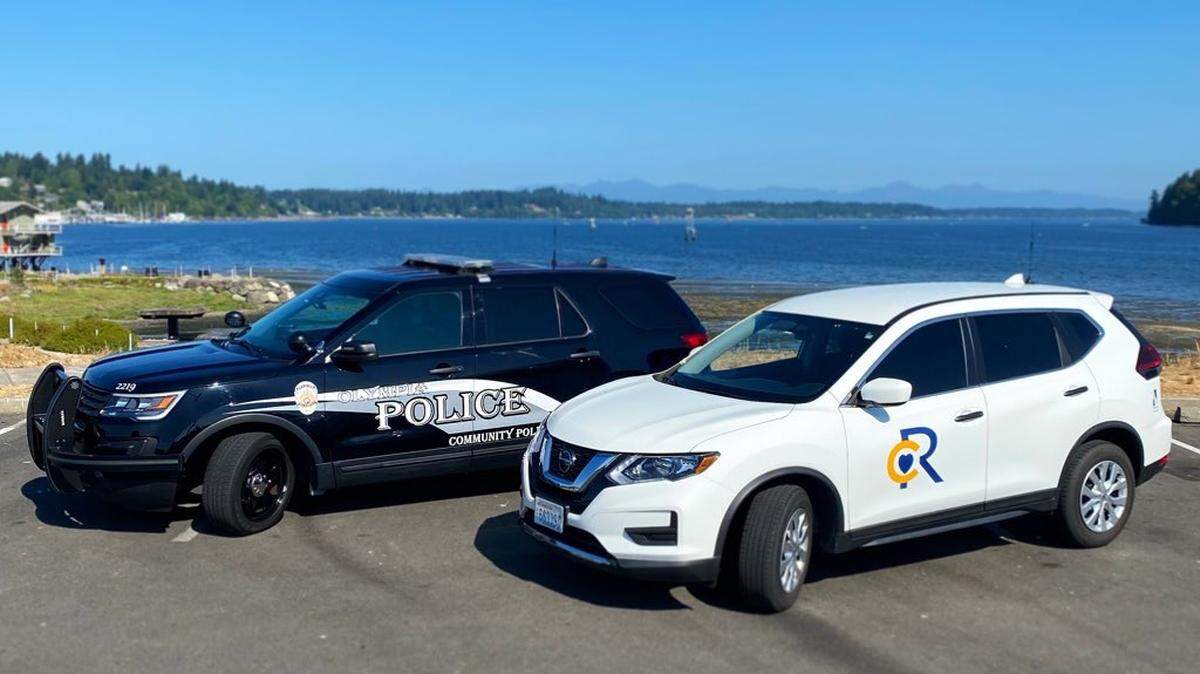
An analysis by The Olympian of call data from TCOMM, Thurston County’s 911 dispatch center, shows that community caretaking calls make up one-fifth of all 911 calls.
Police departments across Thurston County announced in July that they would stop responding to the majority of community caretaking calls — which broadly overlap with mental health, substance use, and other behavioral health disturbances — in response to a slate of new accountability laws passed by the state legislature.
“If it’s not a crime, it shouldn’t be an officer” who responds, Aaron Jelcick, then Olympia’s interim police chief, said in July.
Law enforcement and city leaders in Olympia have since partially walked back that position, but it’s not clear what criteria police departments are using to evaluate which calls they respond to. The uncertainty has upended the emergency response system and set off a new round of debate around how cities prioritize funding for public safety and social programs.
Of the more than 51,000 emergency calls originating from the Olympia area between April 2020 and April 2021, community caretaking calls accounted for 11,104 of them. That figure includes calls such as welfare checks (1,600), area checks (1,724), business checks (1,132), loitering (1,371), unwanted person (1,092), noise complaints (666), and drugs (295).
In a presentation to the Ad-Hoc Committee on Public Safety in late July, Jelcick initially told Olympia residents to expect “gaps in service,” when alternatives like the Crisis Response Unit (CRU) are not available.
A week later, City Manager Jay Burney put out a statement contradicting that message, in an attempt to assure residents that all calls would receive some sort of response.
“When called, the Olympia Police Department will respond,” Burney wrote. “Depending on the seriousness of the call, OPD’s response may be a uniformed officer in a matter of minutes, or a car driving by the situation, or a follow-up phone call.”
In an interview in early September, Jelcick echoed Burney’s message that all 911 calls will still be responded to, but it may take longer or be a different type of response than expected.
“I think there’s always careful evaluation of every single call,” Jelcick told The Olympian. “In most cases, an officer won’t be the first responder to these calls. But that doesn’t mean that nobody’s going to respond, and that doesn’t mean we’ll never respond.”
Jelcick, who retired from OPD at the end of September, had initially construed the changes as a response to the new laws, but has since said that nothing in the laws prevents officers from responding.
“We can respond to any call that we need to go to,” he said. “Ultimately if nobody else is available — which is rarely the case, right, we have fire personnel, we have medics, EMS, we have CRU on, we’re expanding those hours — then we’re going to respond.”
Expanding policing alternatives
Olympia has already invested in alternative first responder programs such as the Crisis Response Unit (CRU), a two-year-old program that dispatches mental health workers instead of police to certain 911 calls. CRU will soon double in size from 6 to 12 employees and expand its hours significantly.
The city also has a Familiar Faces program, which pairs people with lived experience to work one-on-one with people who generate a lot of 911 calls.
As these types of policing alternatives expand to cities across the country, they reflect a burgeoning consensus that police officers — who in many cities are the first point of contact for all manner of social problems — are not the appropriate response to many emergencies.
Even some in police leadership are saying this.
“Our lawmakers really don’t want uniformed police officers responding to all these folks with medical needs,” Jelcick said.
What the expansion of alternatives like CRU means for police departments is not as clear.
“City institutions have been essentially addicted to the law-and-order tools for dealing with social problems,” said Olympia City Council member Renata Rollins, who sees her long-held ideas around criminal justice reform, once considered radical, now getting their due. “I just think it’s inevitable things are going to move, particularly in Olympia, things are going to move to a smaller police force footprint.”
What’s next for OPD?
For Rollins, the decision by local law enforcement to step back from service is a better argument for budget cuts than any that advocates could make.
“My thought when they’re saying, ‘Well, we’re not going to respond to these calls,’ it’s like, well okay, there’s an easy equation: let’s just add up the percentage of your staff time that’s used to do those calls, and there’s an easy reduction,” Rollins said. “You’re gonna make the case for us.”
The city is currently undertaking a “reimagining public safety” process, but the nine-member community work group is not expected to make recommendations until at least March. Despite facing calls to reduce police spending, Olympia’s council actually increased police funding in 2020 to $21.8 million — although that was in part to fund an expansion of the CRU team and to hire them on as city employees.
Rollins, who has been the most vocal on Olympia’s council about redirecting money from the police department towards social programs, sees this moment as an opportunity.
“I think we may be in a position to call their bluff,” she said. “I’m not a lawyer, but I would argue that that’s a material change to your contract. So that immediately should open up, and we can start talking about [reducing] mandatory [staffing] minimums right now.”
Rollins is referring to the Police Guild contract, which expires in December. Certain provisions — like one requiring a minimum number of officers on shift at all times — bind the city’s ability to downsize the department by cutting officer positions or curbing overtime.
Asked whether budgetary priorities should shift to reflect the 21% of mental health calls now being routed away from uniformed officers, Jelcick rejected the idea of reallocating police department funds to programs like CRU.
“We’re already operating lean,” Jelcick said. “If you take from here to put to here, over here you’re going to run deficient.”
Speaking about HB 1310, the bill that sets a new standard for police use-of-force, Jelcick said it will actually require more officers to comply with the new legislation’s call to de-escalate situations before using force.
“You can’t do it when you take cops off the street,” Jelcick said. “When you take away from those minimum staffing officers, all you do is increase your risk of using force down the road. You don’t have those options anymore.”
This story was originally published October 10, 2021 at 5:00 AM.
.jpg)