Lacey group tackling homelessness reveals dissension, disappointment in its work
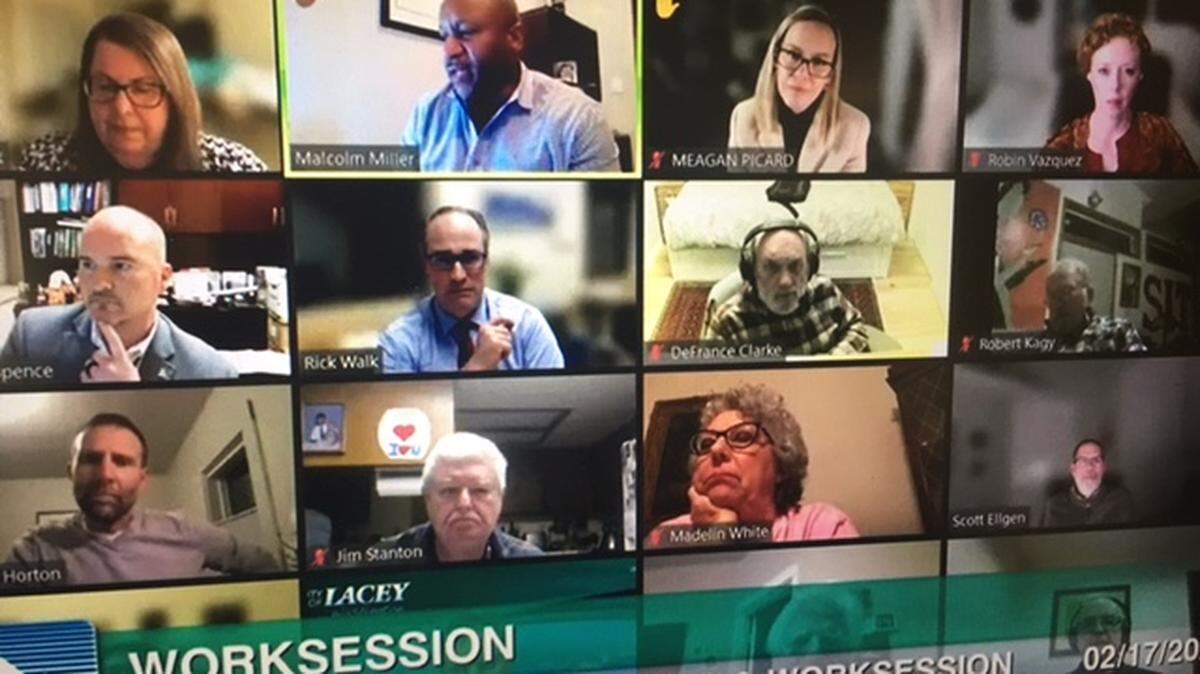
After 18 months, Lacey’s community work group on homelessness made its recommendations to the City Council on Thursday, but the difficult conversation that followed nearly overshadowed their work.
Seven group members, as well as Lacey City Council and staff, participated in a work session Feb. 17. Some work group members shared frustration and disappointment, while others defended their work.
“I’m feeling blindsided,” said group member Scott Ellgen after hearing the dissension and disappointment. “I felt we worked well together and the recommendations are the result of 18 months of hard work.”
The group was formed after the city had rolled out some initiatives to address homelessness — including a plan to move RVs parked at City Hall to a new site in northeast Lacey, not far from the outdoors store Cabela’s. That idea was never realized and ultimately resulted in an angry meeting with residents.
Community and Economic Development Director Rick Walk explained Thursday that it was then that the city hit pause on its efforts to address homelessness and decided to form the community group to solicit ideas and recommendations. An organization called The Athena Group facilitated their meetings.
Walk acknowledged it wasn’t an easy process because the original 30-member group had intended to meet in person. Instead, the pandemic arrived and those meetings shifted online, and some members dropped out. The group eventually fell to 12-14 active members, he said.
He also noted the topic of homelessness is “terribly complex, emotional and polarizing.”
Mayor Andy Ryder asked the group about their biggest takeaways from the process.
Small business owner Madelin White said she was disappointed that more wasn’t done to help business owners, many of whom dropped out of the group.
“What I find really disturbing is that people are not being held accountable,” she said, claiming there was push back within the group when accountability was suggested.
Member Ed Pole acknowledged the professionalism of The Athena Group and Walk, but he felt the group was led in a particular direction rather than being allowed to originate its own ideas.
As a result, he felt the recommendations were not very specific, laden with jargon and did not reflect the viewpoints of Lacey’s population.
Mayor Ryder also wanted to hear some personal recommendations.
White shared an extreme example, suggesting vacant state buildings could be used to house the homeless, including the former state prison on McNeil Island in Pierce County. The homeless who suffer from poor mental health or substance abuse could be sent there, she said.
“Take the mentally ill and put them in one half, put the drug addicts in the other half, and they could come out of there as the people they used to be,” she said.
White seemed the most frustrated by homelessness.
“We need to quit giving and giving and giving like the West Coast does,” she said. “I just came back from Tennessee and there is not a problem like this.”
Mayor Ryder quickly cast doubt on the McNeil Island idea, adding that has little to do with Lacey’s jurisdiction.
Pole suggested the Mottman Industrial Park area as a place where services could be concentrated to serve the overnight needs of the visible homeless population and RV dwellers.
Member Jim Stanton suggested that once the indoor mask mandate is lifted on March 21, the city could hold some community workshops to get additional feedback. Ryder supported the idea.
Councilman Lenny Greenstein praised the group for the work they did, but he also found it a little wanting. He pointed out one of the goals was the creation of a micro-house village, but there wasn’t enough direction and input on how to get there.
“It’s not giving me what I was hoping to get as a council member,” he said.
Group member Bob Kagy said the group would have been more specific, but could only come to agreement on some broad-based concepts.
Lastly, Meagen Picard of The Athena Group took issue with the idea that the group was guided to an end result.
“We worked really hard to create a space for all to be heard and to bring out information about a variety of options as well as invite new ideas from the group,” she said.
The work group’s recommended goals
▪ Safe and affordable shelter options are available to anyone that is unsheltered. Safe and affordable housing solutions are available to all.
▪ Services and resources are seamless, streamlined, easy to access, trauma informed and tailored to the individual person experiencing homelessness.
▪ Robust prevention and early intervention strategies complement other strategies to reduce longer term and chronic homelessness.
▪ All services offered in Lacey are highly collaborative and connected, making the most efficient and effective use of available resources toward achieving all other local goals on homelessness.
▪ The community is educated about homelessness — causes, how to make meaningful difference, and what Lacey and its partners are doing to address it.
▪ Ensure the community is safe, clean and (has an) inviting environment for all who live, work and play here.
This story was originally published February 21, 2022 at 5:45 AM.