
Olympia, Tumwater fire chiefs break down benefits of proposed Regional Fire Authority
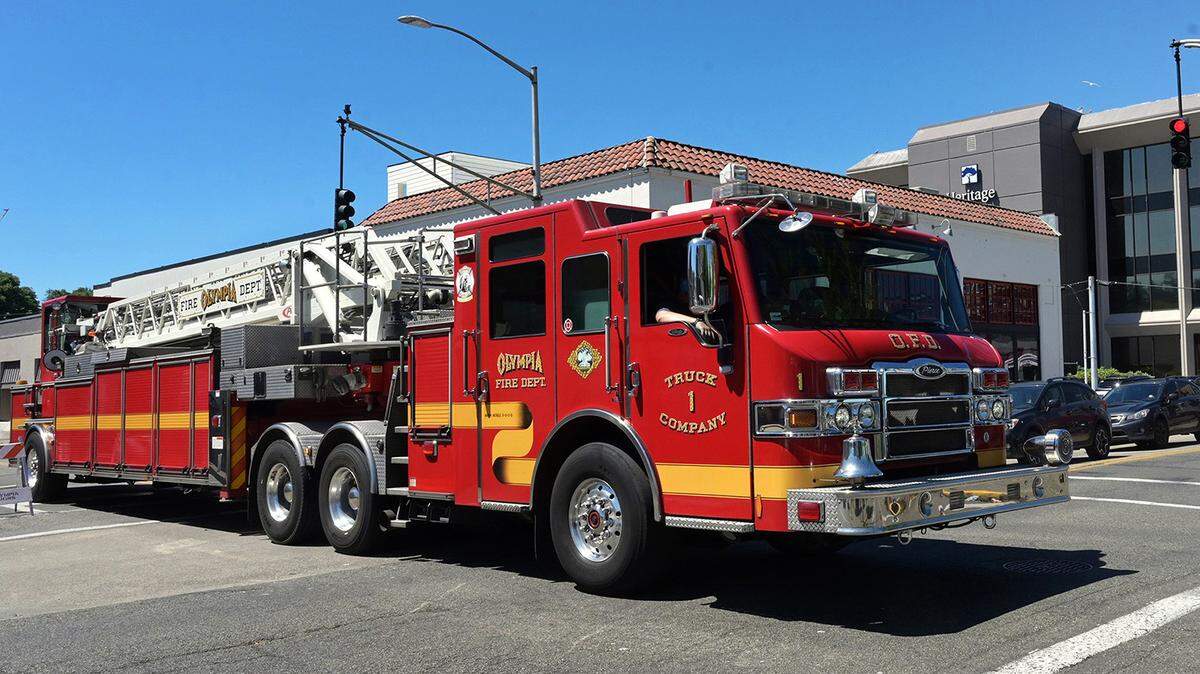
After three years of planning, Olympia and Tumwater’s city councils will soon review a plan to consolidate their fire departments under a Regional Fire Authority. The idea has garnered heavy support from leadership and members of both city’s departments.
The move would be a big change for the cities and their fire departments both structurally and financially. Fire Chiefs Brian Hurley and Todd Carson laid out the benefits of creating an RFA and answered questions posed by the public during a Town Hall on Aug. 15.
The cities are contemplating an RFA in an effort to improve response times and availability of units as the cities continue to grow. An RFA also would allow fire and EMS services to be funded through a separate tax levy and a Fire Benefit Charge, as opposed to through the cities’ general funds.
About a dozen people signed up for the Town Hall, moderated by Karen Meyer, a consultant with the Athena Group in Olympia. Meyer took a variety of questions from the public and consolidated them into a handful for chiefs Hurley and Carson to answer. Here are the answers to the main questions about an RFA.
Funding an RFA
Tumwater City Administrator John Doan said the RFA plan has funding coming from Thurston County’s EMS levy, which was voted on and raised to 50 cents per $1,000 of assessed value. This funds Basic and Advanced Life Support needs in the community. Inspections and other fees, as well as grant money, contract revenue and state money for government facilities in Olympia also would contribute to the pool.
The plan also includes a yearly fire levy of $1 per $1,000 of assessed valuation. But officials say both cities are reconfiguring their property taxes to reallocate $1 to the fire levy, so citizens won’t actually pay any more than they already do. By the time RFA charges would be collected in 2024, the property tax general levy rate is projected to be $1.05 in Olympia and $1.09 in Tumwater, after the general levy reallocation.
However, citizens would pay an annual fee called a Fire Benefit Charge. The amount is based on estimated fire-fighting resources needed to combat a fire at a given location, such as ability to provide water, how large the structure is, and what type of structure it is. Doan said a single-family homeowner can expect to pay anywhere from $380 to $450 a year.
These funds work with the fire levy to provide base support and long-term funding for the RFA to expand programs across both cities.
Coordinated, consolidated services
Chief Hurley in Tumwater said the funding provides the chance to do more training and integrate two programs into one. One person asked why both cities don’t train together now, and Hurley said they often do, but it comes down to equipment and staff availability.
“We do some joint training, but as fire chief in Tumwater, we have two engines on duty each day,” Hurley said. “We do training with one engine in Olympia. If we’re busy, we have to pull that engine from training.”
He said they’d be able to consolidate to one training officer and purchase equipment together. Another benefit would be combining all six of the fire stations in both cities, meaning there’d be six primary engines and six reserves.
Another benefit would be the expansion of the FD CARES program, which stands for Community Assistance Referrals and Education Services. This would allow for a more streamlined process to help people who make non-emergent and non-EMS calls without sending out fire engines and ambulances.
“This system gets the closest response unit to you faster,” Hurley said. “Breaking down jurisdictional boundaries, you can create better response times.”
The chiefs said the RFA would hire a second battalion chief who would serve as a shift commander to oversee high-acuity calls. They said combined, the departments receive close to 20,000 calls per year, or more than 50 calls per day.
Incidents and response times
One person asked the breakdown of proportion of calls for fire response and medical response. Chief Carson said about 80% of the calls are for EMS and the other 20% is a mixed bag. Only 2 to 3% is for fire response, he said, but when a fire arises, the departments need to be able to provide a full response.
“We always have to be ready to respond to those structure fires,” he said. “We have to be prepared with any alarm activation that it’s an active fire.”
Both chiefs talked about how strained the departments have been to get to a scene on time, as populations in both cities continue to grow and call volume rises. They said when it comes to cardiac arrests and EMS response, getting there in less than 10 minutes is crucial, and four minutes is ideal. But they often miss that mark.
James Osberg, firefighters union president in Tumwater, said he believes an RFA would provide more sustainable funding to ensure they’re more adequately prepared for these calls and can make it on time.
“We don’t take our jobs lightly,” Osberg said. “With every response we intend to make better what has gone wrong in those calls. As it pertains to cardiac arrest, structure fires, strokes, the time matters.”
The timeline
Tumwater’s Doan laid out the timeline for the RFA proposal. Another Town Hall is planned for September, but the exact date is to be determined. The RFA Planning Committee will submit its plan to both city councils by October, and they will deliberate until February 2023. If the councils approve the proposal, a measure will be placed on the April 2023 ballot.
If the RFA proposal is passed, it will go into effect Aug. 1, 2023, with taxes and charges imposed starting Jan. 1, 2024.
“Our fire departments are old and historic institutions in our communities,” Doan said. “We care a lot about them, they have a lot of history and tradition. But they’re also very important in situations where your heart stops, your home is on fire, or you don’t know who else to call. That’s what they’re there for.”
This story was originally published August 21, 2022 at 5:30 AM.
.jpg)