
Here’s where the Port of Olympia commission candidates stand on the marine terminal
If you’re running for a seat on the Port of Olympia commission — and this year each district race has a primary — the big question goes something like this: Do you support marine terminal operations or do you support making a change?
The marine terminal is the area of the port on Budd Inlet where ships tie up to the dock and load and unload cargo. The port does not handle containers like the Port of Tacoma does, only what is known as “breakbulk” cargo, the type of item that might be shipped in a large bag, for example, instead of a rectangular metal box.
The question about the marine terminal is being asked after the existing port commission — Joe Downing, Amy Evans Harding and Bob Iyall — received an update on terminal operations at their July 10 meeting. The news wasn’t good.
That’s because after 35 ships called on the port in 2022, making it one of the best years at the marine terminal in more than a decade, the marine terminal in 2023 finds itself with much less business — at least so far, said marine terminal senior manager Afsin Yilmaz.
He described it as a “big reversal of fortune for many ports on the West Coast,” including the Port of Olympia. Year-to-date, 10 ships have called on the port, of which eight were log export ships, he said.
Marine terminal revenue has fallen as a result. The terminal generated more than $8 million in revenue in 2022, but has so far produced about $2 million for 2023, a Port of Olympia chart details.
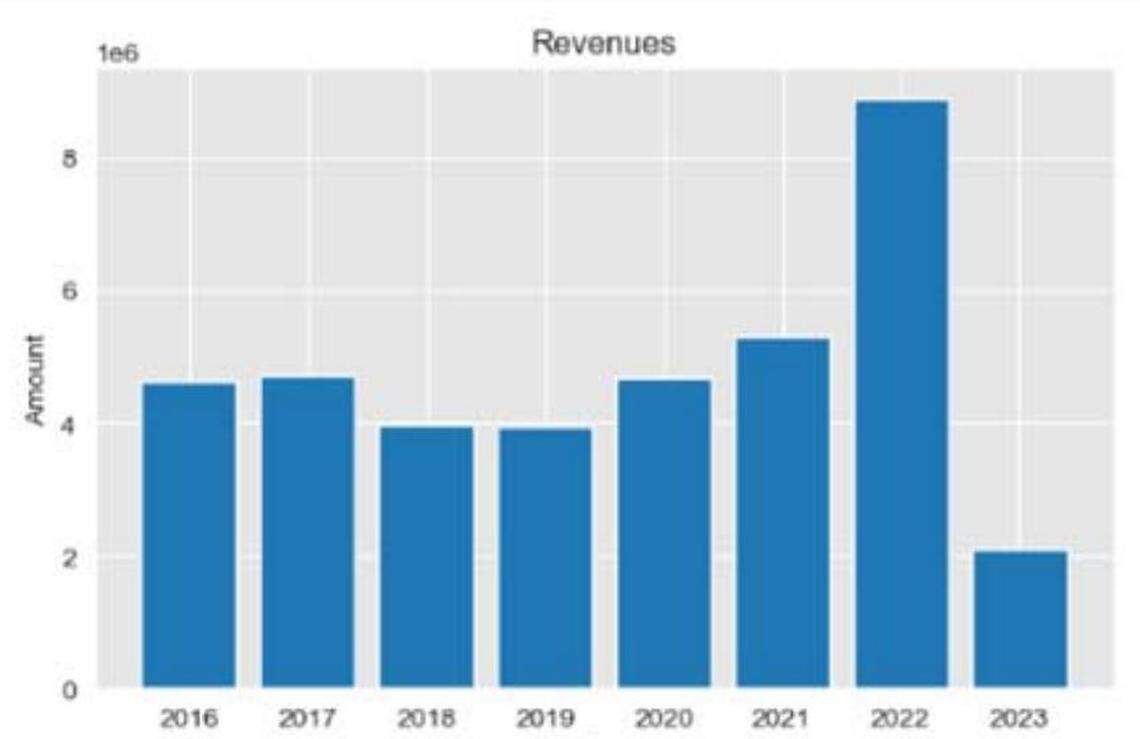
Yilmaz identified a number of factors that have contributed to the slowdown. One of the key points he made is that container rates have fallen and shippers have taken their business elsewhere after shipping cargo through the Port of Olympia made financial sense in 2022.
Immediately after the pandemic, the demand for goods soared and so did container rates, rising to $18,000 to move a 40-foot container, Yilmaz said. Rather than pay that price, shippers moved rice and sugar, normally a containerized product, in break-bulk fashion through the Port of Olympia.
But in 2023, container rates have stabilized, falling dramatically to around $1,800 to $2,000 per container on the West Coast, he said. Yilmaz said shippers now are demanding more warehouse capacity than what is available at the Port of Olympia.
Boom and bust cycles are nothing new for the port’s marine terminal. The Olympian asked the commission candidates if they support business as usual at the marine terminal or want to see something different happen there.
There are contested races in three Port of Olympia districts for the Aug. 1 primary election. The port is expanding its commission from three members to five members, so Districts 4 and 5 are new positions.
The Olympian was able to reach all but two primary candidates for this story: District 1 candidate Jasmine Vasavada and District 4 candidate Bill Moomau. District 5 candidate Nick Adams said he has suspended his campaign.
District 1
Skye Campbell-Ragsdale, 35, who works in invasive species removal, said she does generally favor change at the marine terminal, particularly if it is not a consistent source of revenue and continues to impact the environment.
However, scrapping or altering the marine terminal is not something that is going to happen overnight, she said. Instead, if elected, she would start the discussion about what the options and alternatives might look like.
“I would start the conversation because there can never be change if we don’t start the conversation,” she said.
Bill McGregor, 75, who is retired, previously served on the commission for 15 years and is a longtime supporter of marine terminal operations. So, how does the terminal move beyond boom and bust cycles?
McGregor thinks the port’s marketing needs to improve. “I think we need a broader presence than we have had in the past,” he said, adding that the port needs to work closely with stevedores and shipping companies.
He also supports the idea of an expanded or second marine terminal warehouse, so long as there is careful analysis of it, and permanent shore power for a layberth opportunity. “I think it’s viable, but it has to be paid for through an actual layberth opportunity,” he said.
District 4
Rose Chiu Gundersen, 60, vice president of operations and retail services at the Washington Retail Association, said whether it’s the marine terminal or another line of business at the port, the port has a legislative mandate to support economic development. Yes, there are going to be ups and downs at the marine terminal, she said, but she believes there is still a lot of potential there, which is important because the port does levy a property tax on residents.
“We need to show them a return on investment,” she said.
Joanna Manson, who declined to share her age, has a community planning background and works for the U.S. Department of Transportation. Manson said that if there is just one major user (just ships, for example) at the marine terminal, it is going to be susceptible to booms and busts. A diversity of uses can act as a buffer, such as ferry service or mixed-use development — housing with a commercial component.
Manson said she’s not advocating for any particular outcome, but as a planner, she would be prepared to look at the alternatives, using vetted criteria and input from the community.
“We should be looking at viable alternatives to transition to a more sustainable use of the lands they manage,” she said.
Maggie Sanders, 51, said she is working full-time on her campaign. “I would like to see something different at the marine terminal,” said Sanders, adding that over time the port should move away from that business. “It’s a long-term goal, but I would work toward that,” she said.
As a result, she supports the idea of a green, sustainable workforce. “It’s critical to look at other economic opportunities,” she said. She supports using the waterfront as a destination and extending the buffer shoreline to protect the environment.
District 5
Sarah Tonge, 33, an IT professional, said she does not believe in business as usual at the marine terminal, preferring that the port seek out higher value industries that do less damage to the environment. “I have lived here all my life and I am not about business as usual,” she said.
On that note, she referred to the Biden-Harris Administration CHIPS and Science Act, which seeks to revitalize the U.S. semiconductor industry with manufacturing incentives. “Ultimately, we have that accountability to the taxpayers,” Tonge said.
Martin McElliott, 53, works for the state Department of Natural Resources as as properties and acquisitions specialist. He said he supports the basic marine terminal business and would like to see more ships, and if there are more ships, then perhaps the port wouldn’t have to rely on its tax levy, he said.
But that doesn’t mean he supports business as usual at the marine terminal. “I’m not one to do business as usual; however, I would have to see what the data shows before I would make a snap judgment.”
Troy Kirby, 47, small business owner who started The Cider Barrel in downtown Olympia, acknowledged that the question of the marine terminal is a complex one, but he said he supports living-wage union jobs. “I will always fight for those jobs,” said Kirby, saying those jobs provide workers with important safety standards for dangerous work.
He also supports the idea of an expanded warehouse or second warehouse on the marine terminal, although it likely would face some challenges under the state Environmental Policy Act.
He doesn’t believe in closing the marine terminal outright. “I don’t think that eliminating someone’s job is a Thurston County value,” he said.
This story was originally published July 16, 2023 at 5:00 AM.
