
Here are the groups getting the $5 million in Inspire Olympia cultural access tax dollars

The Olympia City Council is set to approve a list of 60 local organizations that will get a cut of the voter-approved Inspire Olympia cultural access tax revenue.
The tax has collected more than $5.3 million, which includes $3.1 million of projected revenue from 2024 taxes and roughly $2.2 million carried over from 2023 collections. A list of groups that applied for funding was discussed during a Community Livability and Public Safety Committee meeting on May 22.
To be eligible to receive funds, applicants must be nonprofits in Olympia whose primary purpose is the advancement and preservation of science, technology, visual or performing arts, heritage, natural history and more. They also must be providing programming and experiences to the public.
State agencies and their political subdivisions were excluded from eligibility as well as radio and television stations, cable and internet-based communications systems, newspapers and magazines.
Money is divided into two categories: comprehensive and impact funding. Comprehensive funds are meant for larger organizations with established year-round programming. Impact funding is meant for organizations that aren’t registered nonprofits but have fiscal sponsorship from one.
Larger organizations can apply for up to 15% of their annual budget and can receive a maximum of $75,000 a year through a two-year contract. That’s $150,000 in total. Smaller ones can ask for funds for a single event, or get $3,000 to $30,000 a year to get year-round programming started.
Two-year Allocations
.png "Funding Request and Funding Recommendation (1).png")
One-year Allocations
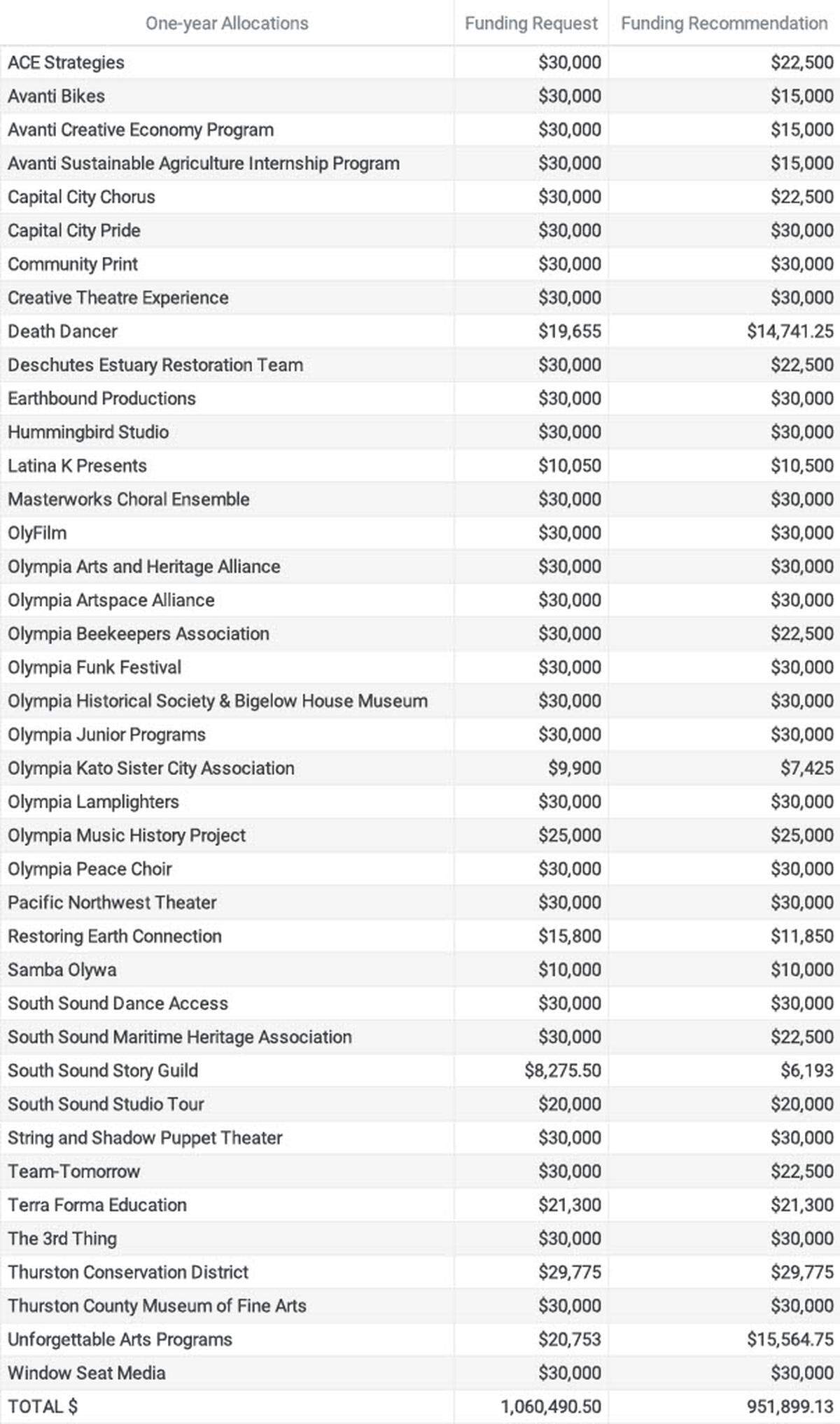
Smaller organizations have to provide a one-to-one match for their requested amount. It can be a cash match, or in-kind donations and volunteer service.
Another $430,000 will go toward Cultural Access in Public Schools and $50,000 will go toward workshops and learning opportunities for the funded organizations. Another 10% of Inspire Olympia funds, or $300,000, was set aside for administrative costs.
Program Manager Marygrace Goddu said there were no bad ideas pitched in the dozens of applications, but there were some criteria. She said the focus was on if it seemed the applicant had the capacity to meet all the deliverables they hoped to with the money.
The Cultural Access Advisory Board also kept in mind the possibility of collaboration between organizations and how much the applicants seemed willing to work together. Goddu said most of the groups that applied really hit the mark.
One organization didn’t receive funding. Sound Studios Olympia, a music school, applied for $53,164 over two years but received none. Goddu said the group appears to be operating as a for-profit business despite their nonprofit status. And the application didn’t include any programs for public benefit.
This story was originally published June 3, 2024 at 5:00 AM.
.jpg)