
Is discrimination a problem in Olympia? Many surveyed say it’s happened to them
“There are times I don’t feel comfortable in my own neighborhood,” an Olympia resident named Kyra is quoted saying in a new report compiled by the city.
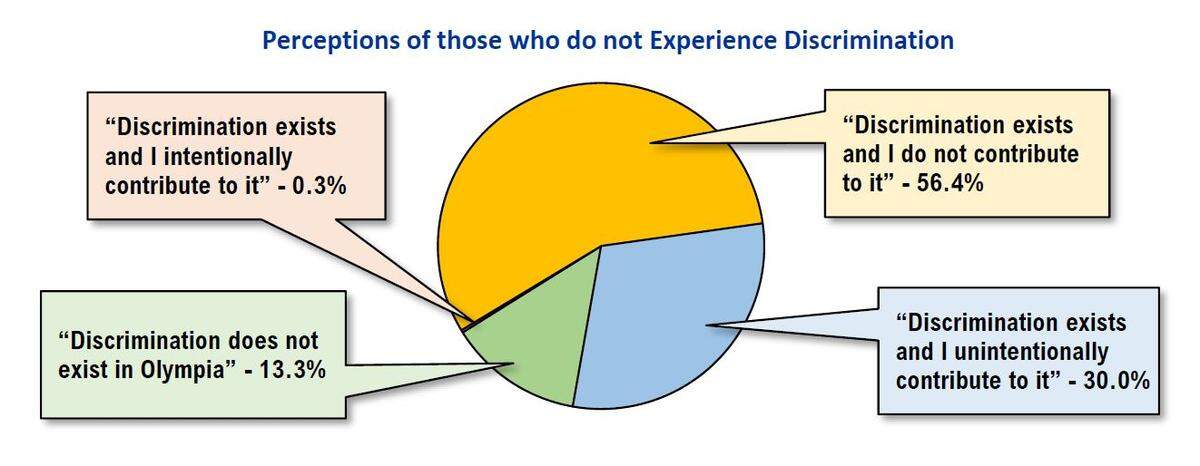
Nearly 1,000 people who responded to the Experiences of Discrimination in Olympia Report said they’ve faced some form of discrimination in the city. But about 100 people believe discrimination doesn’t exist at all in Olympia.
The City Council received a briefing on July 23 by Program Manager Tobi Hill-Meyer and members of Truclusion, the consulting firm that conducted the report.
Hill-Meyer said the purpose of the assessment was to better understand occurrences of discrimination from the perspective of Olympians who experience it, so that the findings can inform the Social Justice and Equity Commission’s work.
Marvin Jones with Truclusion said the Olympia study is one of a kind and no similar study of discrimination in a community or city has been done in the United States. Therefore, there’s not much they were able to compare Olympia to, other than a national study from 2017.
There were 1,981 respondents to Olympia’s survey whose answers were used for data analysis.
According to the report, 984 people said they’ve experienced some form of impediment discrimination in Olympia. That’s defined as discrimination that limits a person’s access to opportunities because of their identity.
Impediment discrimination can include being discouraged from pursuing further education, not being hired or promoted at work, not being able to live in a desired neighborhood or not being safe from law enforcement harassment.
Transgender oppression
According to the report, transgender men and women had the highest rates of any group in 3 of 4 forms of discrimination.
The four forms include being treated with less respect, being seen as less smart, having others act afraid of them, and being harassed or threatened.
Every transgender man and woman who answered the survey said they’ve experienced both being treated with less courtesy/respect and being treated as if they were not smart.
The report says transgender men and women are three times more likely than cisgender men to experience others acting afraid of them, and eight times more likely than cisgender men to feel threatened or harassed.
Compared to all other identities, transgender men and women were found to have the highest rates of experiencing discrimination in education, health care, and accessing services.
According to the report, transgender men and women in Olympia are 11 times more likely than cisgender men to be denied health care or provided inferior medical care. They’re also three times more likely to be prevented from renting or buying a home where they want to live.
Transgender people in Olympia are also three times more likely to not receive a job promotion; three times more likely to be hassled by law enforcement or security; five times more likely to be discouraged by an educator or adviser from pursuing further education; and eight times more likely than cisgender men to be denied service or provided inferior service by a plumber, car mechanic, or other service provider.
According to the report, transgender oppression was the most-reported issue. Truclusion recommended that such oppression could be remedied through education across the community, and further inclusion of the entire LGBTQ+ community with pride imagery, events, and communications.
Other remedies may include ordinances, policies, and/or best practices for curtailing harassment of transgender individuals.
Colorism is prevalent
Colorism, or discrimination negatively affecting people based on skin tone, was reported as more prevalent in Olympia than racism, which is discrimination negatively affecting people based on race.
Non-white American Indian and Alaska Native respondents reported the highest rate of housing discrimination of any identity. According to the report, they also experience law enforcement discrimination at 15 times the rate of white respondents.
More than 90% of the 76 Black and African American respondents reported experiencing discrimination in Olympia. Many reported they avoid predominately white spaces when possible and cautiously engage when interacting in those spaces.
“I’m scared of every interaction, because behind it, I have to worry when you get mad at me, what happens?” one respondent said.
Black and African American people are three times more likely than white people to report being treated with less courtesy or respect than others, and three times more likely than white people to be treated as if they are not smart.
They’re also eight times more likely than white people to report that others act afraid of them.
Black and African American people in Olympia are also four times more likely than white people to be prevented from renting or buying a home where they want to live. They’re six times more likely to be denied a loan, five times more likely to be hassled by law enforcement or security, and three times more likely to be discouraged by an educator or adviser from pursuing further education.
The report says they’re three times more likely to be passed over for job or promotion and four times more likely to be fired than white people.
More insights
According to the report, native English-speakers who are Asian are often perceived by other people in Olympia as not able to understand English.
Survey respondents younger than 25 years old were 63% more likely than those over 54 years old to say that discrimination has interfered with them having a full and productive life.
At the same time, the same young age group also had the highest rate of white cisgender men and women without disabilities believing discrimination doesn’t exist — or that it exists but they don’t contribute to it.
The report says these perspectives of young white cisgender men and women can foster unintentional discrimination.
“As Olympians born after 1998 increase their share of power and influence in the community, there is a risk that occurrences of discrimination will increase,” the report says.
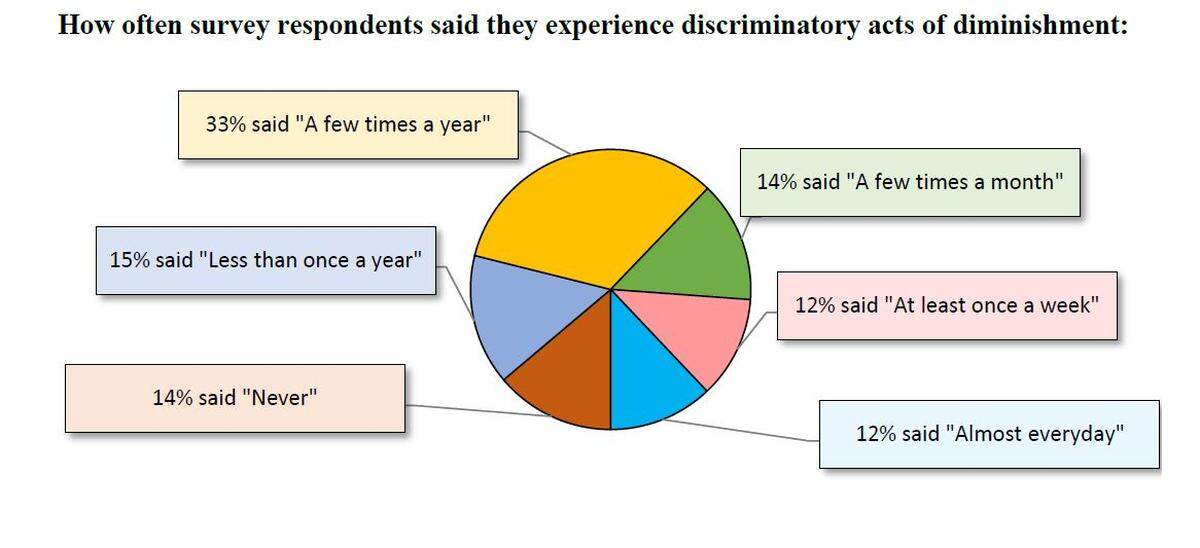
Nearly a third of respondents reported experiencing employment discrimination in Olympia because of their identity.
City council member react
Council member Robert Vanderpool said as someone who is action oriented around policy, it’s difficult to look at the data.
“It’s difficult because you have so many friends and colleagues and coworkers from here and then out at my day job and people I know out in the community. I struggle with this, because I wish there was something I could do more in,” he said.
Vanderpool said his partner works at Providence St. Peter Hospital and has a lot of younger patients with suicidal ideation because of the discrimination they deal with in Olympia.
“Frankly, I believe our community can do better than this,” he said.
Council member Clark Gilman said he thinks seeing that such a large portion of the community experiences discrimination gives him courage and motivation to consider affirmative, anti-racist, reparations-pointed actions.
Mayor Dontae Payne questioned how the city can measure what people feel and what they experience, and what the government can truly do about it. But there are actions the city can take to make the city more inclusive and inviting. He said the city has already made progress with actions addressing homelessness and housing affordability, increasing walking patrols and joining in on the countywide Home Fund.
“All of these actions lead to doing bigger and more expansive actions or projects that ultimately have an impact on people’s experience and how they feel,” he said. “And so I don’t necessarily feel discouraged, I feel like there are things that we could do to try to chip away at some of what people say they feel and what they experience by doing tangible things.”
He said the report is a reflection of the community, which he said is seen as progressive. But this data puts that reputation at risk, he said.
“We think we’ve arrived and that we don’t have more work to do, but we certainly do,” Payne said. “This will help us do more to use that equity lens that we talked about a lot in the work that we do going forward to try to address some of these very systemic issues in our community.”
Next steps
Hill-Meyer said she regularly meets with equity staff from the county and from Lacey, and she plans to discuss the report with them.
She said city staff will be given training based on the report. After that, they will be following up with community partners who helped get the word out about the survey and invite them to a focus group discussion.
Finally, the Social Justice and Equity Commission will have a retreat in October focused mostly on the discrimination report and begin the process of developing recommendations to address issues.
About the assessment
The assessment cost $80,000, which came from the city’s 2023 budget.
The research was approved by Temple University’s Institutional Review Board, ensuring the project and its procedures adhere to FDA ethical research regulations. Data collection ran from June 12, 2023 through October 20, 2023.
.jpg)