Meet some of the residents at Sandy’s Flats. Here’s how the supportive housing site is doing
Katie Barajas lived in a tent at the bottom of an embankment on Wheeler Avenue, just a few feet from Interstate 5, in 2023. One day, outreach workers gave her a choice: move into a shelter or find somewhere else to camp.
Though initially unsure, Barajas chose to pack up her possessions and move into the shelter. She spent more than a year at the Interfaith Works shelter at Unity Commons in Olympia.
Barajas now lives at Sandy’s Flats, a 26-unit permanent supportive housing project that took over the Olympia Inn building on Capitol Way. This type of project combines accessible housing with voluntary support services to keep people housed, even if they’ve experienced chronic homelessness.
To see how Sandy’s Flats was doing, The Olympian spoke with Barajas and two other residents a few months after they moved in Aug. 13.
“The staff is really good here,” Barajas said. “The people are very caring and we all try to help each other out.”
Ivy Ayers, director of administration for Interfaith Works, told The Olympian in December that all 26 units at Sandy’s Flats are occupied and no residents have left the project so far.
“We’re fully leased up,” Ayers said. “Folks are settling in really well.”
Ayers added all current residents have been funneled to Sandy’s Flats through Washington state’s Encampment Resolution Program, an effort to remove people living on state-owned transportation corridors.
Barajas said Sandy’s Flats offers her stability, privacy and a foundation from which she can continue her sobriety and pursue her goals.
How did Barajas fall into homelessness?
Barajas lost her apartment in 2021 while she was incarcerated for about two and half months. She said she was caught shoplifting portable air condition units and selling them online for hundreds of dollars.
“I was able to lift them up, put them in my cart and walk out the front of Home Depot or Walmart or wherever I decided to go that day.” Barajas said.
She said she did it so she could afford meth. People she knew used meth and she started using it herself after her son’s father died and her brother was injured in an assault.
Barajas eventually found herself living at the encampment on Wheeler Avenue with a now ex-partner. She called it a “huge mud hole.”
“I lived at the bottom of the embankment, so there’s all that mud and gross stuff and snow,” Barajas said. “It wasn’t my choice that I lived on Wheeler. It was the only place I could go other than The Jungle and I don’t like The Jungle.”
The Jungle is a colloquial term for a large encampment in a wooded area on the 3200 block of Martin Way East in Olympia.
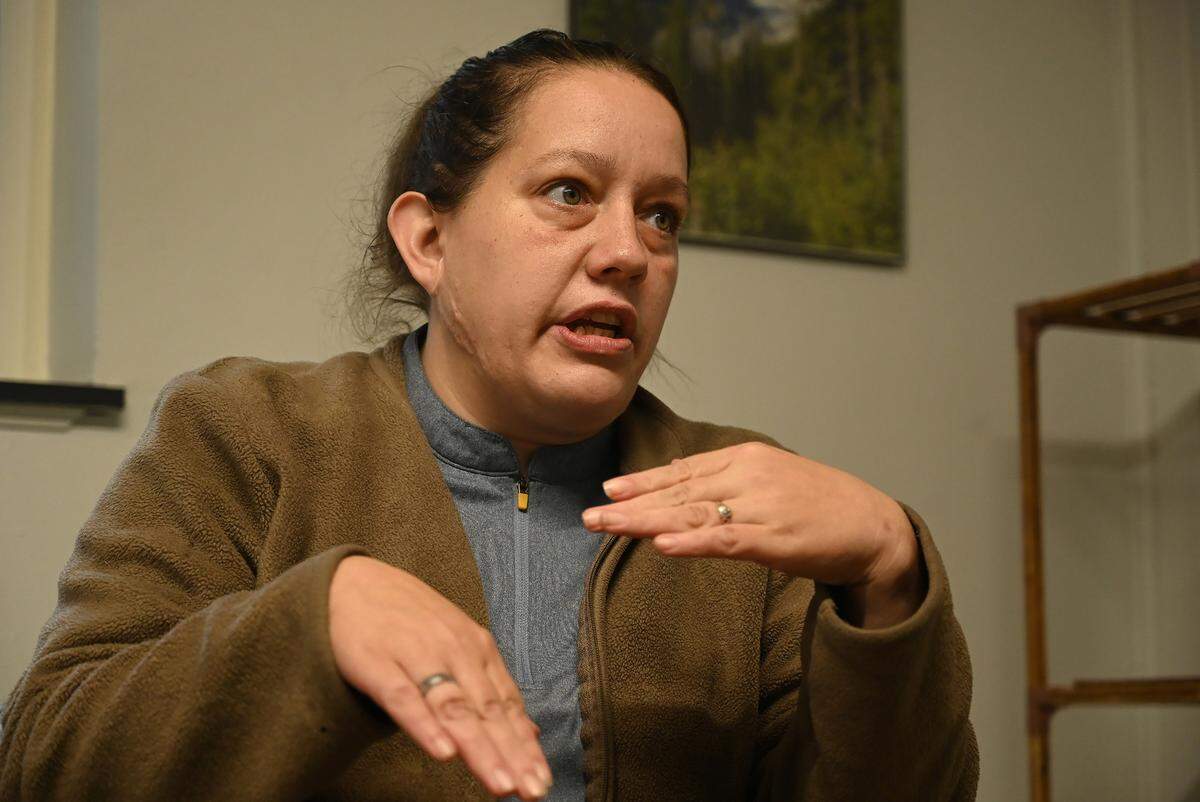
Barajas stopped using meth about 13 months before she moved into Sandy’s Flats. To do it, Barajas said she entered a Christian recovery program in Shelton for about three and half months.
“I was fed up from going to jail and stealing from stores,” Barajas said. “It was time for my kids. My kids were more important.”
Barajas said she got a job as a cook at local fast-food restaurant two months after moving into her Sandy’s Flats unit, which she shares with her rescue dog Buddy.
She now hopes to reconnect with her children – an independent 18-year-old daughter and an 8-year-old son who has been living with his grandmother.
“My hope is to get my kid back full time and be a mom again,” Barajas said. “And hopefully get into a better place where I can have him in his own bedroom.”
What’s life like at Sandy’s Flats?
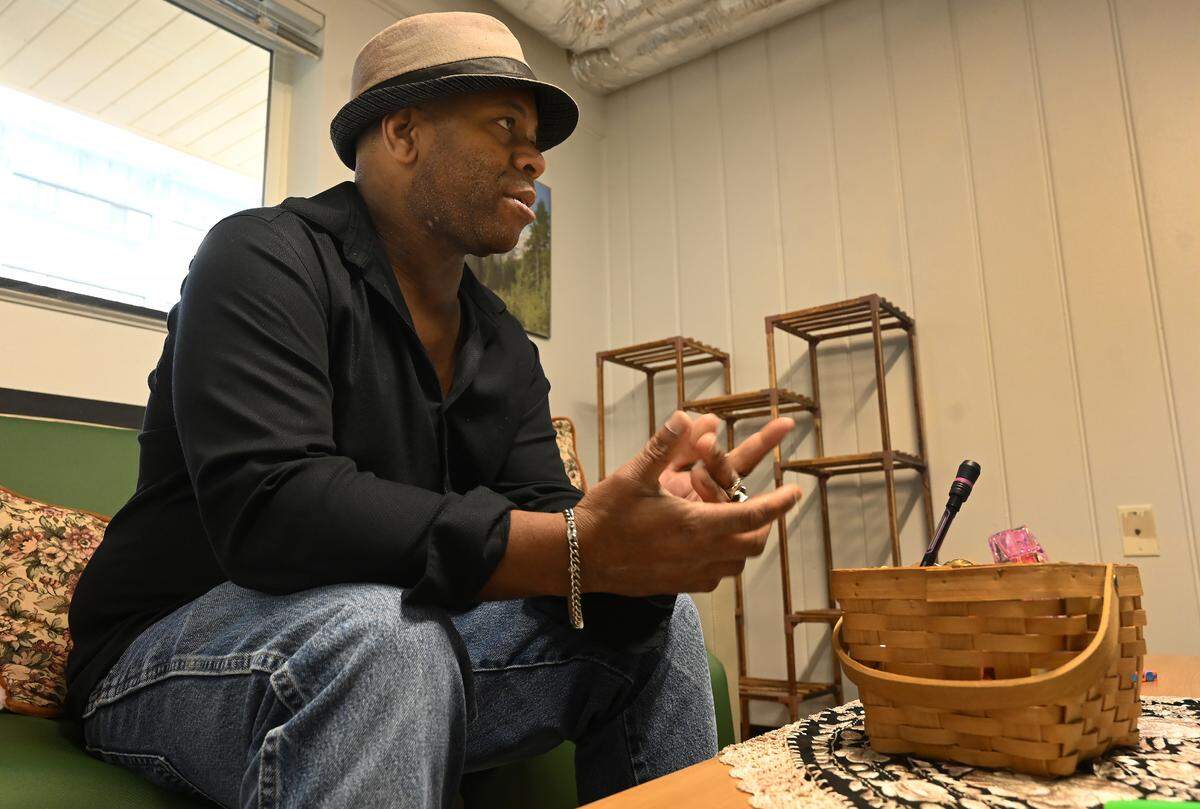
Rio Stevensen moved into Sandy’s Flats on Aug. 13 with his dog Jaxx after spending almost a year at the Interfaith Works shelter.
He said he lost his housing in 2022 after health complications made it difficult to continue working and paying rent. He’s still living with those health issues but he’s grateful to have landed at Sandy’s Flats.
“We’re not having the issues that some may have expected us to be having at this time,” Stevensen said. “We’re really trying to embrace this as our home.”
Ayers said on-site case managers have helped residents build community by holding events such as movie nights and a holiday potluck. They’ve also set up walking and jobs clubs as well as resident elections — the latter of which resulted in a draw, so now Sandy’s Flats has two co-presidents, she said.
The presidents’ duties are still being fleshed out, Ayers said, but so far, they have started a welcoming committee for new residents and have been tasked with being in the know about what’s going on and who may need support.
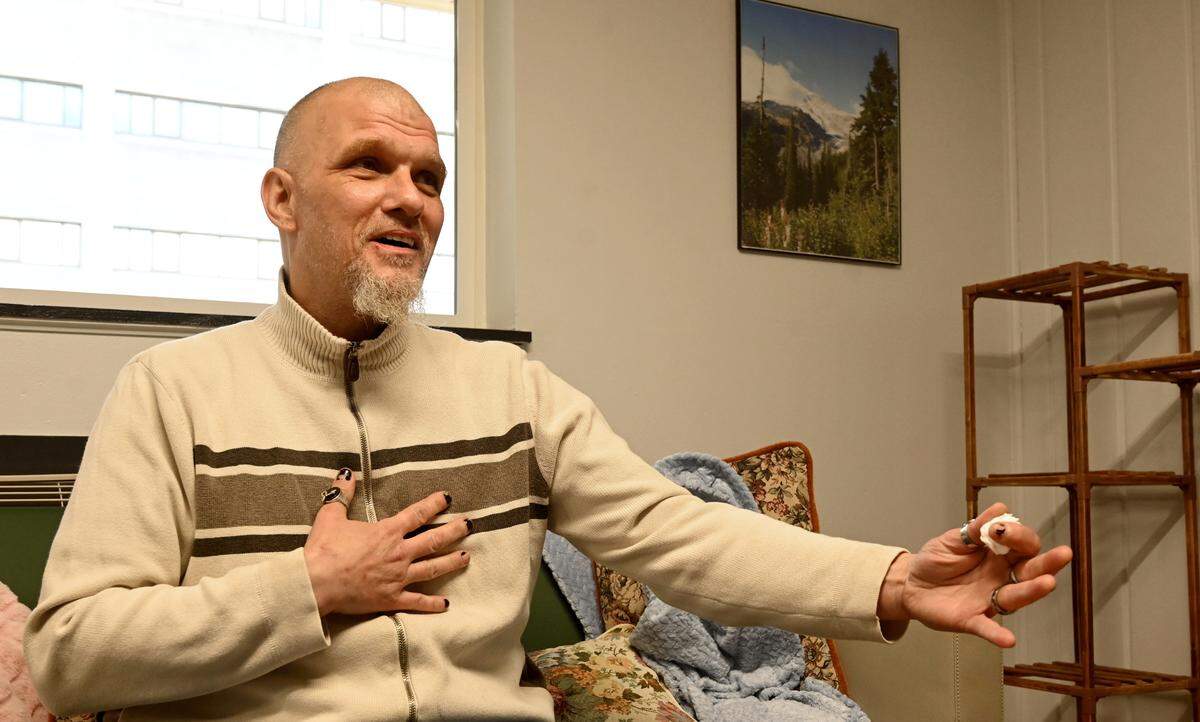
Shane Bird moved into Sandy’s Flats from the Interfaith Works shelter around the same time as Barajas and Stevensen. Before then, he said he had been living next to train tracks along Percival Creek near U.S. 101 in west Olympia.
“It’s just horrible there,” Bird said about the encampment. “That’s all I can say. My heart goes out to some of the people that are down there too.”
Bird said he started using heroin and later fentanyl after several family members died in various circumstances. He stopped using those drugs after entering treatment last April.
He said he’s thankful for his new life at Sandy’s Flats and the help he’s received from Interfaith Works.
“If you want to change your life, if you want to do something positive, this is a good deal,” Bird said.
However, Bird did share some limitations. He said Sandy’s Flats is only staffed during the day, so some people have taken to breaking some rules late at night.
Ayers said staff are only onsite from about 7:30 a.m. to 10 p.m. on weekdays and 10 a.m. to 6 p.m. on weekends. She said Interfaith Works is exploring tweaking those hours or adding a security position.
“Now that we’re 100% full, we feel like we’re going to start really getting an idea of what the needs of the building are and needs for the residents are,” Ayers said. “We’ll let that drive the decisions around presence and staffing.”
How was Sandy’s Flats set up?
Gov. Jay Inslee started the Rights-of-Way Initiative in 2022. Now, the initiative is known as the Encampment Resolution Program (ERP), but the purpose is the same.
The state partners with cities, counties and service providers to identify encampments along state’s rights of way, establish a by-name list, assess residents’ needs and offer them housing before clearing the encampment.
The program had closed 53 sites as of Oct. 31, and 1,310 people have accepted housing, according to the Washington State Department of Commerce website. About 74% of people who accepted shelter or housing have remained stable and indoors.
In the case of Sandy’s Flats, Commerce gave Interfaith Works approval in early 2024 to buy and convert the Olympia Inn into permanent supportive housing.
The non-profit paid about $2.7 million for the property in March, The Olympian previously reported.
Then in June, the Thurston County Board of Commissioners approved a two-year $804,594 contract with Interfaith Works to pay for operations at the property.
Renae Miller, a Thurston County spokesperson, said the contract requires Interfaith Works to abide by state guidelines as well as provide the following services.
- Case management/peer navigation services
- Resource/service connection
- Enrichment support to promote housing stability and social skills
- Tenancy skills improvement
Additionally, Miller said Interfaith Works must establish an advisory council of neighborhood representatives. Ayers said Interfaith Works held an open meeting last month that only drew a couple neighbors.
“We haven’t had really enough interest to get it off the ground, but we’ll probably try another neighborhood meeting in spring,” Ayers said.
How is Sandy’s Flats being evaluated?
Miller said the county provides oversight and collects data every two weeks on the number of ERP beds occupied, participants in the project as well as entry and exits.
It remains to be seen how successful Sandy’s Flats may be in the long run, but there’s evidence to suggest it may make a difference.
Permanent supportive housing projects like Sandy’s Flats have been proven to help people remain housed and improve their well-being, according to a 2018 report published by the National Academies Press.
As a housing-first model, permanent supportive housing projects can be more successful than treatment first models, which prioritize making people “housing ready.”
A review of 26 studies from the U.S. and Canada found housing-first programs reduced homelessness and improved housing stability more effectively than treatment-first programs, according to a 2020 report published in the Journal of Public Health Management and Practice.
Such projects also give the state, counties and towns a place to house people in a cost-effective way.
In a 2017 study, the National Alliance to End Homelessness found a chronically homeless person costs taxpayers an average of $35,578 per year in crisis services such as jail stays, hospitalizations and mental health services.
Meanwhile, the study shows supportive housing costs an average of $12,800 a year.
Will Sandy’s Flats last?
The county’s contract with Interfaith Works was made possible by funding from the state Department of Commerce, but that funding may dry up soon.
Commerce has told the county that it expects to maintain some level of funding for projects to shelter and house people on state-rights-of-ways this year. However, Commerce has not committed to a level of funding because that will be dependent on the state legislature and the budget it passes this year.
This uncertainty was described in a county document from a Dec. 10 Board of Health meeting. The document lists 12 projects contracted by Thurston County or the City of Olympia, including Interfaith Works’ Sandy’s Flats and shelter at Unity Commons.
State funding to operate ERP projects is currently contracted only through June 30, 2025.
“Failure to maintain full funding for these projects creates a significant risk that Thurston County and the City of Olympia will be unable to maintain these projects, resulting in participants returning to unsheltered homelessness,” the document says.
Miller said the county, in partnership with the cities of Olympia and Lacey, will take “all reasonable steps” to ensure no participant leaves these programs into unsheltered homelessness.
“Ultimately, what we are able to accomplish is tied to resources that might be available to respond,” Miller said.
When reached for comment, Ayers said she did not feel terribly concerned and Interfaith Works remained committed to supporting Sandy’s Flats.
“We’ve been around for a pretty darn long time at this point,” Ayers said. “We’re pretty used to lifting and shifting and making adjustments to be able to keep services rolling.”
This story was originally published January 5, 2025 at 5:00 AM.