
IT bus drivers make the case for better wages to transit board. ‘We need to be able to pay our bills’
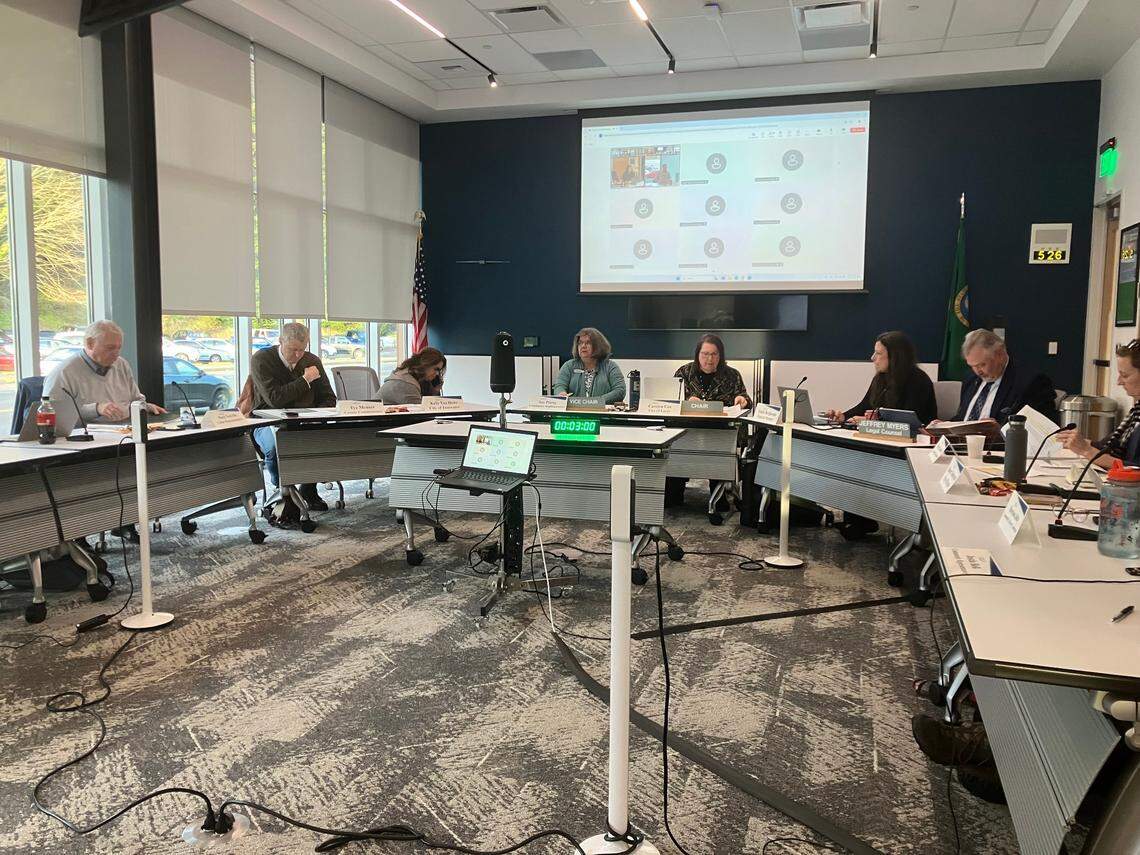
About 20 union members on Wednesday urged Intercity Transit management to come to terms on a new three-year labor contract for bus drivers, customer service representatives and other workers.
They aired their concerns during a meeting of IT’s authority, a governing board that includes elected leaders from around Thurston County. Lacey City Council member Carolyn Cox chairs the board.
At issue is a labor contract with the Amalgamated Transit Union that expired at the end of 2024. It covers 345 bus operators, Dial-a-Lift specialists and customer service representatives. Negotiations began in November and continue today.
Attorney John Lee, the lead negotiator for IT, said the union and IT have reached tentative agreements in a number of areas, mostly tied to benefits, but they are still far apart on wages.
Intercity Transit has proposed a 10.75% increase in wages over three years, with wages rising 4.25% in the first year, 3.5% in the second year and 3% in the final year, he said.
The union has countered with a 21% increase over the same period. That’s 8% in year one, 7% in year two and 6% in the final year of the deal, Lee said.
Union President Mark Neuville said the benefits are good, but they don’t pay rent and that’s the challenge.
“Like I told you before, most of the young drivers, if they don’t have an outside source of income, they can’t afford to work here,” he said. “And I mean, that’s just the fact. And most of the younger people out there, they’re either living with their parents or on their parent’s property or on in-laws property, and those kind of investments, not to mention robbing Peter to pay Paul. That’s the reality.”
Although the last contract expired, the union continues to operate under the parameters of the previous deal, said IT General Manager Emily Bergkamp.
Under that contract, a new bus operator currently makes $24.44 per hour. Under the IT proposal, a new driver would make $25.48 per hour, according to information shared at the meeting.
Union members at the meeting said that is not good enough.
“We need to be able to feed our families; we need to be able to pay our bills as well,” said bus operator Stacy Catarina. She also raised concerns about bus driver safety, pointing out the threat of being attacked or verbally abused, and asked whether barriers were going to be installed on buses.
Bus operator Matthew DeWitt said he doesn’t make the income needed to get a nice apartment at $24.44 per hour.
“But I still come to work and I still provide exceptional customer service because I believe in this job and I believe in this community, and I would really like to believe in this authority board,” he said.
Operator Nick Parisi said he spends $1,250 per month on child care and $2,000 on rent.
“I just hope that you guys can help out however you can,” he said.
Olympia City Council member Robert Vanderpool, who serves on the authority board, voiced support for the union.
“I’m always concerned about people in our community not being able to afford to live here, and I hear about it all the time,” he said. “And, you know, cost of living is certainly going to get worse. Even in my own life, you know, I, as a state worker, I am very concerned about furloughs (proposed by the governor) and I’m really concerned about getting by and so I’m 100% behind meeting the needs of the union on this.”
Intercity Transit responds
General Manager Bergkamp and others responded to some of the concerns raised during the meeting, including those pointing to IT’s healthy end-of-year cash positions, including reserves.
According to data shared at the meeting, those total around $220 million a year for the foreseeable future. Those reserves ballooned during the COVID-19 pandemic through a combination of sales tax revenue, decreased expenses and delays in buying vehicles due to supply chain problems, said IT’s Chief Financial Officer Jana Brown.
“Once you receive the money and you don’t spend it, it goes into your reserves, and it needs to be very thoughtfully used,” she said. “It should not be used on ongoing expenses because then you create an environment that is not sustainable. And so our reserves are set aside for our capital improvements.”
One IT bus costs about $1 million, Bergkamp added.
IT leaders expressed concerns about slowing revenue, expenses outpacing revenue growth and uncertainty about grant funding, which accounts for 30% of all revenue, IT data show.
The general manager also responded to driver Catarina’s safety concerns, saying IT had looked at a couple of barrier options.
“We don’t want folks injuring themselves in a device that is meant to protect them, and getting in and out of that device every day was showing that we would have some ergonomic issues,” she said.
But she said fixes have been addressed.
“We have finally landed on all of the corrections with one of the suppliers, and that order is being finalized, and we hope to bring that before the board for approval relatively soon,” Bergkamp said.
She also addressed the delays in negotiating the new contract, pointing to the amount of new language in the proposal.
“You know, each page of the contract has had some changes that they’ve asked for us to consider, and in order for us to fully enact those and understand those, it does take time to walk through those and have conversations about them,” Bergkamp said.
Bergkamp said they have had an open negotiating process.
“An open session allows observers to come in and view what’s happening, and we were happy to make that happen,” she said. “It’s difficult to hear the criticism, but we’re not trying to hide anything. We’re just simply trying to get to a point where we can identify what would work best.”
This story was originally published March 6, 2025 at 12:05 PM.
