
Parents say Tumwater school board is restricting public comment, meeting access
AI-generated summary reviewed by our newsroom.
- Tumwater School Board changed its public comment policy to screen submissions.
- Parents and students criticized the move as limiting speech and silencing dissent.
- Concerns rose over trust in the board and its support for anti-trans policies.
Some parents in the Tumwater School District spoke during the board of directors’ May 21 meeting against a new policy that allows the board to screen public comments ahead of time and potentially limit participation.
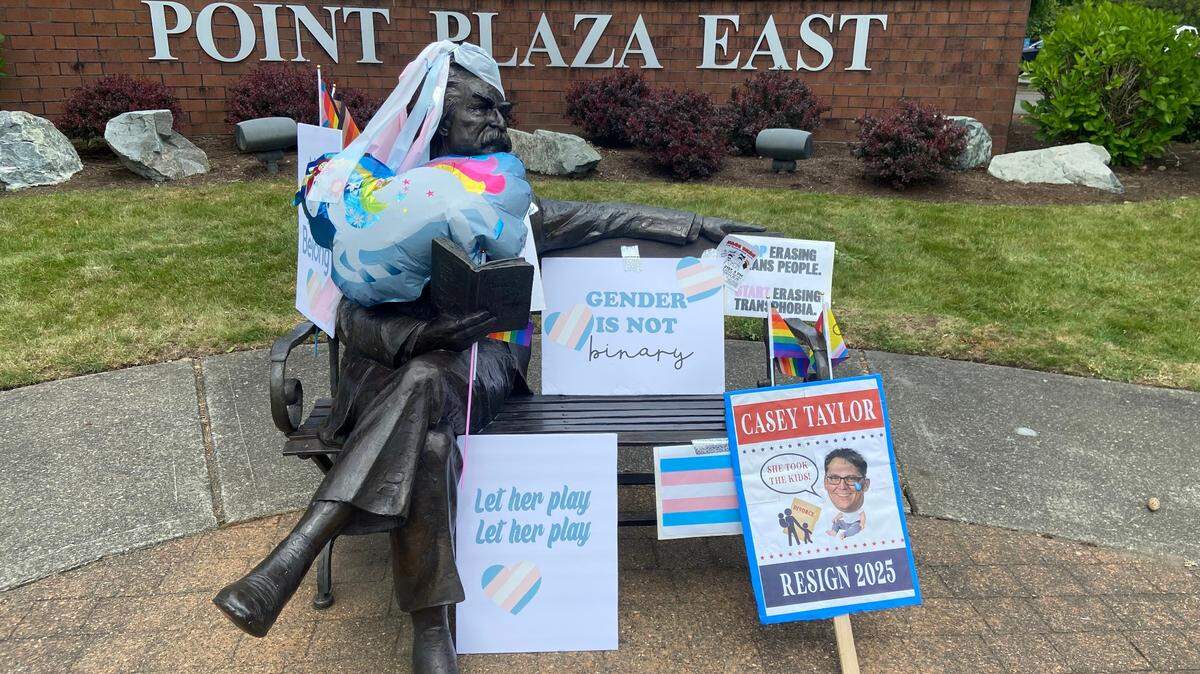
The board meeting was held at Littlerock Elementary School rather than the district office. According to the district’s social media, the meeting was moved due to the “continued disruptions to meetings at the district office.” Earlier in the day, students participated in a district-wide walkout in support of trans and queer student rights.
The public comment policy was updated so that, rather than accepting the first 10 signups, the board will review the list of submissions after the 9 a.m. signup deadline and select speakers “that will ensure a broad range of perspectives on the topics within the board’s scope of responsibility.”
The public comment period is near the beginning of the meeting and is at a maximum 30 minutes long, giving people three minutes each to speak.
District spokesperson Laurie Wiedenmeyer said the changes were made because at previous meetings, the public comment portion was “often monopolized by speakers addressing topics that were not on the agenda.”
“As a result, those who wanted to provide public comment on action items were unable to do so if they weren’t among the first 10 to sign up,” she said. “The new procedure includes a specific opportunity to prioritize public comments related to action items on the agenda.”
Only four people signed up to speak during the May 21 meeting. Each of them spoke about the changes to public comment and the board’s actions on anti-trans student policies.
Parents push back on new policy
Lindsey Jones said she wished she could have focused her comments on her support of trans kids, but instead she was there to argue against the changes to the public comment policy.
Jones said that even under the best of circumstances, where the community trusts and supports its local government bodies, nobody should have the power to select which comments will be heard. She said that power should especially not be granted to public servants or public officials.
Jones said the Supreme Court has ruled repeatedly that selecting speech based on content is unconstitutional.
She said the community has little trust in the board right now, and there’s no guarantee the board will choose to hear from voices they disagree with.
“We should all be concerned that this set of directors wants to limit the freedom of speech that we have, and we can only assume a government that seeks to restrict free speech is not a government of the people and not a government body to be trusted,” she said.
Jones said the board should be pushing to hear from the public more often, not less. She asked that the board reverse its decision on public comments, as well as its decision to support policy amendments to ban trans athletes from participation.
Julie Watts told The Olympian that she and other district parents are concerned that the board’s actions violate the public meetings act. She said the board has moved its meetings to a more remote location, and IDs are being checked at the door.
“Overall, I think there is not a lot of trust about how the board will implement the policy given the motivation appears to be to stop hearing from youth, parents, teachers and community members about their decision on the anti-trans student resolution,” she said.
Amanda Mahoney has been emailing the board about her concerns. She said according to the ACLU of Washington, it’s unconstitutional for a government body to restrict a member of the public from speaking based on their viewpoint or group affiliation.
She said this means that any policy or practice that allows some members of the public to speak while denying that right to others — based on what they are saying or who they are — is “not only unjust but also unlawful under the First Amendment.”
“While the board may adopt content-neutral rules about time, place, and manner of comments (such as time limits applied equally to all speakers), it cannot discriminate based on the content or viewpoint of speech without violating constitutional protections,” Mahoney said.
Superintendent offers explanation
In an email response to Mahoney, Superintendent Kevin Bogatin said this process isn’t designed to exclude dissenting viewpoints, nor is any speaker selected or excluded based on whether their views align with those of the board.
“The focus is on the relevance and diversity of topics within the board’s scope of decision-making,” he said. “Additionally, all written comments submitted by the deadline are shared with the full board, and individuals unable to attend in person can request to provide comments remotely when feasible.”
He said to be transparent, the board president will share details at each meeting about how many people signed up, how many topics were submitted and how the speaker list was determined.
“We hope this added clarity reassures the public that the process is being applied equitably and transparently,” he said.
More defense of trans students
Parent Regina Brown said she was enraged by the board’s decision “to force a vote to deny children the right to play sports in a manner that aligns with their gender identity.” She called the vote an act of harm.
Brown said May is Mental Health Awareness Month, and LGBTQ+ young people are more than four times as likely to attempt suicide than their non-LGBTQ+ peers. She said transgender and nonbinary youth are 2.5 times as likely to experience depression symptoms, sexism and other issues compared to their cisgender LGBTQ+ peers.
Brown referenced the Healthy Youth Survey that’s conducted every two years. She said TSD’s results from 2023 show a disparity between LGBTQ+ students and cisgender, heterosexual students who identified with feelings of hopelessness, suicidal ideation, anxiety and depression.
“I guarantee your hasty, unwarranted vote against transgender athletes sent a loud and clear message right to the center of the heart of every child in Tumwater who answered ‘other’ instead of ‘boy’ or ‘girl’ and ‘other’ instead of ‘heterosexual,’” she said. “Your actions had an immediate, direct negative impact on student mental health.”
Cody Coleman is one of six student representatives on the board. He said at the previous board meeting, he sat behind a woman who spoke about the harm her transgender child was enduring in the school district. He said it was upsetting for him to hear.
Coleman said it showed him that the decisions around trans student rights are not being made by students, but by the parents and adults in the community.
“The motion was discriminatory, it was unreasonable, and I really think it should be reversed,” he said. “The only reason that I could come up with to even present it in the first place over these past couple weeks, to think about it, is because things were different when you guys were in school.”
Coleman said he doesn’t think ignorance is a valid excuse for discrimination.
This story was originally published May 26, 2025 at 5:00 AM.
.jpg)