
Could old WSDOT site in Tumwater become aquatics center? Leaders review options
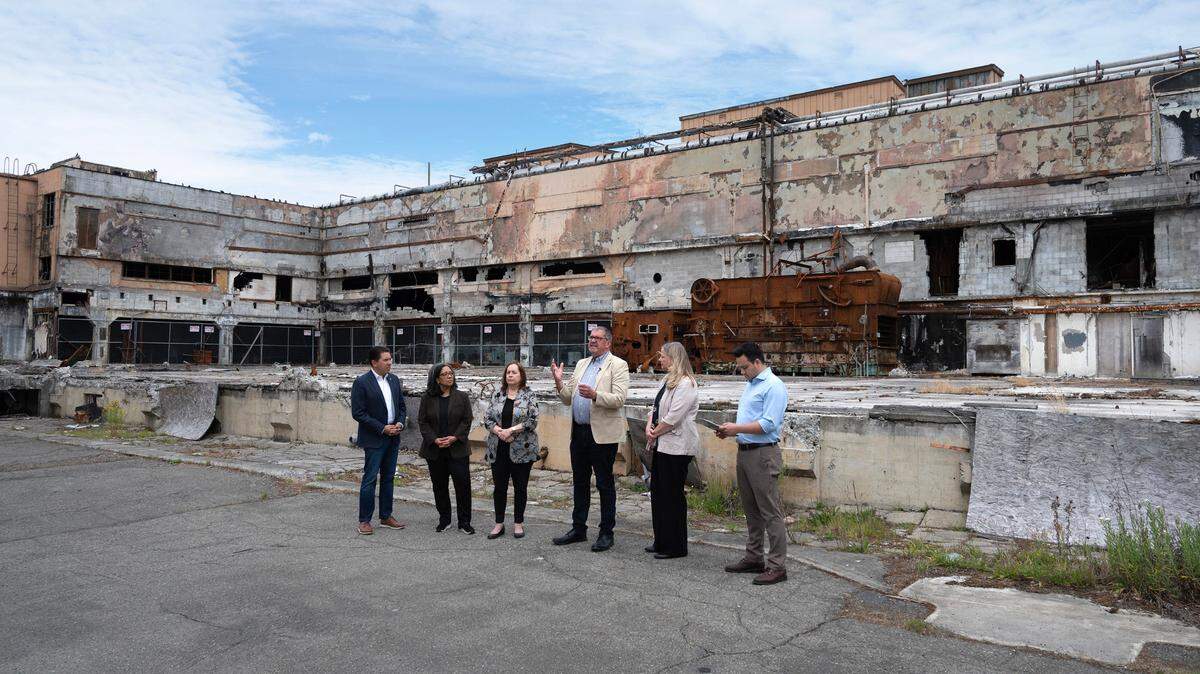
The Tumwater City Council met on May 27 to discuss the future of the dilapidated Olympia Brewery site and the former WSDOT Olympic Region headquarters complex, including what it will take to clean up the iconic properties and prepare them for redevelopment.
City Administrator Lisa Parks and assistant city administrator Kelly Adams presented the council with updates on where the two properties and cleanup efforts stand. The city will develop a Planned Action Environmental Impact Statement (EIS) for the cleanup of the two sites and align future potential redevelopment efforts with the city’s master plans.
Parks said the EIS will compare alternative development scenarios and partnerships that could come out of redevelopment. She said it could be something like a partnership with the YMCA to locate a new indoor recreation facility in the city’s core. Or it could be a partnership with the City of Olympia for a regional aquatics facility.
Parks said she and Mayor Debbie Sullivan met with Lt. Gov. Denny Heck more than a year ago and he said revitalization of the brewery properties isn’t just a Tumwater issue, but a state one too.
“For decades that whole area was an iconic symbol of the state of Washington, and now, for the past two decades, they’ve also been a blight on our entire community and the region, and so we want to ensure a collaborative approach with our regional partners across the community, and the planned action EIS process specifically allows us to do that, and we also want to keep in mind the different partnerships that could be available in terms of reuse of this property,” she said.
Both sites contain what are known as brownfields, properties with real or perceived contamination. Adams said their past uses make them a bit tricky to develop, and that causes uncertainty for potential developers and whether or not they’ll see any return on investment after redevelopment.
Adams said there are two phases of environmental site assessment that have to be conducted to help tell what sort of contaminants are present and how much.
She said phase one is heavily research based, interviewing former workers, owners, looking at aerial photography and more to deduce whether contamination is suspected. Phase two involves soil and groundwater testing. Then remediation is planned.
Parks said drilling and testing has already been completed at one of the brownfields at the brewery site, and the city should know what contaminants are there by the end of summer. Another one of the contaminated brewery sites has gone through phase one and will go through soil and groundwater testing soon.
Phase two for the former WSDOT site began May 27 alongside WSDOT environmental engineers, and the city will have that data soon as well. Adams said the city is working with the department to acquire demolition permits to knock down two buildings on the site.
Funding cleanup
Adams said the city has access to cleanup grants from the Department of Ecology and the Environmental Protection Agency, something private industry doesn’t have the ability to use. The properties are easy candidates; Adams said the projects would facilitate job growth, reduce nuisance properties, and improve and protect the environment.
“We are facilitating private investment, and all of these factors work together to improve public services through creating a stronger tax base,” she said.
Parks said Ecology’s integrated planning grant will be focused on tasks at the WSDOT site, while the EPA grant is focused on the brewery. According to the Department of Ecology’s website, the grant award limit for a single site is $200,000. The limit is $300,000 for a study area with multiple sites.
EPA brownfield grants can vary significantly, from $400,000 to $4 million.
Parks said there is $100,000 set aside in the 2025-2026 city budget for some of the work as well.
“This can be a very costly process because it does such a detailed and in-depth review of existing conditions and potential impacts, as well as identifying solutions and mitigation measures,” she said.
The funding will help the city get a long ways down the road in terms of planning, Parks said. It will help identify the study area, the scope of work and later form regional committees to move the cleanup process.
Council member Leatta Dahlhoff asked about concerns about EPA funding cuts. Parks said there’s currently a multi-page spreadsheet of projects that are being targeted with funding cuts, but the brewery redevelopment project isn’t among them. She said staff will be keeping an eye on any changes.
Parks said the state of Washington has a dedicated source of funding for these types of projects as well. She said it’s reliable for these iterative processes that require a lot of planning before eventually being cleaned up and redeveloped.
Parks said the city is also applying for a $250,000 thriving communities grant, which is another EPA-run program.
Parks said the basic timeline for this work runs through the end of 2026. She said there will be two ongoing community engagement efforts. One will be a more general conversation about brownfield redevelopment and the other will be about brewery redevelopment. More outreach will be done as the EIS process moves forward and the scope of work is refined.
This story was originally published May 30, 2025 at 12:16 PM.
.jpg)