
Foundation to offer showers, shelter and food to women in need in Thurston County
AI-generated summary reviewed by our newsroom.
- Skoolie Foundation plans a Thurston County campus with mobile shelters, food and jobs.
- Pierce County success drives expansion; 5,000 meals served in 2025 alone so far.
- Partnership with Nurture Hope aims to support women overcoming housing challenges.
Puyallup-based nonprofit The Skoolie Foundation plans to set up mobile shelters, a thrift store, food truck and shower bus at a new women’s empowerment campus in Thurston County, according to its founder Brandon Simmons.
The campus will offer resources to those in need at stations operating out of “skoolies,” a knickname for retired school buses.
Though Skoolie’s work in Thurston County is only in the beginning stages, the nonprofit already is providing free showers at Union Gospel Mission each Thursday from 9 a.m. to 12:30 p.m.
“Our shower trailers are already giving showers every Thursday down at Union Gospel Mission. We did 28 showers last week. We handed out 100 meals,” Simmons said.
As The Skoolie Foundation searches for a long-term site for its campus, the organization is joining forces with another Thurston County nonprofit, Nurture Hope, to make the project come to life.
Nurture Hope has invested in similar resources, including mobile showers and mobile shelters, since 2019, but the organization has recently struggled to gain traction, so it decided to merge with Skoolie, becoming The Skoolie Foundation Thurston County. Former board members at Nurture Hope will serve as Skoolie committee members, charting the vision for a new women’s empowerment campus.
“Our goal is going to be to help women business owners get involved with women in need of housing, women who have come out of incarceration, out of homelessness or come out of the military, and they need somewhere as a safety net for the first six months coming out of that situation,” Simmons said.
“We will not only house them for six months in our mobile shelter program, but we’ll hire them, whether it’s through our thrift store, through our food truck, through our shower bus or through our mobile bus conversion.”
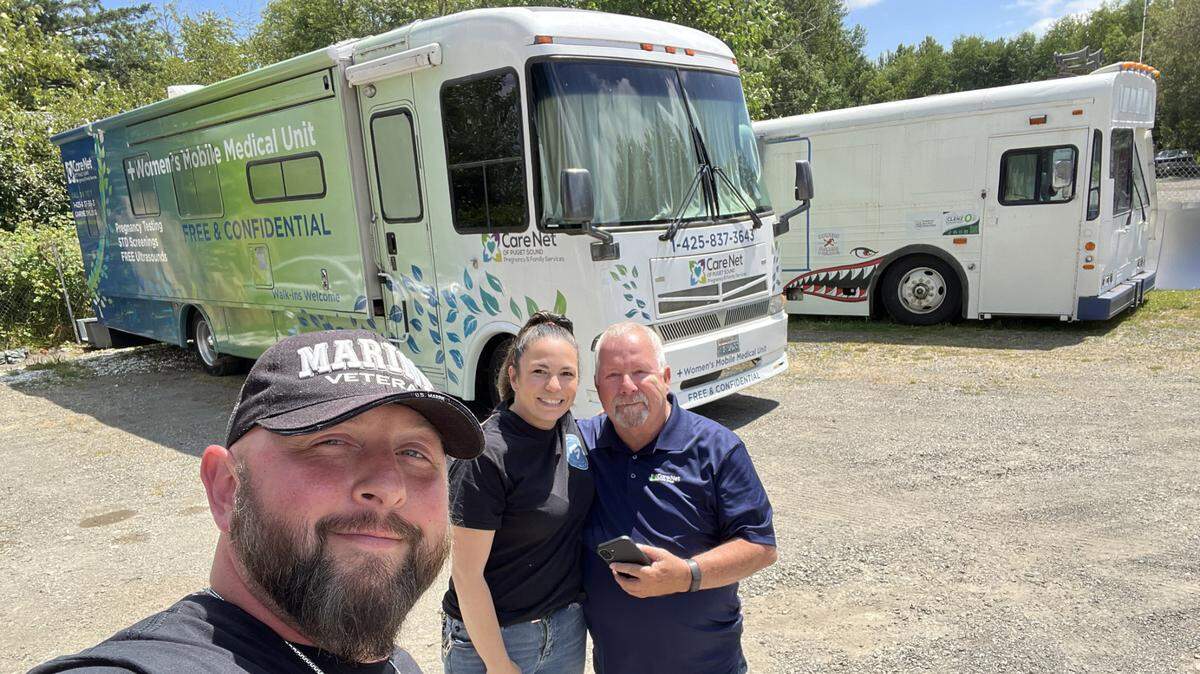
In Pierce County where Skoolie began, a similar campus has provided resources to people who are homeless and other community members in need, offering support through mobile showers, shelters, a food truck, thrift store and even a mobile medical unit donated by Care Net.
But Skoolie’s impact stretches beyond just showers and shelters. The organization also serves thousands of students through community partnerships with Tacoma Public Libraries and seven school districts county-wide.
“We’ve been doing haircuts for hope at Tacoma Public Libraries. Last year, we served thousands of people meals through our Skoolie Bags of Hope, which are assembled by our volunteers. We’re at about 5,000 meals this year so far,” Simmons said.
He said Skoolie’s goal is to foster dignity and hope.
“If you start to take away the resources that we we take for granted every day — a shower at home, the ability to go to a barber, or vehicles or a bus — and we look at someone who has their home in a tent on the side of the road, in the bushes, in the woods, in their car, those are the moments we don’t realize that that’s where we can really build dignity. We can restore hope,” he said.
But for Simmons and The Skoolie Foundation, investing in the community has not come easy. He said the process of building and maintaining the Pierce County campus alone cost $83,000 of his life savings last year.
“And of course, we looked for local grants, but it literally took $83,000 of my life savings last year to build this,” he said.
“I thought, just like everyone else did, I have a good idea. Let’s start a nonprofit. I thought people would follow behind and join the efforts, and it doesn’t happen. It’s not like people see a great idea and go, ‘here’s $100,000, how can we help?’ It was humble beginnings for us.”
How Skoolie got started
In 2020, Brandon Simmons made the switch from painting houses to fixing up used buses. Simmons was a house painter who ran his own company, but the challenges of the COVID pandemic hit led him to consider something new.
“It got to a point where I was painting houses, but I didn’t feel like I was doing a lot in life. You’re on the side of a house by yourself,” he said.
That’s when Simmons began converting retired school buses into RVs. To his surprise, clients poured in from across the state, searching for the perfect home on the go.
“I get a lot of clients that call me without me doing any advertising,” he said. “And it’s been a very interesting business because we work with people that are looking to retire and want to travel, so we help them facilitate that dream.”
Then, Simmons got the idea that he could use his skills to serve the community. Simmons said renovating buses for travelers helped him to see the similarities between minimalism and homelessness.
“[My clients], they wanted to minimize life, minimize payments, and minimize responsibilities and travel and enjoy life while they had time and available life left, and that, for me, was a big impact moment, because in a lot of ways, individuals experiencing homelessness learn to be minimalist,” he said. “They learn to use resources to maximize the situation in the minimal capability. A small amount of food, a little bit of water stretches a long way.”
In 2023, Simmons founded The Skoolie Foundation in Pierce County with the mission of addressing homelessness, hygiene and hunger by turning ‘skoolies’ into mobile shelters and resource hubs.
With help from Tacoma’s Metropolitan Development Council, St. Vincent de Paul and Living Access Support Alliance, Skoolie identified key insufficiencies in the area, including the need for things like hygiene supplies and health services.
The Metropolitan Development Council told The Olympian, “Through a comprehensive community needs assessment focused on Tacoma and Pierce County, MDC identified critical resource gaps impacting residents facing poverty and housing instability. Chief among these were limited access to behavioral health services — especially mental health and substance use disorder (SUD) treatment — as well as barriers to transportation, basic hygiene supplies, and ongoing outreach and case management.
“These essential services are often siloed, located far from where people live, or only available during limited weekday hours. This makes them especially inaccessible for vulnerable individuals throughout Pierce County who are navigating complex and unstable circumstances.”
However, maintaining Skoolie’s Pierce County campus, in addition to navigating insurance for volunteers, staff and people receiving services or shelter through Skoolie, comes at a high price.
“This campus currently is $10,000 a month in just real estate and another $4,200 a month in insurance. No, it’s not just the campus that’s a shower trailer, we have two box trucks, we have multiple buses on our insurance,” Simmons said.
The organization is funded through grants and community partnerships with local businesses. In Thurston County, Skoolie is introducing a unique model called the bus pass which offers donors discounts to local businesses with a monthly donation.
Despite the costs, Simmons said Skoolie intends to reach communities in need across the state with hopes of helping 100,000 people one day.
“So what we’re working towards is opening in Kitsap County, next South King County, next Spokane County, next we’re looking at being 14 counties with 20 locations,” he said.
“If Pierce County can do 40 showers a day, five days a week, it’s 200 showers. That means we’ll have clothed, showered and given hope to 200 people a week. Fifty-two weeks a year means we’ll have done it 10,000 times. Our vision is to give 10,000 meals, 10,000 showers and clothed 10,000 individuals per campus,” he said.
“And if we can open 10 campuses, that means 100,000 meals, 100,000 people that have been impacted by our organizations, and 100,000 people that have had showers. And our bottom statement for our foundation is providing basic necessities to people in need.”
This story was originally published July 15, 2025 at 5:00 AM.