
Nearly 28,000 areas of sidewalk damage were identified in Olympia. Are repairs coming?
Throughout the City of Olympia’s 226 linear miles of sidewalks are nearly 28,000 points of damage. Out of those, 1,458 were labeled as high severity damage, and another 4,305 as moderate severity damage, according to an assessment from engineering firm Cross Reiter.
Associate Planner Max DeJarnatt walked the city’s Planning Commission through the assessment on Aug. 4, as well as plans to tackle the worst areas.
DeJarnatt said the city’s code on sidewalks has gone relatively unchanged since 1909. It states that if the city’s Public Works director deems a sidewalk unfit or unsafe for public travel, the homeowner can be instructed to “clean, repair or renew such portion of sidewalk within a reasonable time.”
He said if the homeowner doesn’t make the repairs, the city can do so and assess the property for the cost. However, he said the city takes on more of a hybrid approach.
“Broken sidewalks are mostly addressed through city repairs with a smaller number fixed voluntarily by adjacent property owners,” DeJarnatt said. “We’re not typically involving code enforcement in these repairs, nor are we charging any of our repairs to the property owners.”
He said that approach comes with its own challenges, though. It’s slow and difficult to make significant progress on repairs. He said it’s also inequitable and reactionary, in that the city is addressing issues as they’re brought to staff’s attention, rather than taking a proactive and systematic approach.
The sidewalk damage assessment was completed in the summer of 2024 and was followed by 19 repair projects that cost $450,000 in capital funds. The streets crew also addressed 25 problem areas at the cost of $40,000 from the operations budget.
DeJarnatt said those repairs were done at the time to help estimate the true cost of the problem.
He said to have a dedicated sidewalk repair crew, rather than contract out for the work, the city would need to hire two more full-time staff members to the streets crew, and increase their materials budget by about $30,000. The total cost would be $270,000, and DeJarnatt said they estimate the city could replace 24 panels annually with that level of funding.
“Sidewalks link not just people to places, but link some of our more central city goals around climate policy, densification, equity and, of course, pedestrian accessibility,” he said. “Cities across Washington are also facing an increase in insurance claims, both in number and in the judgment award value.”
Where’s the worst damage?
DeJarnatt said the damage was sorted into different categories. The first category is panel uplifts, which represents 57% of the recorded damage. He said the engineers measured lifts of a half inch or more and put them into three severity brackets, with the most severe being those over an inch and a half.
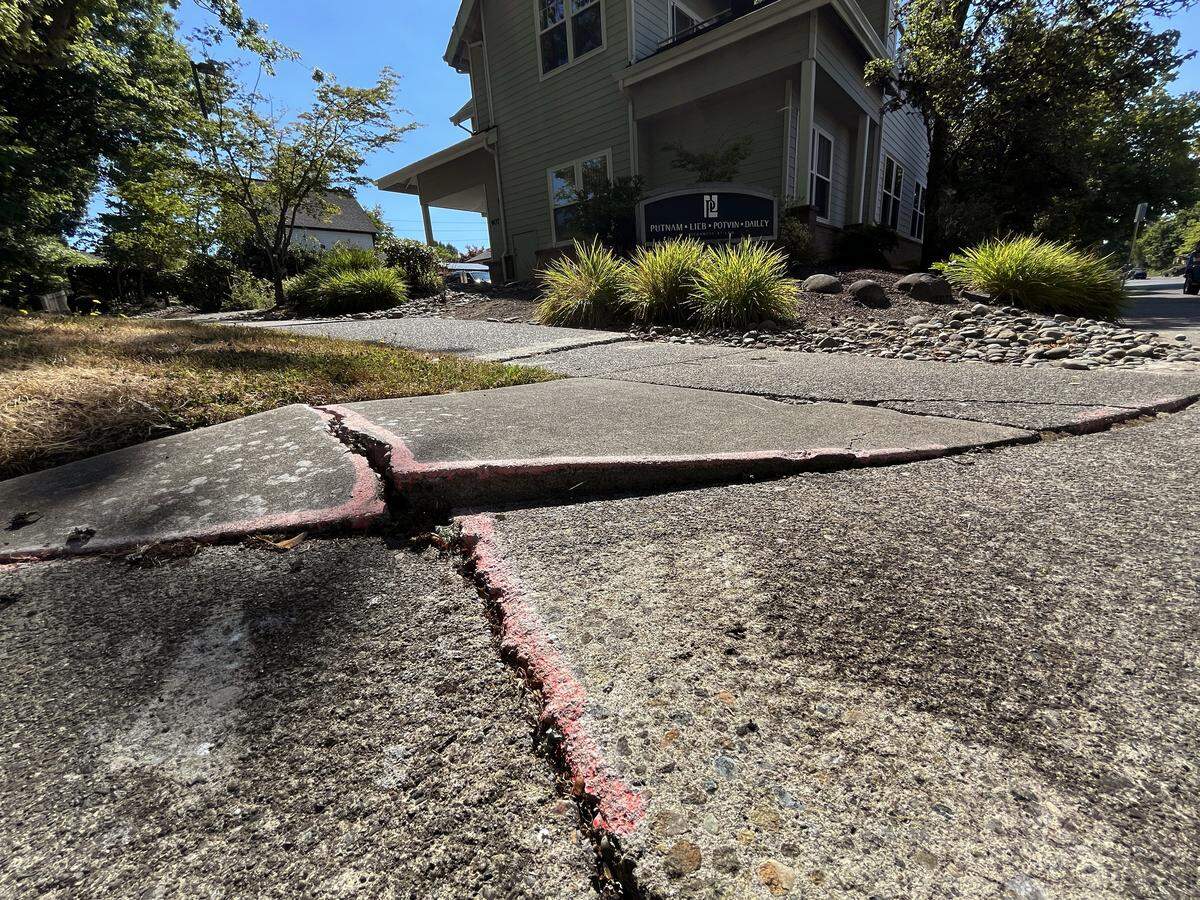
The next most common type, cracking or spalling, represents 38% of the recorded damage. DeJarnatt said the remaining defect types are far less common. They include underground utility vaults that breach the sidewalk surface over time, unpredictable ground shifting and more.
The consultants also recorded missing sidewalk panels, which DeJarnatt said are the result of trees displacing them, severe cracking, or frontage improvements.
He said trees play a central role in sidewalk damage.
“Though trees provide such value to our community in terms of heat reduction, carbon sequestration, fresh air habitat, traffic calming and overall pleasantness, they are clearly also creating barriers to accessibility and must be managed,” DeJarnatt said.
He said tree roots contribute to nearly 70% of the moderate to high severity uplifts.
DeJarnatt said the research separated street trees from private trees that are within the parcel adjacent to the sidewalk. He said they found that street trees account for two-thirds of the tree-related, high severity uplifts.
“Relatively young trees in newer developments are causing problems, presenting a puzzle for our development standards,” he said. “If we require trees, how do we do it so that a new home buyer or the city, should it choose to take this on, won’t be faced with such costly repairs so soon?”
According to the assessment, the most damaged sidewalks are generally located in downtown Olympia, close-in portions of the east side, South Capitol, Southwest Olympia, Northwest Olympia, and the arterials and major collectors bordering the Capital Mall area.
Specific areas
- Downtown Olympia and adjacent portions of the east side, particularly along the State Avenue Northeast, Fourth Avenue East, and Legion Way corridors (especially between Plum Street and Eastside Street), as well as along the Capitol Way South and Central Street Southeast corridors.
- South Capitol, where sidewalk damage is relatively well-distributed around the neighborhood/district.
- Southwest Olympia between Fifth Avenue Southwest and Ninth Avenue Southwest, especially along Decatur Street Southwest.
- Northwest Olympia where Garfield Avenue intersects Sherman and Plymouth streets.
- Discrete stretches of Harrison Avenue, Cooper Point Road, and Black Lake Boulevard near Capital Mall.
Residential subdivisions
- The north phase of the Wellington West development in Southwest Olympia (Fern Street SW, Division Street SW, and 15th Avenue SW).
- Portions of Maringo Road SE, Carlyon Ave SE, and Governor Stevens Avenue SE in the Governor Stevens area.
- The Whisper Ridge development west of Hoffman Road SE near 30th Avenue SE (Bittersweet Street SE and 30th Avenue SE).
- The Marie’s Vineyard development northeast of Margaret McKenny Park, near the intersection of 18th Avenue SE and Hoffman Road SE (Craig Road SE) and the nearby Redwood Estates development north of 18th Avenue SE (Redwood Place SE).
- The Covey Street SE and 43rd Avenue SW area east of Ward Lake and west of Boulevard Road SE.
- The Amherst development west of Lilly Road NE along Surrey Drive NE and Newport Street NE.
- The area around Harbor View Drive NW at the north terminus of West Bay Drive NW.
- The Bay Hill development north of Harrison Ave NW and east of Kaiser Road NW.
Are repairs coming?
DeJarnatt said if the city takes all severity level one uplifts and cracking, all utility vault defects and half of the severity level two uplifts and cracking, there’d be 2,452 panel replacements needed. He said that would cost between $36 million and $76 million, depending on whether city crews do the work or a contractor does.
“If we use the city crews approach, we can hope to fix those panels in 102 years,” he said. “Using the contractor, that timeline is extended to 129 (years).”
DeJarnatt said the city has a number of options for tackling this work. The city could enforce the existing code that’s been unchanged for a century, which he said would decentralize the burden and distribute it across the community, as opposed to putting the entire burden on the local government, as done with street surfaces.
However, DeJarnatt said given the volume of issues, this would take a significant increase in code enforcement capacity and more work and cost for property owners.
“The resulting process, hiring a contractor, obtaining permits, scheduling inspections, is expensive and often intimidating,” he said. “This approach can also have a disproportionate impact. Some property owners are more capable of handling this than others, financially and otherwise.”
He said the city could also choose to take on all repairs, not just those along the street tree corridors. He said this shifts the burden from the property owners to the city as a whole, representing a larger expense for the capital and operating budgets, and more staff time.
DeJarnatt also reviewed a number of approaches other cities around the country have taken. He said in at least two California cities, sidewalk repairs are woven into property sales. He said sidewalks have to be inspected and, if needed, repaired before a title may be transferred.
“This has the benefit of triggering repairs right when a property owner’s cash is most available,” he said.
He said another related approach, which has yet to take action anywhere, is to work with banks to allow property owners to fix their sidewalks but pay once they sell their property. These are called deferred assessment accounts, which DeJarnatt said are basically low-interest loans exempt from federal income taxes, as they are for public infrastructure.
DeJarnatt said this approach would accelerate sidewalk repairs, but defer the impact to owners until they sell. He said this year, Denver began funding a voter-approved Denver Deserves Sidewalks program with a mostly flat fee of $150 paid annually by all property owners.
“Using this strategy, they hope to address their sidewalk woes within a decade,” he said.
DeJarnatt said he plans to allow the Planning Commission to sit with this information and then discuss the options for how to move forward with repairs at another meeting later this year.
This story was originally published August 13, 2025 at 5:00 AM.
.jpg)