
What’s the latest on ferry service in Olympia? Port commissioners hear an update
Five months ago the Port of Olympia hosted an electric fast ferry demonstration on Budd Inlet, generating plenty of buzz about the possibility of that service transporting passengers to other Puget Sound destinations, including those close to Seattle-Tacoma International Airport.
This past week, port commissioners learned more about what next steps might look like.
The five-member body heard from Peter Philips, the founder and CEO of Colibri NW, a business the port is working with as it explores ferry service as well as the possibility of ferry manufacturing.
To get to an eventual pilot program with a ferry operator, the port first needs to study the demand, feasibility and operations needed, Philips said.
“So what a demand study will tell us is whether people want it and how much they’ll pay for it,” he told the commission. “And those are two important questions: people wanting it, and whether those people are willing to pay enough money to make it financially sustainable.
“Then, the recommendation would be to engage in a pilot program. And then the pilot program would be an operator engaged in running a pilot to test how it actually works.”
In May, the public was able to watch a 12-person electric hydrofoil ferry manufactured by a business called Artemis based in Belfast, Northern Ireland zip around West Bay.
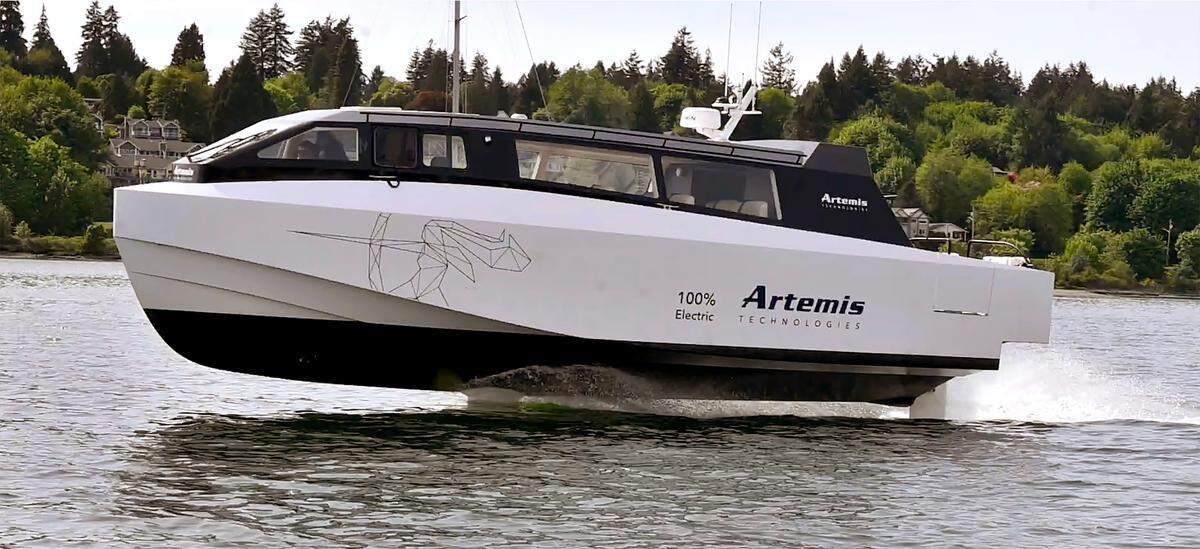
Although that particular design can accommodate more passengers, it is too small to get to the airport — the Des Moines area — on a single charge, Philips said.
“So the boats that are proposed for this are larger boats that would be 150 passengers and about 24 meters, which is about 70 feet long, still small enough to call at a recreational marina,” he said.
Philips also pitched the idea of the green manufacturing of ferries at the port.
“The reason I believe there’s an opportunity in the port to build these boats is that the shipyard capacity in Puget Sound right now is already constrained,” he said. “The current shipyards are full of work with traditional aluminum boats with traditional pipelines, and there’s no incentive for the shipyards that are currently here to go out and begin to build an expertise in a technology with which they’re not familiar.”
After Philips spoke, Commissioner Amy Evans Harding asked a series of questions about the potential ferry service, including impacts on marine mammals in Puget Sound.
“The Europeans are very, very cognizant of marine mammal protections,” said Philips, adding that there is a challenge with hydrofoils because they make little noise and don’t create much of a wake.
“They have technologies that they use to push out whatever is needed. I don’t know if it’s a vibration or noise, but I could get those studies,” he said.
Mike Reid, the port’s community and economic development director, wanted to make clear that the ferry idea didn’t suddenly emerge the past few months. It’s included in Vision 2050, the port’s strategic guiding document, which the commission adopted in 2019, he said.
“The first one that I’ll reference is action item number 26: continue to track state-led ferry service studies and evaluate the feasibility of the port’s potential role as the southern most passenger terminal in the South Puget Sound.
“And action item number 27: evaluate the feasibility of establishing a ‘mosquito fleet’ water taxi system that provides limited scale transportation services for commuters throughout the South Puget Sound, south of Tacoma,” Reid said.
What’s a mosquito fleet?
That’s a reference to a service that existed on Puget Sound waters between 1850 and 1950 in which independent boat owners transported people and goods throughout the area.
“There was no other way to get around,” Philips said. “You got around over the water. There were no roads. So everything that happened on Puget Sound, everything happened on these little boats that zipped around, thus being known as the mosquito fleet.”