Fire chief, residents oppose contentious battery energy site in Thurston County
About 15 residents, including a Thurston County fire chief, testified anew or reiterated their opposition on Tuesday to a battery energy storage system that has been proposed in south Thurston County.
A New York-based company called Convergent Energy and Power wants to bring a 5.4 megawatt lithium-ion battery site to an 11-acre parcel in the 7500 block of 183rd Avenue Southwest in Rochester. The battery energy storage system, or BESS, is proposed to occupy about 16,000 square feet of that overall site.
In order to make the BESS a reality, Convergent needs a special use permit, but Thurston County hearings examiner Sharon Rice denied that permit in November following a public hearing in October.
Among her concerns: “Given the fire risk associated with lithium-ion battery installations, the concerns raised by the Fire Chief and residents regarding air quality, groundwater contamination, and risk of wildfire were reasonable and credible,” she wrote in November.
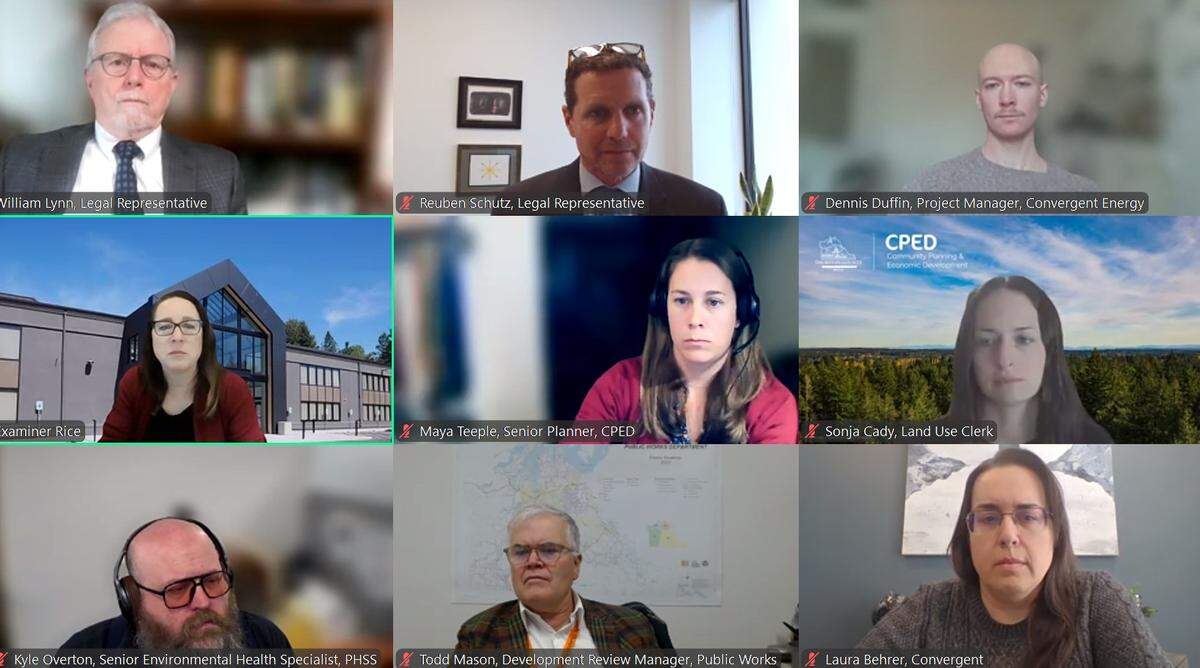
Convergent then sought a request for reconsideration, which was granted by the county and resulted in Tuesday’s four-hour hearing. This time the hearing was limited to three areas: life safety, groundwater and development consistency with the rural character of the area.
Rice heard from county representatives, Convergent officials and area residents during the hearing. Although about 15 people spoke during the hearing, the county also received 55 written comments, 54 of them opposed to the BESS proposal, said Maya Teeple, a county senior planner.
How would it work?
The proposed BESS would operate as a four-hour system.
“What that means is it has the capacity to discharge approximately five to six megawatts (of power) for four hours before needing to recharge,” said Convergent project manager Dennis Duffin during the hearing.
“How the battery works is it pulls from the (power) grid at times when there’s a surplus, which means that there’s relatively more unencumbered power available than is being demanded,” he said. “So it’ll pull that power, it’ll charge the battery, and then it will dispatch at times when demand for power exceeds the supply on the grid.”
Convergent is here because they successfully responded to a request for proposals solicited by utility Puget Sound Energy, he said. PSE operates a substation across from the proposed BESS site, said senior planner Teeple.
If the company is able to secure the special use permit, construction would begin in spring 2027 for a fall 2027 opening, Duffin said.
“The project’s life cycle is 20 years, after which we will decommission the site and return it to its previous state,” he said.
What value does PSE see in a BESS? Spokeswoman Melanie Coon shared the following in an email.
“Battery energy storage systems can be important to maintain grid reliability when demand surges during summer heat waves and cold snaps,” she wrote. “They help to accelerate the transition to clean energy and allow us to get the most value from wind and solar energy if we can store extra power produced by those resources and then use it when the wind isn’t blowing and the sun isn’t shining.”
Fire concerns
Much of Tuesday’s conversation focused on fire risks, including about a Convergent BESS site in upstate New York that was damaged by fire in December.
Convergent official Laura Beher, the company’s senior director of environmental health and safety, defended the technology and the response to that blaze.
“The thermal event at Warwick, New York, was resolved with no application of water and no firefighting activities,” she said. “My team was on the scene within about an hour and was able to relieve the local fire and rescue. We continued fire watch for the next few days as a precaution, but temperatures reduced rapidly within the first five to six hours; we didn’t have smoke.
“After a couple of hours, we had Orange County hazmat actively monitoring air quality concerns, and the outcomes of that with the controls in place, we had no readings that approached anywhere near exposure level limits for gasses, we had no propagation (fire spread) outside of the principal container.
“The firewalls between containers, firewalls between (battery) cells, those controls worked as intended,” she added.
Hearings examiner Rice asked whether she viewed that fire as a failure.
“Within the context of that event, all the choices that our team made, the coordination with fire and rescue and the consequences, the results were managed to the best possible end where we did not have any need to evacuate,” Beher said.
Despite those comments, West Thurston Regional Fire Authority Chief Nathan Drake said he was still opposed to the proposal. West Thurston serves the Rochester area.
“This is a new thing for myself and for our communities, and although I respect Ms. Beher and her expertise on these type of items, this is something that for me as the fire chief of West Thurston, there is a lot of risk and a lot of unknowns, and the same (goes) with our community, so that is just something that we do not want to take on as a fire department,” he said. “And we do have a lot of questions and a lot of concerns to bring up to the public. So for these reasons, I respectfully urge the hearing examiner to recommend denial of this special use permit.”
Because of her workload, Rice asked for 20 business days to issue her ruling on the special use permit. That is expected to happen by March 6, she said.
New proposal
Shortly after Tuesday’s public hearing, the county announced about 3 p.m. that it has received a new and separate notice of land use application for the Centralia BESS project near the Thurston County town of Bucoda at 20337 Tono Road SE.
“The applicant proposed project is a BESS that will be capable of delivering 127 megawatts of electrical energy, with a total storage capacity of 508 megawatt hours,” the county information reads.
This proposal, too, appears to have a connection to PSE, according to the project description.
“The development area for these features, collectively referred to as the ‘BESS site,’ will be on the northern half of the parcel, which is an approximately 84-acre parcel located immediately adjacent to a Puget Sound Energy transmission line into which the project will deliver energy,” the description reads.
The comment period for this proposal ends at 4 p.m. Feb. 23. To comment, go to the county’s project comments page.
This story was originally published February 4, 2026 at 12:22 PM.