
‘No Kings’ protests against Trump planned in Thurston County. Here’s when, where
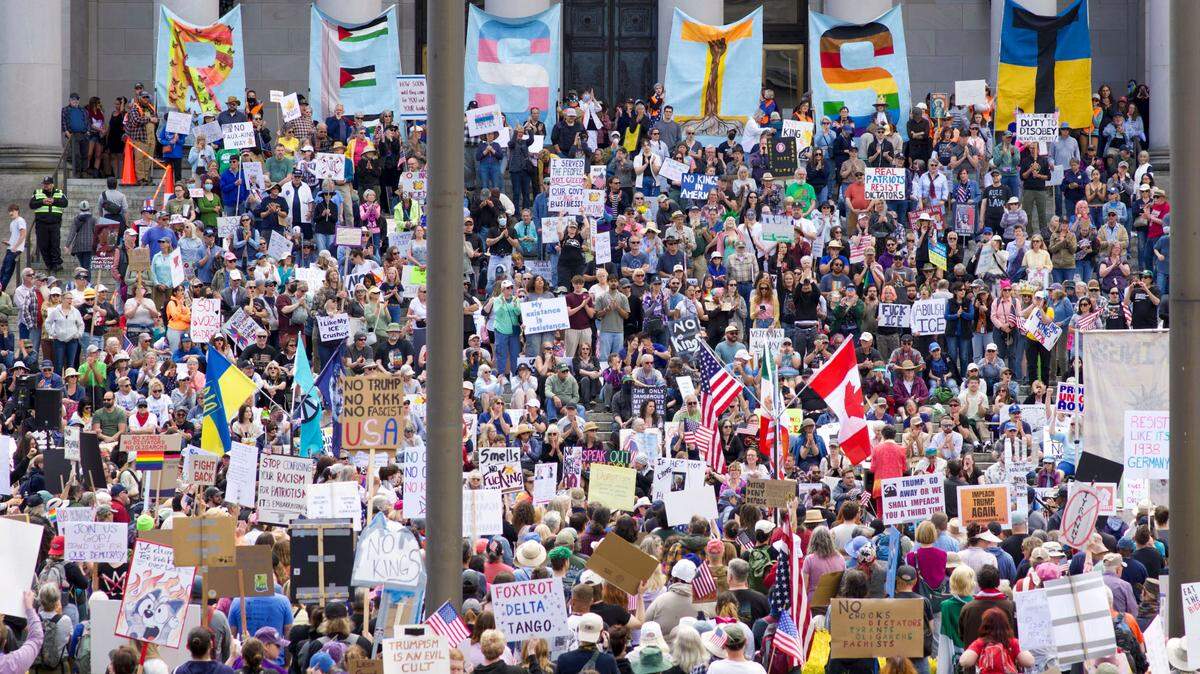
Protestors across the nation — including Thurston County residents — are preparing to take part in more “No Kings Day” demonstrations opposing President Donald Trump and his administration’s policies.
“As President Trump escalates his attempts to control us, it is on us, the people, to show that we will fight to protect one another and our country,” No Kings organizers said. “If he believes we will roll over and allow him to take our freedoms, he is mistaken.”
The goal of these protests is to unite millions of Americans in peaceful protests to “overcome this repression.”
Here’s what to know:
What is No Kings Day?
Organizers describe No Kings Day as a “commitment to nonviolent action.”
Several political organizations, including Americans for Tax Fairness and Amnesty International, are joining forces for nationwide protests.
“Each time we show up, we disrupt President Trump’s attempts to rule through repression and remind the country, and the world, that people power is our path to a truly free America,” No Kings organizers said.
In 2025, millions of people across the country participated in what organizers called “morally grounded, nonviolent direct actions by any movement in U.S. history,” with events held in June and October.
“We expect all participants to seek to de-escalate any potential confrontation with those who disagree with our values and to act lawfully at these events,” organizers said.
When and where are No Kings Protests in Thurston County?
Three No Kings demonstration are planned in Thurston County for Saturday, March 28th.
Protestors will gather at 11:30 a.m. at Percival Landing Park in Olympia, and march to the Washington State Capitol building by 3 p.m.
In Shelton, protestors will gather at Kneeland Park at 11 a.m. and stand on the sidewalk alongside the park until 1 p.m.
In Yelm, demonstrators will meet at East Yelm Avenue and North First Street at noon. The protest will conclude at 2 p.m.
“We expect all participants to seek to de-escalate any potential confrontation with those who disagree with our values and to act lawfully at these events,” organizers said.
What are my rights as a protester in Washington?
The American Civil Liberties Union of Washington has guidelines for protestors.
Your right to protest in strongest in so-called “traditional public forums” such as streets, sidewalks and parks, The ACLU said.
You also “likely” have the right to speak out in front of government buildings, as long as you are not blocking access to that building or interfering with its purposes, the nonprofit organization said.
“Private property owners can set rules for speech on their property,” the ACLU said, adding that the government can’t restrict your speech if it’s “taking place on your own property or with the consent of the property owner.”
Are counterprotests allowed?
According to the ACLU, people who show up to protest a protest also have free speech rights.
“Police may not treat protesters and counterprotesters differently based on their messages,” the organization said.
Police can to keep opposing groups apart to prevent conflict, but both sides have the right to be within sight and hearing distance of each other.
When can police interfere with protests?
When protesters fail to comply with legal restrictions, such as evoking violence, law enforcement can intervene, the ACLU said.
“Civil disobedience is a public, nonviolent, conscientious yet political act contrary to law, usually aimed at bringing about a change of the law or government policy,” the U.S. Department of Justice said.
However, civil disobedience is not protected under the U.S. Constitution, according to Eastern Washington University.
An act of civil disobedience includes sitting on a public road to block traffic. It can be a successful tool in non-violent action, experts say.
What can I do if my rights were violated?
Here’s what the ACLU says to do if you feel your rights have been violated during a protest:
- Write down everything you can remember, including officers’ badge numbers and what agency they work for.
- Get contact information from any witnesses.
- Take pictures.
“Once you have all of this information, you can file a written complaint with the agency’s internal affairs division or civilian complaint board,” the ACLU said.