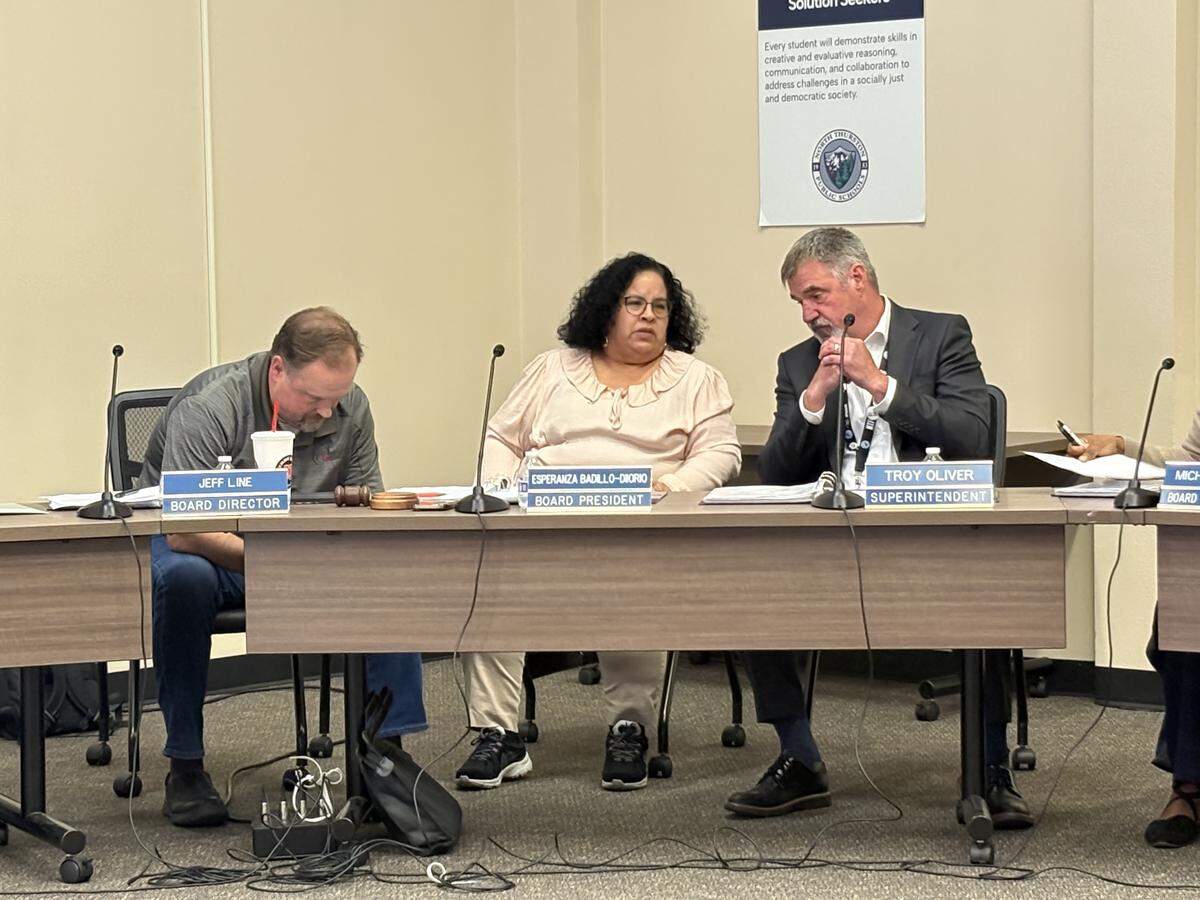
Thurston Co. school board struggles with decision on layoffs, finally votes 3-2
The five-member North Thurston Public Schools board approved a reduction in force on Thursday to partially address a budget deficit, but not before they deliberated, took a break and deadlocked on a 2-2 vote with one abstention.
After more discussion, board member Michelle Gipson, who had previously abstained, voted in favor of the reduction, which will cut the number of mental health specialists in the district to three from 11. It also eliminates two physical therapist positions.
“I am apprehensive,” she said about the cuts, “but I know that we have to move to balance this budget.”
Board members Gretchen Maliska and Sarah Tracy also voted in favor of the reduction in force while board members Jeff Line and Esperanza Badillo-Diiorio voted against it.
“I think while this is extremely uncomfortable, and it’s tragic when districts have to do this, I do think that North Thurston has been extremely proactive with their finances and strategic historically; this is a complicated process,” Maliska said. “I can see the thoughtfulness inside the process. I know that the district understands the impact of this.”
At issue is a $10 million budget deficit created by lower student enrollment and higher expenses. The district had 178 fewer students for the 2025-26 school year and forecasts 117 fewer students for the 2026-27 school year, according to updated information shared during the meeting.
The district, the largest in the county, currently has about 14,600 students.
The reduction in force represents $1.5 million in savings. The rest is coming from other areas, such as attrition, non-staff cuts and 21 non-renewed staff. Under state law, certificated staff in their first three years with the district are considered provisional, and their contract may not be renewed for the following year, according to district information.
“We have committed to posting positions internally for a period of time to give first consideration for non-renewed staff to be hired back,” said district spokeswoman Amy Blondin in an email prior to the meeting.
Mental health services
The school board was faced with the same decision on April 28, but decided to postpone their vote because they wanted to learn more about potential mental health partnerships for the district.
Superintendent Troy Oliver explained one of those in detail Thursday, saying the district is set to work with Behavioral Health Resources (BHR). It would require a memorandum of understanding between the two parties, but once approved it would operate at no cost to the district and could begin in the fall, he told the board.
The district’s obligation would be to provide space for the therapists to work in the schools, Oliver said.
“To give you a little bit more detail, we would need to identify high priority schools, typically all schools with a high free-and-reduced lunch population,” he said. “They would likely have a lot of students on Apple Health insurance (Medicaid), because BHR can only work with Medicaid-eligible students.”
He also reminded the board about existing services for students.
“We do have a robust school counseling program in all of our schools,” he said. “We have five counselors in every one of our high schools. We have two counselors in (most) of our middle schools, and then we have one counselor in every one of our 13 elementary schools to support kids.”
The board asked questions about how this new arrangement would apply to undocumented students or those without insurance.
“Students who do not have Apple Health or other insurance, our first step would be to work with the families to get them qualified,” Oliver said.
Spokeswoman Blondin, who previously worked for the state’s Health Care Authority, said after Thursday’s meeting that children do not need to be documented in order to receive Apple Health.
The ‘no’ votes
Board President Badillo-Diiorio said she had lingering concerns about what the lack of mental health services might mean for a student largely on their own.
“I think that’s what I’m worried about most, is there are a lot of students in our district that do not have support from their family at home,” she said.
Board member Line said he was torn because the board had only recently learned about some additional funds that might help the reduction-in-force situation.
“It was a quick list of about $900,000 that would potentially solve part of the problem,” he said. “... I think it’s tough to be asked to decide this, or be a deciding vote, and then not have all the answers until late. ... There are people that are losing their jobs, there are kids that are losing support.”
Superintendent Oliver defended the work of his cabinet.
“The assessment of my team as we went through all of this for the last four or five months is that what we put in front of you fits the criteria in terms of funding and strategic goals,” he said.
‘This has to happen.’
After the meeting a woman, who declined to identify herself, said she was one of the mental health specialists about to lose her job.
“What’s next? I’m not worried about that for me right now. I’m worried about what’s next for the kids on my caseload and who they go to,” she said, adding that she worked with about 80 children, some individually and some in groups.
“I understand there’s a dollars and cents piece to this conversation,” she added. “I understand that deeply as a community member, as a taxpayer, as a parent of kids in public schools.”
Still, she cast doubt on the district’s mental health plan.
“They don’t have a plan that is equitable for kids,” she said.
North Thurston Education Association President Ray Nelson also attended the meeting.
“As far as I understand unless there’s money elsewhere, this has to happen,” he said about the reduction in force. “I mean we’re still months from the beginning of the school year, so could other things happen? It’s a possibility, but they made the decision, and we will continue to work with the staff to try to provide them a soft landing, if we can.”