
Nisqually Middle School math teacher named ESD 113 Teacher of the Year
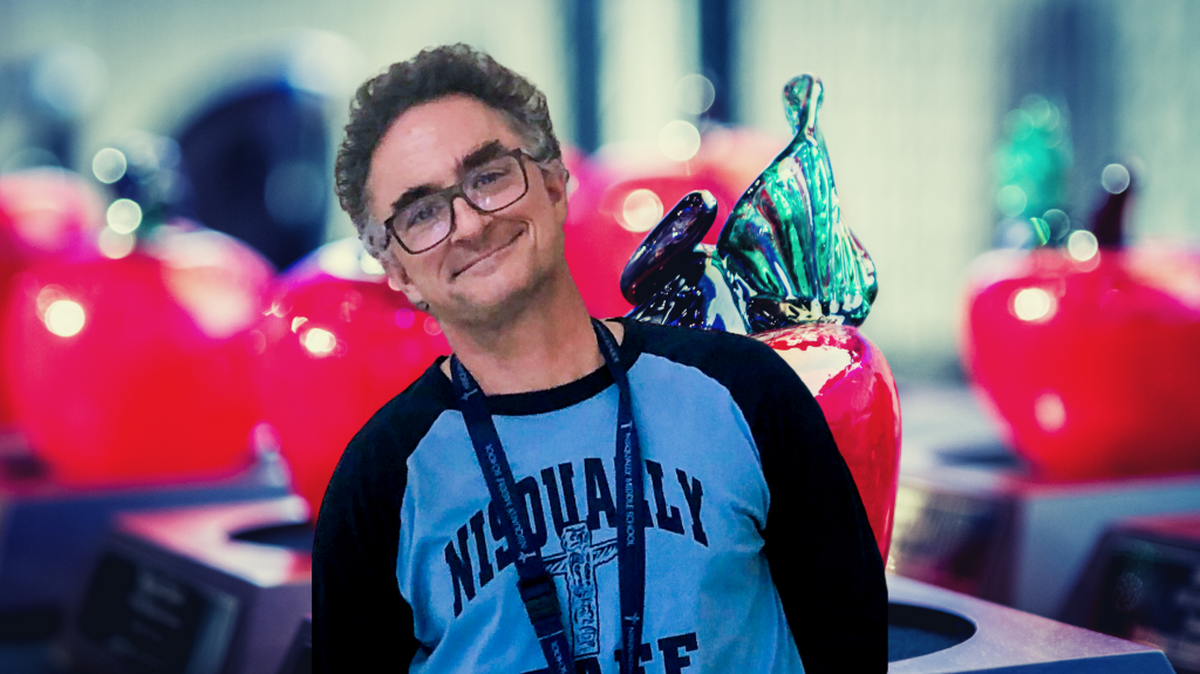
David Buitenveld, a former tech entrepreneur turned math teacher at Nisqually Middle School in the North Thurston Public Schools, has been named Teacher of the Year by Capitol Region Educational Service District 113.
Buitenveld was recognized for keeping his students engaged and imparting to them that failure is not only OK, but part of the process of becoming better. ESD 113 covers school districts in Thurston, Mason, Lewis, Grays Harbor and Pacific counties.
Before becoming a teacher, Buitenveld told The Olympian he started a software company with friends in Olympia. After a while, he felt “something wasn’t working.” He wanted to do something that was more meaningful. So he began signing up for various classes, bouncing from cooking school, to architecture school, to learning horticulture. None of those fields resonated with him as future career.
Then, he was asked to help tutor his niece in math.
“I really enjoyed doing math with another person — a learner — and getting to know this niece, who at the time I didn’t know all that well,” Buitenveld said. He soon began tutoring other children in math. One of the students was the daughter of a math teacher who asked Buitenveld, “Have you ever thought about being a math teacher?”
He hadn’t up until that moment. He went back to school at The Evergreen State College, getting a master’s degree in teaching.
Buitenveld volunteered at high schools and elementary schools in Thurston County and noticed a trend: Elementary students were confident in their ability to understand and master math, but the high school students had largely given up on the subject entirely. Buitenveld found his way to middle school where the transition from enjoying math to hating it seemed to occur.
At Nisqually Middle School, Buitenveld began his crusade of keeping kids confident in their mathematical abilities. How does he do it? By failing in front of them over and over.
“I have no fear of totally screwing up in front of students,” he said. “That’s just how we learn stuff, we have to try and it doesn’t always work. You can fail and decide that means you’re bad at something or you can fail and say ‘Well that’s just a step at being a little bit better at something.’”
Teachers, school administrators and ESD 113 Superintendent Dana Anderson noticed Buitenveld’s dynamic teaching style.
“He brought perspective to his math class and real-world application,” Anderson said. “He incorporated finance, personal finance and household budgeting into his middle school curriculum late in the spring” as classes shifted online and students began learning from home.
His efforts to help students extended beyond his middle school classroom too, Anderson told The Olympian. “One of the things that really stood out, too, was how he has established relationships with the feeder elementary schools. He goes down to meet with students to assist them with the transition from elementary to middle school and address some of their concerns and anxieties.”
As school transitioned from in class to online, Buitenveld maintained his work at both the middle and elementary schools, conducting a bit of an experiment along the way. He held daily optional Zoom meetings for his middle school students, and daily mandatory Zoom meetings with fifth graders, so students could ask for help with whatever they were working on.
“Neither of those ended up being particularly optimal,” he said, explaining that trying to read student engagement in a Zoom’s mosaic of faces was “really difficult,” and it’s still something he’s trying to figure out.
He’s spending the summer thinking about how he will teach students to be independent learners when classes start back up in the fall.
“There’s a bunch of thing’s that happen in person that are no longer present,” Buitenveld explained. Gone is the structure of the six-period day and the hourly bells telling students it’s time to move onto the next subject. Gone are the chairs with built in surfaces. They’ve been replaced by parents trying keep their kids’ schedule and students hunching over and staring into Chromebooks.
“I can see, you’re going to get a headache in 20 minutes and in 5 years, you’re going to need back therapy,” Buitninveld said.
To try to fix these problems, Buitenveld says he’s going to teach kids more than just math. He want’s them to learn how they should be sitting and what healthy posture would be, how they should be keeping track of time and planning their days.
He wants his students to leave the Zoom knowing not just how to divide fractions, but “what are all the things that need to be in place for me to successfully learn something.”