
Olympia schools could be shuttered as district looks to cut budget and consolidate
CORRECTION: Superintendent Patrick Murphy is scheduled to speak about the budget during the next school board meeting Nov. 9. The date was incorrect in a previous version of this story.
The Olympia School District is looking at closing schools to avoid a budget deficit in the 2024-25 year. But when a decision will be made on possible closure scenarios is up in the air, as a committee studying the issue has failed to make a recommendation.
Olympia School District board president Darcy Huffman had hoped the current board could make the decision before new members, elected Nov. 7, take office in January. But members of the school efficiency review committee said a decision needs more time, especially since school administrators don’t yet know how much must be cut from the 2024-25 school budget.
A consultant working with the committee said the most-preferred scenario being considered involves converting Olympia middle schools to seventh and eighth grade only (they now serve sixth graders as well), and closing Jefferson Middle School on the west side, Reeves Middle School in northeast Olympia and LP Brown Elementary School in northwest Olympia. But other scenarios also exist that involve closing other schools or changing school boundaries.
The consolidation process
School consolidation, which was discussed at a school board meeting Thursday evening, has been under consideration for more than a year now, after the district faced an $18 million deficit for the 2023-34 year that was lowered after layoffs were made and class sizes grew across Olympia. In March, Huffman said consolidation would likely be on the table for the 2024-25 school year.
It’s unclear exactly how much of a budget deficit the district is likely to face in the next school year, but the preferred scenario would save the district between $3 million and $5 million. Superintendent Patrick Murphy is scheduled to speak about the budget during the next school board meeting Nov. 9.
The school efficiency review committee was created earlier this year, consisting of approximately 30 voting members including students, staff and community members. Their first meeting was Sept. 25, where they met Shannon Bingham, a consultant with Western Demographics Inc., who was hired to lead the “right sizing” effort.
Bingham introduced the committee to a few options they could work with: school consolidation, boundary optimization and fractional staffing. In October, the group examined GIS data analyzing school boundaries and student density. Bingham pointed out that some middle schools have just two schools feeding into them, while another has four.
Bingham’s research found that if an elementary or middle school was closed, there would be about $1 million in annual savings. If three were closed, that would be $3 million annually. That would include cutting staff.
“I think the majority opinion here is that we’ll see attempts to identify the least harmful course of action,” Bingham said Thursday evening. “But it concedes that these changes will have a significant and lasting effect on the district. And the nature of some of what we’re proposing is very drastic.”
Top scenarios
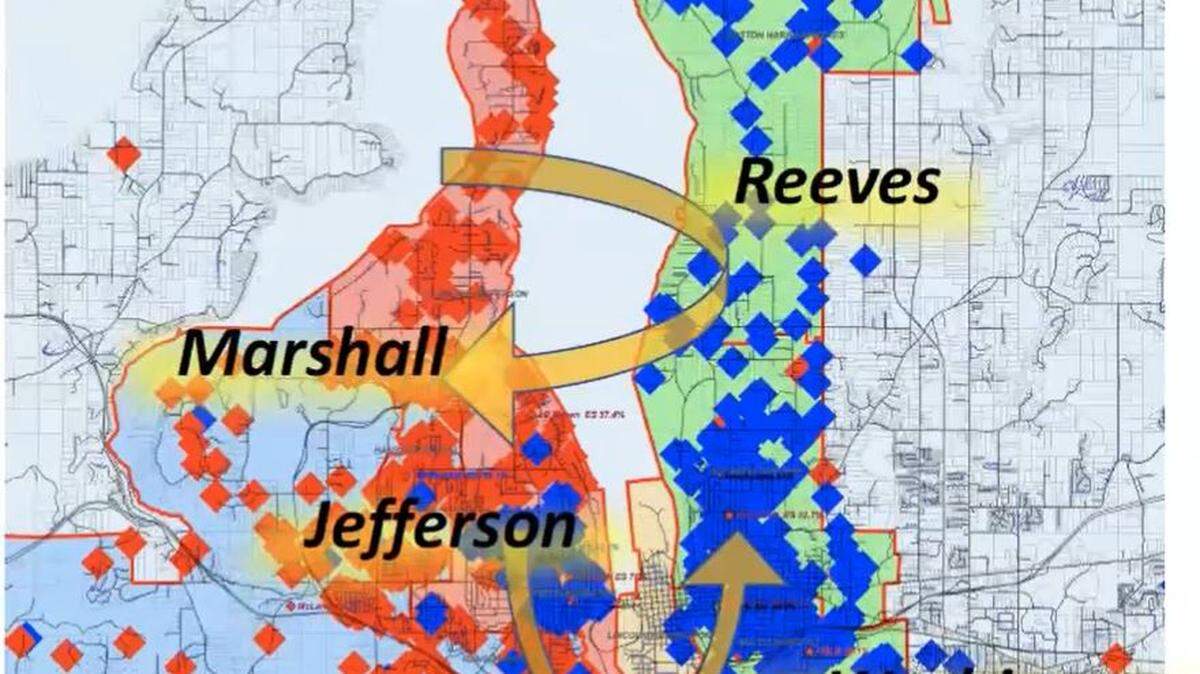
The scenario the committee focused on is converting Thurgood Marshall and Washington middle schools to seventh and eighth grade only, and closing the district’s other two middle schools, Jefferson and Reeves. Marshall and Washington would be significantly larger than they are now, Bingham said.
L.P. Brown Elementary School, which now feeds into Jefferson, would close, too, because its students could easily attend Hansen Elementary, which already feeds into Marshall. The remainder of the elementary schools in the district would operate as pre-kindergarten through sixth-grade schools.
The second-most preferred scenario was a standard consolidation, which would close Boston Harbor, L.P. Brown and McKenny elementary schools as well as Jefferson Middle School. It would result in the Jefferson area being split between Marshall on the west side and Reeves on the east side.
When questioned why Boston Harbor was on the list when it doesn’t have any neighboring schools for students to easily feed into, Bingham said the school didn’t rank well on size or other factors, including pedestrian function, with the school being in a rural area. It was built to serve a specific neighborhood, which has changed in size since the school was first established.
An incomplete puzzle
Ben Higgins is a community member who represents Boston Harbor on the review committee. He said Thursday evening that he has two children in the district, one at Boston Harbor and another at Reeves. He said working through the school efficiency process has felt like working on a puzzle with an undetermined number of pieces.
“The thing we knew for sure is that there were missing pieces, some big pieces that the community asked for and did not receive, or did not receive in enough time to figure out exactly how to place them into the larger picture,” Higgins said. “Because of this I can’t in good faith tell you that I think we fulfilled our responsibilities as specified by the charter, which was to make recommendations to achieve financial stability without reducing programs.”
Higgins said the committee was not given adequate information to successfully demonstrate how the neighborhood school closures would not diminish services. He said the majority of the committee supported boundary optimization over consolidation.
Sean Shaughnessy, principal at L.P. Brown Elementary, spoke Thursday as well, agreeing with Higgins and saying one of the biggest pieces missing from the puzzle is knowing exactly how much the district is trying to save.
“Like you’ve heard tonight, these are not recommendations that we’re presenting to you from a committee,” he said.
Shaughnessy said the committee was all over the board on its recommendations and that a consensus was never entirely reached. He asked what the true purpose of the entire process was.
“I think it’s important that we clearly identify our purpose in this mission,” he said. “Are we trying to save money? Or are we trying to change our identity? The Olympia School District is built on small schools and optional programs, with lots of choices for people to choose in our capital city.”
Shaughnessy said the consolidation effort likely isn’t going to solve long-term financial issues, which require changing the district’s fiscal policies.
Timeline for a decision
A student representative from Avanti High School asked if there is a deadline to make a decision on consolidation, and if there were any consequences for taking more time to review the possible outcomes.
Huffman said the board will start to work on its 2024-2025 budget within the next few months. She said she felt the current board should make the final decision on consolidation since its members called for the committee to do this work in the first place. New members will be elected Nov. 7.
Huffman wants there to be a vote by the end of November, but she’s unsure if it will happen.
Board member Maria Flores said the board doesn’t have to make a decision by the end of the month. She said she doesn’t want the board to take too long to do something, but a matter of weeks simply isn’t enough. She said the 2024-2025 budget isn’t finalized until nearly August of next year, so they have some time to study the scenarios more.
This story was originally published November 4, 2023 at 5:00 AM.
.jpg)