The London borough of Westminster – known for its famous abbey and the seat of Britain’s parliament and monarchy – is one of the city’s richest. But about one mile south of Buckingham Palace is a quiet set of apartment blocks that represent some of London municipal government’s most radical attempts at building socialized housing.
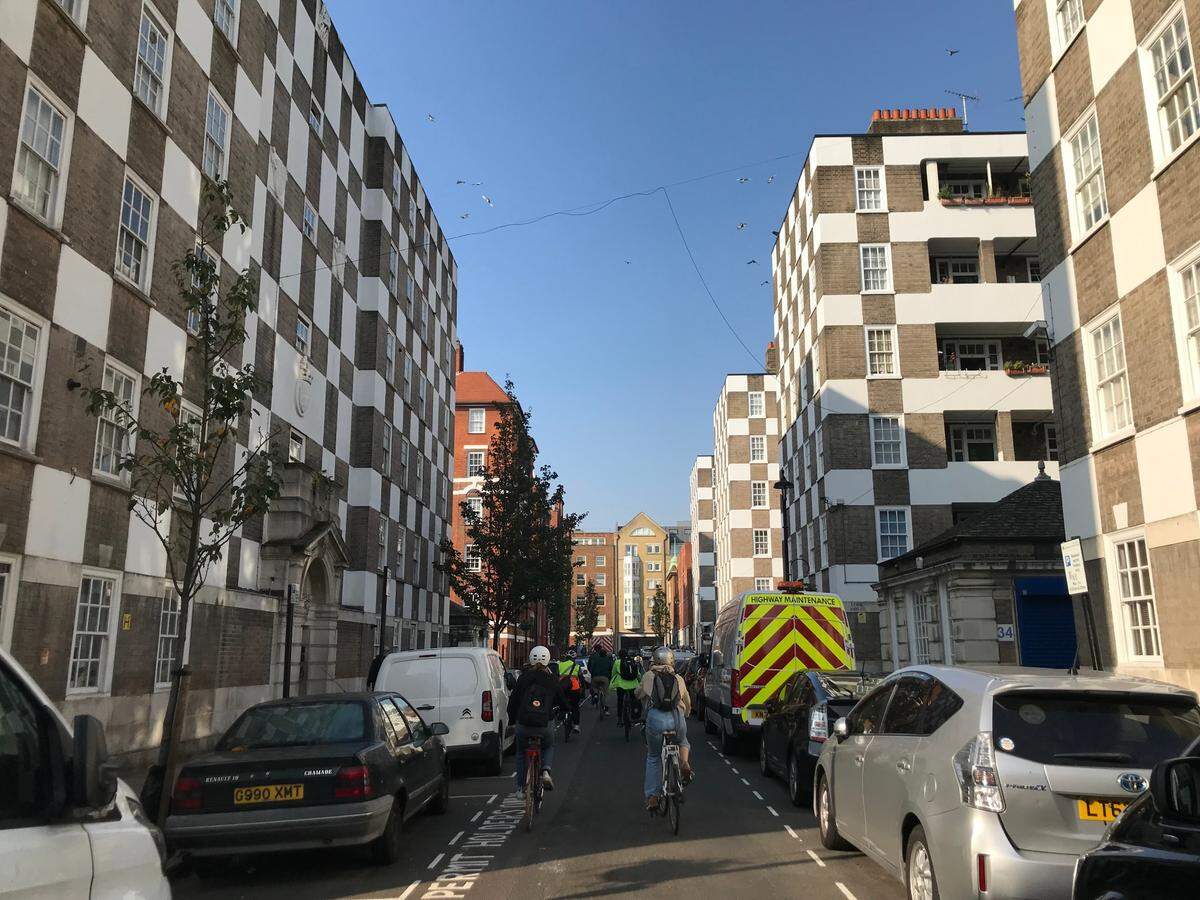
Thousands of people live in Lillington Gardens, in 777 apartments spread across 14 buildings. Seen from an interior courtyard, the façades evoke ziggurats (stepped temple towers) or Tetris blocks, with rectangular flats dropped at irregular frontages, some jutting out, others receding.
When Americans think of public housing, they’re more likely to imagine the crumbling concrete towers of Cabrini-Green in Chicago – the squalor and neglect of which inspired the horror film franchise “Candyman” – than they are the sophisticated flats of Lillington Gardens. But public construction was once the dominant force in England’s housing market, and in the decades following World War II, middle-class people queued up for coveted government flats. By the late 1970s, more than 30% of Britons lived in social housing, rivaling cities like Vienna and Hong Kong.
Things are different now. But for cities like Seattle and Olympia facing unprecedented levels of homelessness, England’s once-vast council estate system offers a model for how government can proactively prevent homelessness and housing insecurity by directly building and operating low-cost apartments.
“For us it’s quite important the optimism of the era that we’re talking about, that everyone is kind of in it together,” said architect Roz Peebles, who leads cycle tours of Lillington Gardens and other architecturally unique public housing estates in London with the organization Open City. “It’s not housing for the ‘quote unquote’ poor, it’s housing for everyone.”
That universality is a crucial distinction between social housing, as it’s known across the world, and the American understanding of public housing, which was conceived during the Great Depression to serve the working class, but these days increasingly serves only the extremely poor.
England’s system has become more means-based over time, but in countries such as Denmark and Sweden, nearly the entire population is eligible to live in social housing, regardless of income.
On a brisk but uncharacteristically sunny day last October, Peebles led a group of cyclists through the sprawling city-within-a-city, noting its complex system of terracing and walkways that allow some residents private access to their flats. For Peebles, Lillington Gardens is proof positive that architecture can be both intricate and serve masses of people – a reminder of a time when design was more commonly understood as a public resource.
“We feel that they are exemplary in terms of the architecture, but also in terms of how people live there,” Pebbles told The Olympian.
The design of Lillington Gardens, where the tallest block is eight stories high, was in many ways a reaction against the prevailing 1960s trends in public building which favored Brutalism, a strain of modernist architecture defined by concrete tower blocks with little ornamentation. Although this style has defenders in the architecture world, council housing in the UK has come to be perceived by many as drab, monotonous, and cookie-cutter at best. At worst, some have argued that the concrete architecture actually incites violence among residents.
For Peebles and her co-lead Aidan Hall, those perceptions miss the architectural diversity of public housing in the UK, which was more complex and innovative than the “slab blocks and pebble-dashing” many imagine. Through their tours, they are trying to recover the idealism and elegance of the early to mid-20th century, when local governments built millions of public housing estates.
Much of that housing stock is no longer in public hands. Through a privatization plan introduced by Prime Minister Margaret Thatcher known as “Right to Buy,” flats at public housing estates such as Lillington Gardens, built by municipal governments and once-rented cheaply to people of all income levels, now sell for more than $1 million on the open market.
Even as it increased homeownership and wealth for some tenants, Right to Buy is widely blamed for wiping out much of the U.K.’s once vast-system of publicly owned housing. In addition to forcing councils to sell flats to tenants after three years’ occupancy, Right to Buy also prevented councils from using funds to build new housing. Today, over 1 million families are on waiting lists for housing and roughly 17 percent of Britons live in public housing — a steep decline, but sizable compared to the less than 3% of Americans who receive some form of housing assistance.
Lillington Gardens, a public housing estate built in the 1970s in the Westminster borough of London. Brandon Block bblock@theolympian.com
America’s public housing failures
American politicians are generally unenthusiastic about the government playing a major role in the housing market. Public housing in the U.S., which at its peak accounted for less than 1% of the nation’s housing stock, is often cast as a failed experiment which concentrated poverty and reproduced segregation.
After decades of chronic underfunding and mismanagement led to tenants living in crumbling buildings with billions in repair backlogs, public housing authorities in cities such as Chicago and St. Louis demolished their most derelict buildings.
Susan Popkin, a fellow at the Urban Institute who has written several books about public housing redevelopment in Chicago, described those buildings as “uninhabitable.”
“People were living with broken elevators and lead paint, in dangerous conditions, kids were falling out of windows,” Popkin said. “I don’t know how to describe how bad it was.”
Americans generally consider living in government housing to be only for those with no other options. Following the integration of public housing in the 1960s, conservative politicians such as President Ronald Reagan used terms such as “welfare queens” to portray largely Black public housing recipients as undeserving. Successive Presidents gutted funding for public housing, and many demolished units were never replaced. The U.S. has lost more than 200,000 units of public housing since the 1990s.
“Housing in the United States was never an entitlement the way it was in the UK,” Popkin said. “We never made the same investment in social housing.”
Public housing estates in Pimlico, West London. Brandon Block bblock@theolympian.com
Housing as a right
Britain’s history with public housing is not free of failures, and some buildings have been neglected and fallen into disrepair. In 2017, the 24-story Grenfell Tower burned down, killing more than 70 people. Subsequent investigations have found other council estate buildings that are currently unsafe.
Like Seattle and New York City, London is undergoing spectacular growth that is widening economic inequality. Those contrasts are unmissable from a bicycle ride along the Thames River embankment, where gleaming cities of luxury skyscrapers emerge from the once-neglected areas of Vauxhall and Canary Wharf.
As the UK has moved towards a largely private-sector housing system, London increasingly faces some of the same challenges as U.S. cities. Average home prices have nearly doubled in that past decade, now sitting at 514,000 pounds (about $700,000) and more than 11,000 people are homeless in what has become one of the most expensive cities in the world.
Although they face the same housing crisis, English policymakers have something their American counterparts lack: the inheritance of a strong tradition of public infrastructure. Council estates (some gentrified like Lillington Gardens, others not) are everywhere in London, serving as visual reminders of a time when housing was considered a basic right.
“In the aftermath of the second world war, when this country was broke, we were building 150,000 social housing units a year,” said Peter Barber, an architect who is celebrated for designing stylish social housing, at a lecture at the Barbican Hall in London.
“We were building a national health service at the same time. But it was a commitment on behalf of the government with the support of the people to make housing a priority and to treat it as basic infrastructure rather than commodity, which is what it has become.”
Barber’s firm recently won accolades for a collection of tiny houses built for homeless people in Camden. Unlike the dorm-like designs typical of homeless shelters, they are styled after medieval alms houses, with wavy roof lines and arranged around a community garden.
Barber’s emergence as a cultural figure among young and left-leaning Londoners likely has as much to do with his playful, inventive buildings as it does with his expansive vision of the architect as more than a craftsperson delivering a product.
“He’s one of the people still talking about architecture in a political way,” said tour guide Hall, who co-founded the architecture collective and social enterprise Okra, where Peebles is also a member. “There are not enough people [doing that].”
During his lecture last fall at Barbican Hall, Barber spoke not only about his firm’s work but advanced a policy vision to end the “disgrace” of London’s homelessness crisis. To start: a new program of social housing on the scale of the post-war era, an end to Thatcher’s Right to Buy policy, and private-sector rent controls.
If American architects are rarely so vocal about politics, it may be that the notion of public investment in housing sounds too utopian. In England, again, there’s recent history to draw on: During the post-war era, many boroughs employed their own “council architects” and even boasted in-house engineers and construction teams. At its height in the 1950s, the Architect’s Department of the London County Council employed more than 1,500 architects; it is often claimed to have been the largest public architecture firm in the world.
“In the post-war era right until the end of the 1970s, most architects would expect to work for a local authority, for the London County Council, for the Greater London Authority,” said Peebles, who practices with a private firm. “The idea that the majority [of architecture practice] is private is quite a new idea.”
In the foreground: Golden Lane, an early public housing estate built in the 1950s. In the distance: residential towers rise from the Barbican, a multi-use public arts center built in the 1970s by the Corporation of London, the governing entity of the two-square mile city center – but as a moneymaking venture, to be rented at market prices to urban professionals. Brandon Block bblock@theolympian.com
What should public housing look like?
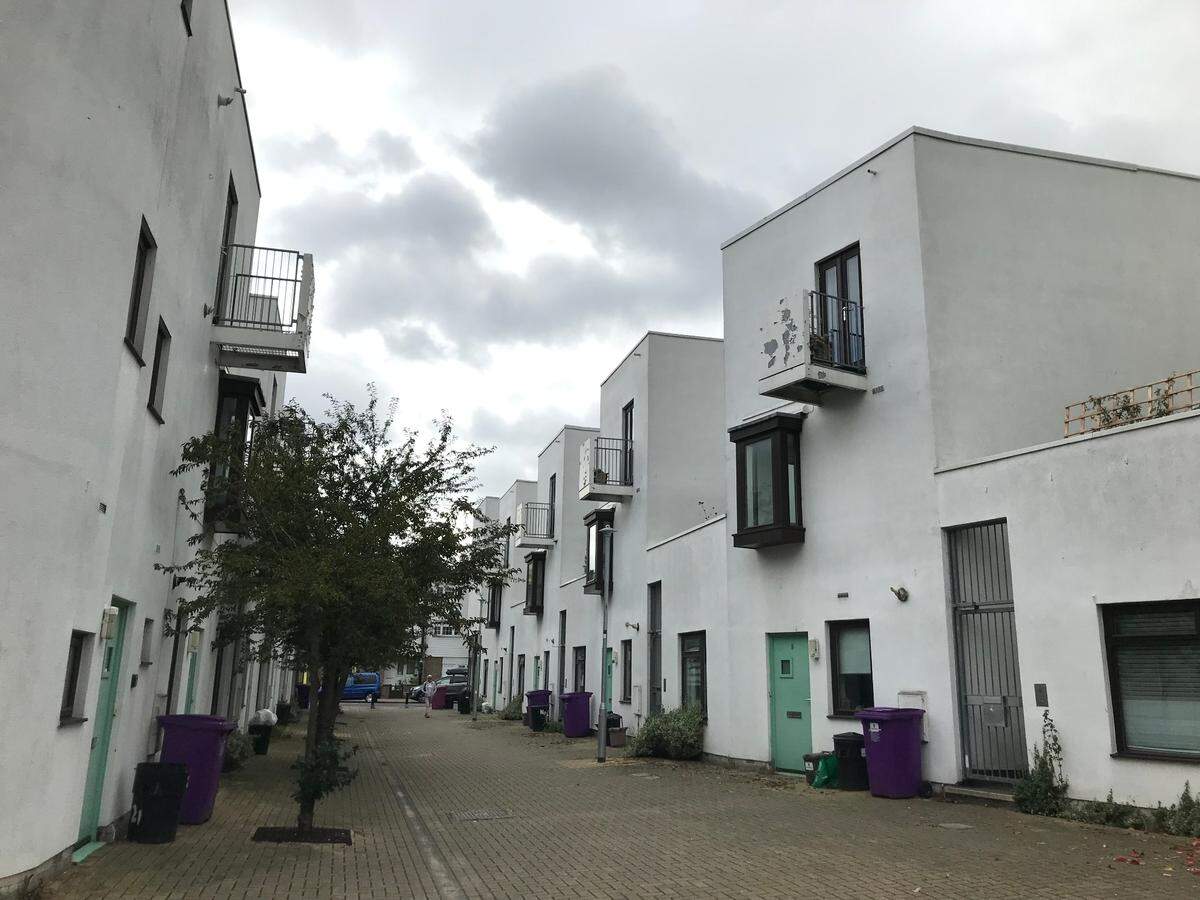
One of Barber’s first council-commissioned projects is an array of whitewashed, terraced townhomes that curve around a pedestrian-only street in the borough of Tower Hamlets. Sporting windows of whimsical shapes and sizes, the flats evoke a Greek seaside village, sticking out in a neighborhood of mostly modernist tower blocks and brick apartment houses.
Like the mid-century buildings Pebbles and Hall feature in their tours, Barber’s playful designs belie expectations of what public housing should look like.
Criticism of modernist public housing, when not focused on the tenants themselves, tends to emphasize the immense size of the buildings and lack of private outdoor space (sometimes termed “defensible space”). Barber’s designs provide each unit with a front and back door, as well as courtyard or roof deck, so that they feel and look like houses even though they’re apartments. They are relatively dense while being fairly low-rise.
Barber told The Olympian the true issue with Brutalist tower blocks may not be the apartments themselves, but how they hit the ground.
“Rather than blowing these buildings up, think about what we could do with them,” Barber said. “And really, what is the issue? We just don’t like it because it’s a symbol of something we don’t really agree with anymore, or are there ways we can use our ingenuity to make them absolutely beautiful and wonderful, make the area fantastic?”
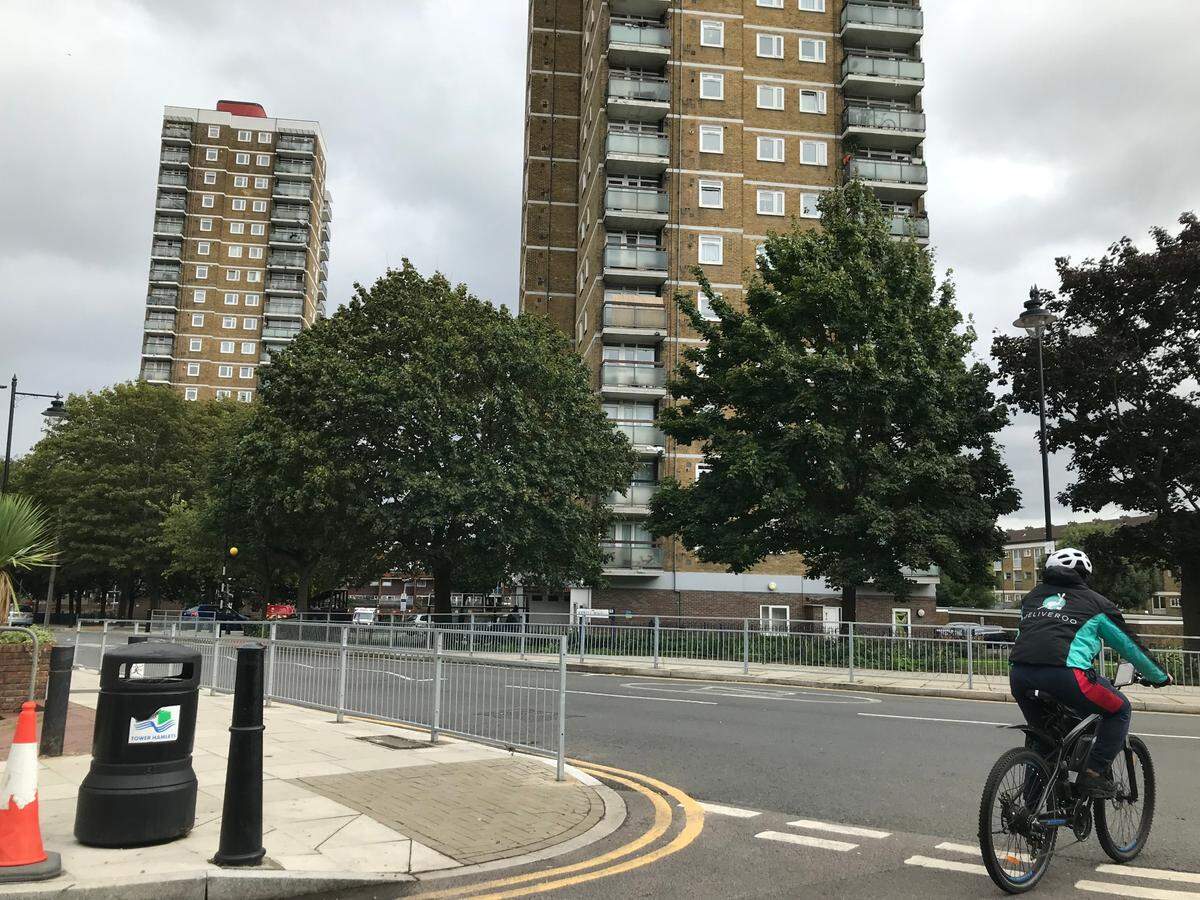
Modernist public housing blocks in the borough of Tower Hamlets, in east London. Brandon Block bblock@theolympian.com
The future of public housing in England
With much of its housing stock privatized, post-Thatcher governments both liberal and conservative have turned instead to mandating private developers include a modest percentage of units in developments at 80% of market rates. These mandatory affordable housing policies, seen as too radical in many U.S. cities, are generally regarded by progressives in London as a meek half-measure that doesn’t make up for disappearing council housing flats.
“The new model cannot keep up with housing demand,” said Callum Bleasdale, a recent architecture graduate who wrote his thesis on the demise of social housing and the stigmatization of brutalist architecture. “The last time London’s housebuilding was keeping pace with population growth was during the era of council estates.”
Bleasdale’s research concluded that successive governments’ reliance on private-sector developers has led London into a chronic housing shortage.
These schemes have put up new apartments but are sometimes criticized for having separate entrances (“poor doors”) for social tenants and walls separating children’s play areas. Similar “poor door” situations have played out in New York City, where the term was first coined.
As housing prices in London continue to soar, there’s a growing movement to look to the past for solutions. Momentum is churning for a council housing comeback, after four decades of being increasingly seen as blight.
Scotland and Wales have abolished the “Right to Buy” policy. In 2018, then Prime Minister Theresa May repealed a Thatcher-era rule that limits what councils can spend on developing new housing.
Fully public developments in the borough of Camden are moving towards the kind of vision Barber wants to see. Still, he cautions against too much optimism.
“On the one hand, we can be very proud of things like Holmes Road, the little alms houses, like I said, built by a council with public money and so on, but it’s a tiny band aid on a really big problem,” Barber said. “It needs to be tackled on a much more systemic level.”
Contemporary public housing designed by Peter Barber Architects, built for the council of Tower Hamlets, East London. Brandon Block bblock@theolylmpian.com
This story was originally published February 21, 2022 at 5:00 AM.
Brandon Block is The Olympian’s Housing and Homelessness Reporter. He is a Corps Member with Report For America, a national service program that places journalists into local newsrooms.

.jpg)