
6-year-old thought he found ‘dragon’s tooth’ in Michigan — but it’s from a mastodon
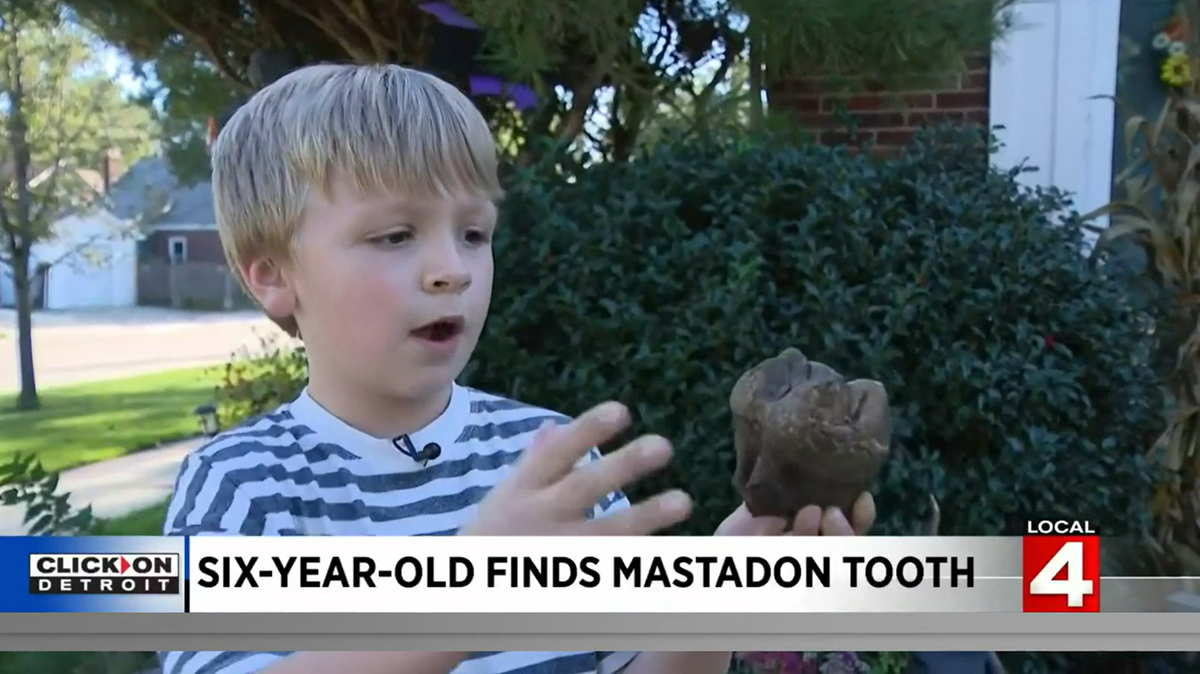
Julian Gagnon wants to be a paleontologist when he grows up.
But at just 6 years old, this Michigan boy doesn’t have to wait until he is all grown up to make a difference in the world of studying fossils. That’s because he’s already made a significant discovery.
While hiking Sept. 6 with his family at Dinosaur Hill Nature Preserve in Rochester Hills, Julian found what he first thought might have been a rock — or even a dragon’s tooth, according to media reports.
“I found it and said ‘oh this is a cool rock,’ ” Julian told Will Ganss in a recorded ABC video interview. “And my mom said ‘uhh is this actually a rock?’”
The answer, of course, was no.
Julian’s mom, Mary Gagnon, recalls her boy exclaiming “Wow! I found a dragon’s tooth,” according to Michigan Live. Her son was hopeful he’d find one while on their family hike, but that’s not what he found either.
“I just felt something on my foot and I grabbed it up, and it kind of looked like a tooth,” Julian said, according to WDIV.
He was right about one thing — this was a tooth. A very rare, ancient one at that.
Julian had found a mastodon tooth, the Michigan station reported, dating back to ancient times.
The University of Michigan’s Museum of Paleontology confirmed to the Gagnon family that his exciting find was once the upper right molar of a juvenile mastodon, Michigan Live reported. Adam Rountrey, the museum’s research collection manager, told the newspaper that Julian is likely the first person to have touched the tooth in 12,000 years.
The American mastodon lived during the Ice Age and are now extinct, National Geographic reports. They were described as “big, shaggy elephants,” much like a mammoth. Though, the two are not the same.
“Despite the superficial resemblance, mastodons were distinct from mammoths,” National Park Service says. “Mastodon were shorter and stockier than mammoths with shorter, straighter tusks. Mastodons were wood browsers and their molars have pointed cones specially adapted for eating woody browse. Mammoths were grazers, their molars have flat surfaces for eating grass.”
The tooth Julian found is between the size of a baseball and softball, Rountrey told Michigan Live, and is definitely not a mammoth tooth, though both did roam Michigan at the same time.
Julian is donating the tooth to the University of Michigan’s Museum of Paleontology, ABC reports. As a reward, the paleontologist hopeful will take part in a behind the scenes tour at the museum.
“This has only fueled his passion for archaeology and paleontology,” his mom told Michigan Live. “As far as he’s concerned, this is his first discovery of his career, and now it’s hard to dissuade him from picking anything up that he sees in the natural world.”
The mastodon was named Michigan’s state fossil in April 2002 as the “magnificent creature once lived all over Michigan and North America,” according to the state. It disappeared about 10,000 years ago, but its bones are still being studied by paleontologists, or fossil scientists.”
This story was originally published October 4, 2021 at 11:20 AM with the headline "6-year-old thought he found ‘dragon’s tooth’ in Michigan — but it’s from a mastodon."