Five takeaways from Supreme Court nominee Jackson’s exchanges with senators
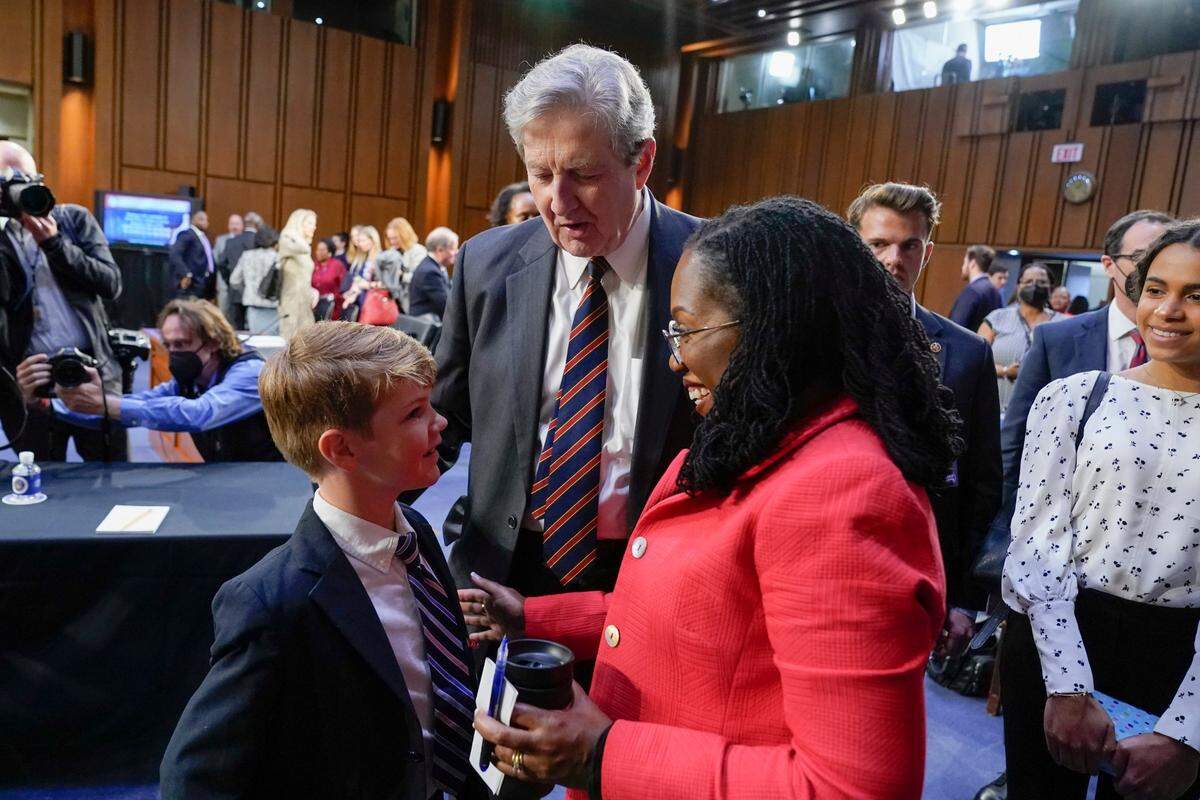
Supreme Court nominee Ketanji Brown Jackson fielded questions about her work defending Guantánamo Bay detainees as an attorney, her handling of sex offense cases as a judge and her views of race as a private-school board member during the second day of her confirmation hearings.
The questions yielded occasionally tense exchanges with Republican lawmakers, but none of the topics came as a surprise or are likely to derail the Floridian’s path to the nation’s high court.
Jackson, a federal appeals judge who would be both the first Black woman and first Floridian on the court, reflected on her family’s path from segregation in Miami to the precipice of the Supreme Court.
She spoke about her work on Guantánamo Bay cases and also defended her record on sex offense cases against criticism from Republicans.
GOP lawmakers had telegraphed these lines of inquiry in social media posts in recent weeks and in their opening statements the day before. Senate Democrats and the White House were ready with rebuttals.
Democrats can confirm President Joe Biden’s nominee to the nation’s high court on their own through Vice President Kamala Harris, who would be able break a tie in the event of a 50-50 party-line vote.
Democratic leaders have repeatedly expressed their desire for a bipartisan vote, but that could be difficult to pull off even if it won’t affect Jackson’s confirmation.
A testy exchange with Sen. Lindsey Graham, R-South Carolina, who backed Jackson for the U.S. Court of Appeals for the D.C. Circuit less than a year ago, highlighted that the judge can’t count on guaranteed support from Republicans who have supported her in previous confirmations.
The hearing continued well into Tuesday evening and is scheduled to resume with more questioning on Wednesday morning at 9 a.m.
Jackson’s Guantánamo Bay defense work closely examined
Tuesday marked Jackson’s most public and thorough comments since her nomination about her work on behalf of Guantánamo Bay detainees during a period when the law was murky.
Jackson served as a federal public defender in Washington, D.C., from 2005 to 2007. Her service followed a 2004 Supreme Court ruling that foreign nationals held at the prison on the U.S. Navy base in Guantánamo Bay, Cuba, had the right to petition federal courts for writs of habeas corpus to determine the legality of their detention.
“After 9/11 there were also lawyers who recognized that our nation’s values were under attack, that we couldn’t let the terrorists win by changing who we were fundamentally,” Jackson told the Senate Judiciary Committee.
“And what that meant was that the people who were being accused by our government of having engaged in actions related to this under our constitutional scheme were entitled to representation, were entitled to be treated fairly. That’s what makes our system the best in the world.”
Jackson never traveled to Guantánamo herself, but as an attorney in the office’s appellate division she worked on the cases of four detainees— Khi Ali Gul, Tariq Mahmoud Alsawam, Jobran Saad Al-Quhtani and Khudai Dad. Dad was released months after his detention began, while the other three were released years after Jackson left the Federal Public Defender’s Office.
She also worked on the case of Al-Quhtani when she joined the international law firm Morrison & Foerster. The firm had taken over the Saudi national’s defense before Jackson joined the firm. She testified that she was not involved in bringing the case to the firm.
At Morrison & Foerster, Jackson also worked on amicus briefs on behalf of former federal judges and libertarian-leaning nonprofits, such as the Cato Institute, the Rutherford Institute and the Constitution Project, that challenged the government’s power to hold detainees indefinitely. Graham and Jackson had a tense exchange about her role in these briefs.
Graham, who noted his own background representing defendants in military court, said he took no issue with Jackson’s public defense work on behalf of the Guantánamo detainees. But he grilled her about her work as a private practice attorney, and he was unsatisfied by Jackson’s distinction between her clients’ views and her own.
“If the court had taken the position included in the brief that you signed onto we would have to release these people or try them. And some of them the evidence we can’t disclose because it’s classified. You’re putting America in an untenable position,” Graham said.
“This is not the way you fight a war. If you tried to do this in World War II, they’d run you out of town. We’d hold enemy combatants as long as they’re a threat. There’s no magic passage of time that you got to let them go.”
Scrutiny of sex crime sentencing
Democrats sought to give Jackson a platform to dispute GOP accusations that she took a soft approach to child pornography cases during her nine years as a federal trial court judge after Sen. Josh Hawley, R-Missouri, attacked the judge on the issue on Twitter last week.
Sen. Dick Durbin, D-Illinois, asked Jackson to respond to the criticism. “As a mother and a judge who has had to deal with these cases, I was thinking that nothing could be further from the truth,” Jackson said.
She discussed reading offenders comments from victims of child sex abuse during sentencing hearings.
“I tell them about the adults who were former child sex abuse victims who tell me that they will never have a normal adult relationship because of this abuse,” Jackson said. “I tell them about the ones who say, ‘I went into prostitution. I fell into drugs because I was trying to suppress the hurt that was done to me as an infant.’”
Democrats repeatedly pointed to statistics that showed Jackson’s sentences in these cases as standard with other judges in both her district and the country as a whole. Only 30% of non-production child pornography offenders receive sentences within the guidelines.
However, Hawley and other Republicans continued to press Jackson on the issue. Hawley pointed to seven cases in which Jackson handed down sentences below federal sentencing guidelines.
Jackson said that the Supreme Court had ruled in 2005 that Congress could not make these guidelines mandatory.
Hawley focused his questions primarily on a 2013 case involving an 18-year-old defendant. Hawley said federal sentencing guidelines recommended up to 10 years, and the federal prosecutor sought two years, but Jackson’s sentence was three months.
“I’m having a hard time wrapping my head around it. We’re talking about 8-year-olds and 9-year-olds and 11-year-olds and 12-year-olds. He’s got images of these, the government said it ended up over 600 images, gobs of video footage of these children, but you say this does not signal a heinous or egregious child pornography offense,” Hawley said.
Jackson pushed back on Hawley’s characterization of her view and defended her sentencing decisions. “The evidence that you are pointing to discussing, addressing in this context is evidence that I have seen in my role as a judge and it is heinous. It is egregious. What a judge has to do is determine how long to sentence defendants proportionately consistent with the elements that the statutes include,” Jackson said.
White House deputy press secretary Andrew Bates on Twitter referred to Hawley’s line of questioning as an “embarrassing, QAnon-signaling smear,” specifically invoking the conspiracy theory whose adherents believe that former President Donald Trump is at war with a secret cabal of pedophiles. Several defendants charged in cases related to the Jan. 6 attack of the Capitol were proponents of the theory.
Jackson repeatedly points to her love of country
When Jackson is given a chance to describe her qualities as a person, she often invokes one specific trait: her patriotism.
The refrain was evident when the judge was asked whether she believes in Martin Luther King Jr.’s vision of a post-racial America, where citizens are judged not by the color of their skin but the content of their character.
Jackson noted that her parents were forced to attend segregated schools in Miami, before recounting how different her experience had been.
“The fact that we had come that far was to me a testament to the hope and the promise of this country, the greatness of America,” she said.
The comments were similar to ones she gave during her opening remarks Monday, when she talked openly about the love she held for America. Combined, the rhetorical approach appears meant to head off any criticism that Jackson is insufficiently appreciative of her home country, a criticism sometimes leveled against the political left.
Republicans try to tie Jackson to critical race theory
Jackson had a far more contentious exchange about race late in the day with Sen. Ted Cruz, R-Texas, who noted that he and the judge attended Harvard Law School at the same time.
Cruz pressed the judge about her role as a member of the board of trustees for the Georgetown Day School, contending that the school’s curriculum “is filled and overflowing with critical race theory.” Critical race theory, an academic concept that focuses on the role of race in shaping public policy, has come under intense scrutiny from Republican lawmakers in recent years.
Cruz highlighted several texts in the school’s curriculum that he argued contradicted this concept, specifically “Antiracist Baby” and “Stamped (for Kids),” two books written by Ibram X. Kendi, the director of Boston University’s Center for Antiracist Research.
Jackson said the board does not control the curriculum and that critical race theory does not come up in her work as a judge.
She said the private school, which was established in 1945, was founded by three white families and three Black families who chose to create an integrated school community at a time when public schools in Washington, D.C., were segregated by law.
“The idea of equality, justice is at the core of the Georgetown Day School mission,” Jackson said. “And it’s a private school such that every parent who joins the community does so willingly with an understanding that they’re joining a community that is designed to make sure that every child is valued, every child is treated as having inherent worth and none are discriminated against because of race.”
Jackson offered the standard answer on abortion rights
It’s not a surprise, but Jackson reiterated that she thinks the Supreme Court has already made the right to an abortion a case of settled law, citing Roe v. Wade and Casey v. Planned Parenthood as two major decisions that affirmed it as such.
“Roe and Casey are the settled law of the Supreme Court concerning the right to terminate a woman’s pregnancy,” Jackson said. “They have established a framework that the court has reaffirmed.”
The judge was quick to note in her response that current Justices Brett Kavanaugh and Amy Coney Barrett gave the same answer during their own recent confirmation hearings. And the issue otherwise didn’t come up often during the day’s session, with Republicans and Democrats alike focusing their attention elsewhere.
That could be because, in large part, conservatives have already placed enough ideological allies on the Supreme Court to at least partially repeal the right to an abortion, as many Democrats expect them to do later this year when the court rules on an Alabama case it heard in December. The court is considering whether to uphold Alabama’s ban on abortions after 15 weeks.
This story was originally published March 22, 2022 at 4:00 PM with the headline "Five takeaways from Supreme Court nominee Jackson’s exchanges with senators."