
Thurston commissioners clash over split property tax vote
A public hearing Tuesday took an unexpected turn when Thurston County Commissioner Gary Edwards voted against a property tax increase slated to fund expenditures the board — and Edwards himself — already approved.
The split vote kicked off a heated exchange when Commissioners John Hutchings and Tye Menser reacted with surprise to their seatmate’s apparent change of heart. Edwards justified his vote in part by tying it to an upcoming levy vote and said he’s listening to the public.
With the 2-1 vote, the property tax increase of 1 percent still passed.
Thurston’s Board of County Commissioners has approved a 1-percent property tax increase — the maximum allowable under state law — each year for at least the last 15 years, to the best of Robin Campbell’s knowledge. Campbell serves as assistant county manager and budget director.
That extra 1 percent is expected to generate just under $400,000 in revenue that will go into the county’s general fund and pay for day-to-day costs, Campbell told The Olympian. That’s one of four county funds property tax directly feeds into. The others — the Roads and Transportation, Medic One, and Conservation Futures funds — get less money per dollar of property tax collected than the general fund, Campbell showed in a presentation Tuesday.
Major general-fund spending increases authorized in 2020 midterm budget adjustments include:
- $197,270 for an additional Sheriff’s Office Patrol Deputy;
- $100,000 for a Sheriff’s Office Crime Analyst;
- $102,250 for a Superior Court Law Clerk;
- $225,000 for Auditor’s election costs;
- $100,000 in medical payments for retired law enforcement officers;
- $500,000 for parks;
- $205,000 for extending two county planning positions; and
- cost-of-living adjustments for county employees that total $1.3 million.
Even though the 1-percent increase was built into the biennial budget passed in 2018, Campbell said, the commissioners could have decided to pass less than a 1-percent increase or no increase at all on Tuesday. They would’ve had to decide how to fill the $400,000 revenue gap: spend less or spend out of the general fund balance, which a county forecast shows has been declining in recent years.
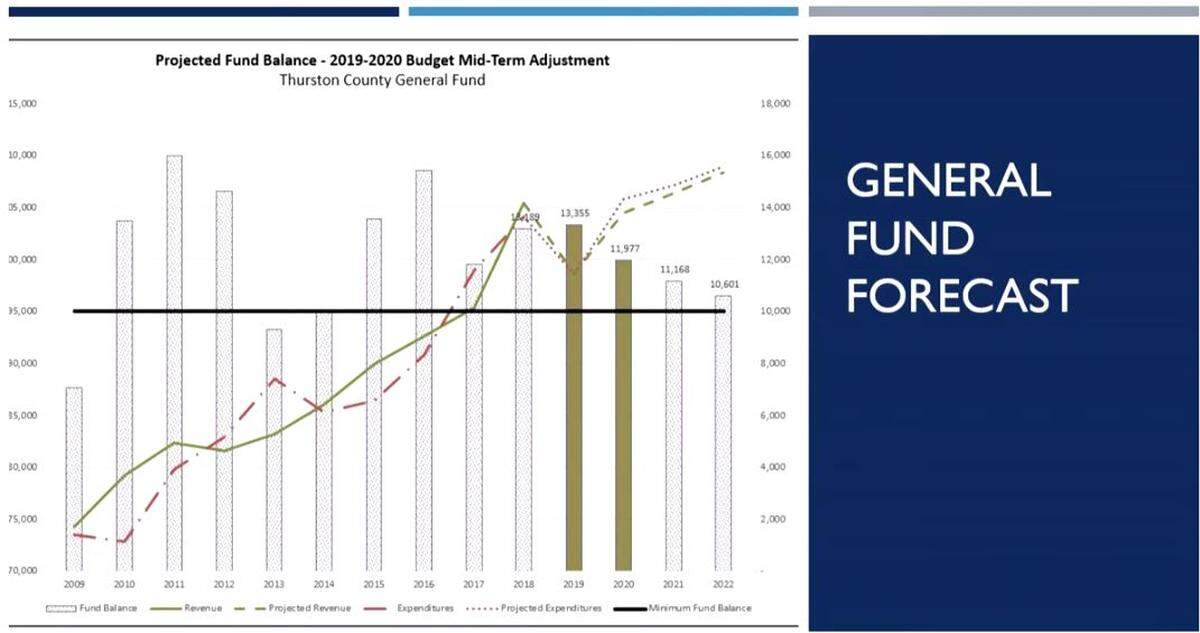
Edwards, who previously served as Sheriff, had supported the additional positions in a vote earlier this month. Commissioner Menser, on the other hand, voted against adding those positions.
“At no point during our discussions about those new positions did I ever hear that you might pull the support for the 1-percent property tax increase that was built into the biennial budget by you, Commissioner Blake, and Commissioner Hutchings before I got here,” Menser said when Edwards indicated he’d vote no Tuesday.
“That should’ve come up a long time ago, not today. So to hear you take that position in light of this testimony is very concerning about financial responsibility for this county.”
At the hearing, and later in an interview, Edwards said the number-one reason for his no vote was that he disagrees with the process the county has followed as it develops a plan to replace its courthouse complex.
He’s expressed his disapproval of the courthouse plan through voting on the issue directly before. Twice this year, he’s been the lone no vote when commissioners voted to put a measure on the ballot asking citizens whether the county should raise property taxes to build a new courthouse.
“Cumulatively, it added up to where I just felt I needed to speak out in a louder voice,” Edwards told The Olympian Wednesday. “I was very unhappy we had proceeded to this point. I wanted the public to know where I stood.”
Money from the general fund will pay for the cost of holding the April election on whether to lift the property tax levy lid to fund a new courthouse. Midterm operating budget adjustments, which Edwards also voted against, included $177,500 to cover the county’s portion of costs for the special election.
Edwards has said he thinks holding the election is an unnecessary expense; he thinks the measure will lose with a 70 percent no vote, he told The Olympian.
Other than the election costs, there doesn’t seem to be a direct connection between the courthouse and the tax increase Edwards voted against.
“Somehow there seemed to be a confusion on how this is related to the courthouse,” Campbell said in the meeting Tuesday, referring to citizen comments the county had received. “And it’s not.”
In a conversation with The Olympian, Edwards said he felt the $400,000 was about equivalent to what he felt “was wasted in moving forward with this whole courthouse process.”
The county had earmarked $300,000 for the courthouse project in 2019 — for expenses such as meetings, selecting a site, and a citizen survey. Year-to-date, Campbell said, the county has spent less — just over $188,000 — on the project. That money comes from a real estate excise tax that specifically funds facilities, not from the general fund. Campbell also said they’d be looking at addressing space needs for years.
In his reasoning, Edwards also mentioned a few other issues he is unhappy with, including that he disagreed with the county earmarking money for a potential homeless encampment and how the “state is suing the public” after citizens voted for $30 car tabs.
“Somewhere along the line, somebody’s got to stick up for the underdog,” Edwards told The Olympian. “And I just felt that was about as good of a way as any to make a statement that I disagreed with the process that led up to this.”
Commission chair Hutchings said while he respects Edwards, he thinks the commissioner was making a political decision. Edwards’s no vote prompted sporadic applause from a small crowd of citizens who had testified against the increase.
“From my perspective, my seatmate made a political decision based on his people in the room, his base,” Hutchings said in a phone interview with The Olympian. “He was making a populist decision rather than a moral, ethical one.”
On Wednesday, Hutchings said he was “still rather upset” and that to see Edwards flip his vote was “just a huge shocker.”
Edwards said his decision was built up over time, with negative comments around the courthouse and “snide remarks” about the commissioners wasting money. And he pointed to a law limiting the commissioners’ “sidebar” conversations, saying “it’s always a surprise.”
“By voting at a particular time, I realize it creates a controversy and that, in turn, probably does develop public discourse about the topic,” Edwards said. “And by doing so, my point gets out there.”
.jpg)