
Washington state families celebrate progress on police reform, name future priorities
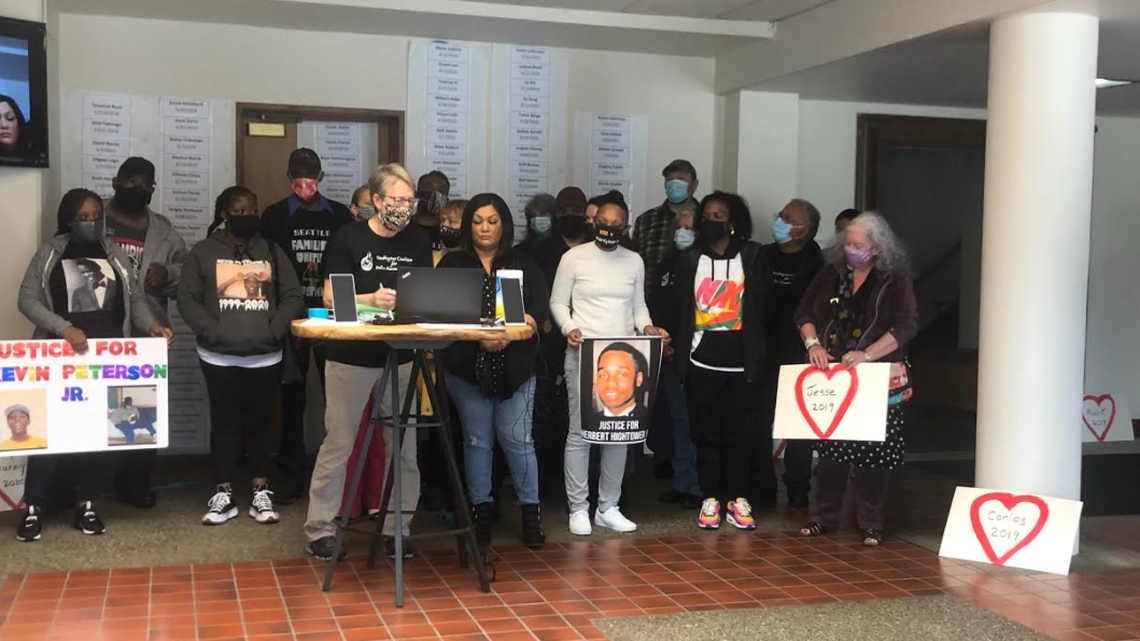
Looking back on the 2021 legislative session, family members who’ve lost loved ones to police violence in Washington state see progress toward rebuilding communities’ trust in law enforcement.
Looking ahead, they see more work to do.
“We all brought our blood, our tears, and our strength,” Nickeia Hunter said at a Washington Coalition for Police Accountability’s press conference the last day of session. “And, unified, we made the beginning steps that will be needed to bring forth the change that will save our children’s children.”
Hunter’s brother Carlos Hunter was killed by Vancouver police in 2019. She and members of well over a dozen other families are part of the coalition, which is an extension of De-Escalate Washington, a group that supported Initiative 940.
The coalition was working on implementation of I-940, which changed state law on police use of deadly force, and pivoted to legislation last summer, after former Minneapolis police officer Derek Chauvin murdered George Floyd and revelations surfaced around Manuel Ellis’ death in Tacoma.
The coalition set its priorities narrowly this year, said member Leslie Cushman, focusing on five bills — and four of them passed.
Four of five priorities
On Jan. 12, day two of the 105-day legislative session that ended April 25, the House Public Safety Committee met for the first time. That meeting was devoted to a public hearing on a bill that would set a statewide baseline for tactics and equipment law enforcement can use (House Bill 1054).
Sonia Joseph was the first member of the public to testify. She told the story of her son Giovonn Joseph McDade, who was killed by Kent Police during a June 2017 traffic stop.
“Running away does not warrant a death sentence,” she said, detailing when her son fled the scene in his car, then was pursued and trapped before an officer shot him.
“My son was killed after a routine traffic stop, another senseless murder of an innocent young man,” Joseph said.
A few months later, after much debate and negotiation, the bill passed the full Legislature. It in part bans chokeholds, neck restraints, and no-knock warrants — and it sets limits on military equipment, tear gas, and vehicular pursuits.
“It was one of the first times I felt like we actually saw the humanity in every single person that wanted to be involved in the process,” said Rep. Jesse Johnson, who sponsored the police tactics bill.
When McClatchy spoke with Joseph and other family members who’ve lost loved ones, it was clear they were hopeful that their five priority bills would pass. But they were also watching with concern for any attempts to weaken or change them.
There was strong pushback on parts of many of the police accountability measures debated this session. Common arguments included that taking away less-lethal options for police officers may lead to the opposite of the desired effect and jeopardize officers and public safety.
“There were several bills that passed this session that will make it harder to recruit good candidates for law enforcement,” said Rep. Jacquelin Maycumber, R-Republic, a former sheriff’s deputy, in a statement. “When we make the profession of law enforcement less desirable, we get less-desirable candidates.”
That statement was part of a press release issued after a bill Maycumber sponsored passed — it creates a grant program to encourage more diverse candidates for law enforcement careers, and it passed unanimously through both chambers.
That bill wasn’t among the coalition’s five priorities.
The five bills, Cushman said in a phone interview with McClatchy, connect to family members’ personal experiences.
“I can’t imagine how hard it must be to talk about your family members, but it is critically important to keep telling those stories, because that is what gets through to the hearts of the people who serve in the Legislature — to help them to understand how critical it is for us to move forward with this work,” said Sen. Jamie Pedersen, D-Seattle, who sponsored another of the four priority bills that passed.
Pedersen’s bill (Senate Bill 5051) dramatically broadens the ability of the state to decertify officers who’ve engaged in misconduct, in part adding reasons they can be decertified and putting more civilians in a position to be part of that process.
Another of the coalition’s priorities that passed, House Bill 1267 sponsored by Rep. Debra Entenman, will create an Office of Independent Investigations within the Governor’s Office to investigate incidents where police use deadly force.
In an emailed statement after the bill passed out of the Senate in April, Tacoma Mayor Victoria Woodards said her “heart was full with hope and gratitude.” Woodards had testified in a public hearing that the bill was Tacoma’s top priority this session.
“Because of the death of Mr. Manuel Ellis in Tacoma Police custody last year, this issue is personal for me,” she said in part of a prepared statement emailed to McClatchy. “Our community has demanded change, as have others throughout Washington State. I do not want another family to experience heartbreak and frustration which is then compounded by a local investigations process.”
But family members pointed to House Bill 1310 on permissable use of force by law enforcement officiers as the bill that might have kept their family members alive.
“1310 and all the bills passed speak to the lived tragedies of so many impacted families trying to prevent another family from joining us, and creating a safer and more accountable society that equates justice to not another life stolen,” Castill Hightower said. Hightower’s brother Herbert Hightower Jr. was fatally shot by Seattle police in 2004.
Looking back on the legislative session, Joseph said the amendment process was difficult.
“The amendment process was terrible,” she said. “Because we set out for policies that would hold officers accountable. We didn’t want to water them down to the point where officers continued to conduct business as usual.”
Family members were involved throughout that amendment process, Cushman said, and the coalition pushed hard for its priorities.
On the tactics bill, for example, limits on the use of tear gas were negotiated heavily. Under the final version of the bill that passed the Legislature, an officer or employee has to get authorization from the highest elected official in the jurisdiction to use tear gas at riots that aren’t in a prison or jail. Joseph’s experience is the reason the coalition also advocated for limits on “hot pursuits,” according to Cushman.
“Tear gas is very important,” Cushman said at the press conference. “We wish it was banned, but it wasn’t what we were going to go to the mat for.”
‘A long bus ride to police accountability’
The coalition has set its focus for the 2022 session on at least two more that didn’t make it through the policy-making process this time around.
One, the remaining priority bill for the coalition from this year, would allow individuals to sue a police officer or agency for violating their state constitutional rights and make it easier for them to recover damages, costs and attorney’s fees if they’re injured as a result of police misconduct.
It would also authorize the Attorney General’s Office to investigate and bring a civil suit if there’s a pattern of misconduct in a department or by an officer.
Earlier this session, Cushman called that bill the “teeth” of House Bill 1310.
The other bill would authorize the Attorney General’s Office to investigate and prosecute crimes involving use of deadly force by police officers.
“This is a great step forward on a long bus ride to police accountability, but it is not so lonely when you have people like Pedersen, Dhingra, Entenman, Johnson, Nguyen leading the way,” said Fred Thomas, naming legislators who have been part of the police accountability effort. Thomas’s son Leonard Thomas was killed by law enforcement on the porch of his home in Fife in 2013.
This story was originally published May 6, 2021 at 5:45 AM with the headline "Washington state families celebrate progress on police reform, name future priorities."
.jpg)