Why are Washington state agencies destroying Microsoft Teams chat messages?
Communication technology is advancing fast — so fast, some say, that current Washington public records and retention laws may not be able to keep up with all the ways lawmakers and others involved with crafting policy can now communicate out of the public’s view.
Whether it’s the use of encrypted messaging applications such as Signal, iMessage, or WhatsApp, or even the use of popular communications platforms such as Microsoft Teams, the fact is that those in charge of making policy have a host of new ways to discuss important work.
In some cases, agencies have adopted their own policies for how and if those messages need to be kept. Some public records advocates in the state see that as a cause for concern.
New methods of communication
Toby Nixon, a Kirkland City Council member and president emeritus of the Washington Coalition for Open Government (WashCOG), told McClatchy in an email that Kirkland uses Teams, but he said that he would never use the platform for any communication that may need to be retained under public records law.
He said that while the platform can be used for transitory messages that are relevant during meetings, such as managing the meeting itself, Microsoft Teams “absolutely should not be used for directing work, policy decisions, etc., unless there is a capability to copy out those message exchanges into email or some other type of archive.”
“But the key point is that it’s not just Teams, but every other means of communication people use that isn’t automatically archived: text messages, Facebook messages, Twitter direct messages, LinkedIn messages, Slack, Discord, WhatsApp. There are dozens or hundreds of ways government employees can communicate with each other that either aren’t archived at all or are archived only if the employees take specific manual steps,” Nixon said.
New policies for keeping records
On Aug. 25, McClatchy received a notification from the Washington State Gambling Commission regarding the use of Microsoft Teams messages by “all state executive branch agencies, specifically ones that report to the Governor.”
James DeHart, a records management officer for the agency, told McClatchy that those agencies are part of what’s called the “Shared Tenant” agreement under Washington Technology Solutions, or WaTech, an agency known as “the consolidated technology services agency” for state agencies, according to the website.
Under WaTech policy, the state Office of the Chief Information Officer has the Teams messages retention policy set at just seven days from the date of the last message sent, and then those messages are permanently deleted, DeHart said.
The guidance was first implemented in the summer of 2021, according to Cynthia Rickman, the records management specialist at WaTech.
“During the pandemic, Washington state government needed a statewide solution that allowed employees to conduct state business remotely,” she said. “The state acquired an enterprise license for M365 which included use of Teams video and chat. Moving to one video/chat application for all state agencies at the time required adopting one record retention policy for everyone.”
Rickman said the seven-day retention policy was set after the Washington Records and Information Managers (WARIM) Forum was asked to review the issue and make a recommendation.
“WARIM recommended the state adopt a 7-day retention policy for Teams chats because the chats are advised for transitory communications only, which are typically of short-term, temporary informational use,” Rickman said. “The WARIM recommendations were reviewed by the Cloud Enablement Advisory Committee, which has representatives from more than 30 agencies.”
Rickman added that there are other types of chats called “posts” that are within Teams workgroups for things like projects, committees, and organization units. Retention of those is based on the content of the records contained.
Carissa Bourdon, the WARIM Chair at the time at the time of the changes, told McClatchy that prior to May 2021, each agency made its own decisions about how long to keep chats and did so based on their retention needs.
WaTech notified WARIM members in May 2021 that “the system had developed an issue, that multiple chat retentions were not sustainable and that we could no longer have our individual chat retentions.” WaTech then notified members that the only option was to have one retention period that applied across the board.
“The WARIM community was clear that a single retention for chats was not reasonable, nor appropriate, and demanded that another solution be found,” Bourdon said.
In the end, the 7-day retention policy was voted in by several state agencies, although other retention schedule recommendations had been made for various time periods. The policy was meant to be temporary as Microsoft figured out a solution, but that fix took much longer than expected, she said.
“The tools have finally been released and WaTech is working collaboratively with WARIM while they test and begin the implementation of the new retention tools,” Bourdon added.
Mike Faulk, the deputy communications director for the Governor’s Office, confirmed in an email to McClatchy that their office is a part of the Shared Tenant agreement.
To abide by the state’s retention policy on records, the governor’s staff go through a verbal orientation from the office’s legal team and public records officers, Faulk said. Occasionally emails are sent out as reminders as well. Faulk noted that all agencies have their own method for educating employees on which Microsoft Teams messages need to be preserved.
“Our office strongly encourages employees not (to) send anything other than a transitory communication via the Teams chat and they have an obligation to preserve it if required by the Public Records Act and our office’s retention schedule,” Faulk wrote in an email. “Staff are encouraged to work with our records staff if they have questions.”
The reality of how state workers communicate
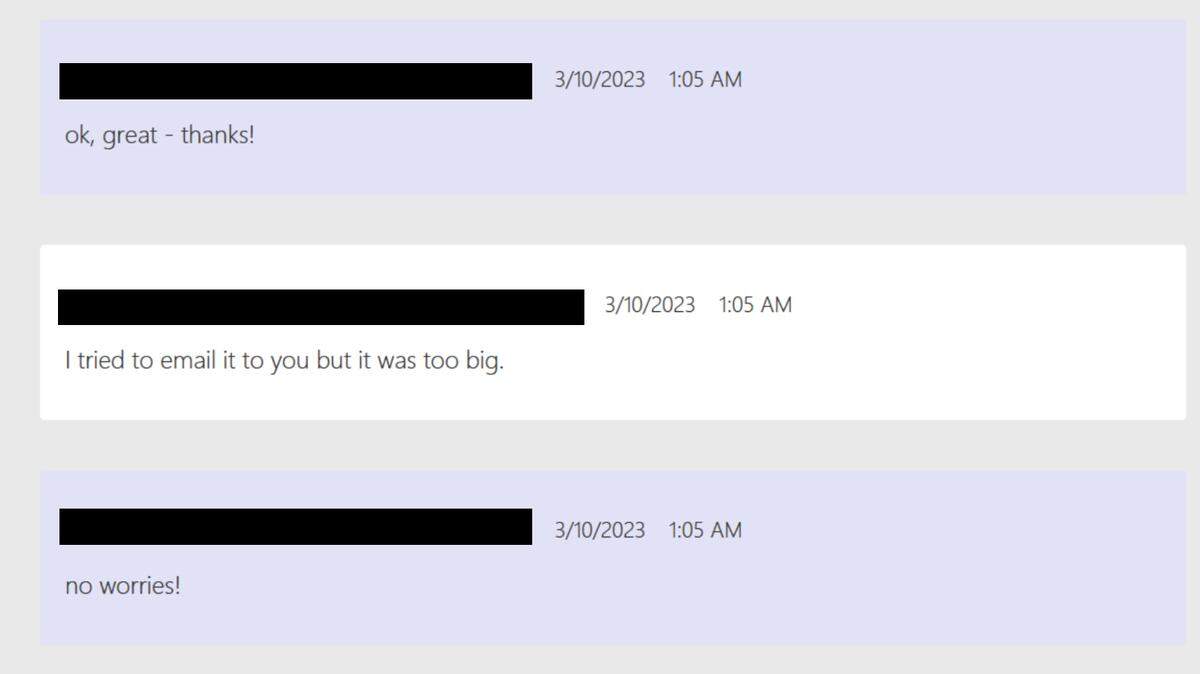
While WaTech advises agencies not to use Teams Chats for work-related discussion, records requests obtained by McClatchy and Jamie Nixon, an open government advocate (not related to Toby Nixon), showed an exchange at the Gambling Commission that might suggest some agencies are indeed using the platform to discuss work.
“ok, here is what he said. amended language for 230-15-506 subsection 10 (line6) following game, and on the printed item given to the patron. If you need to listen to the recording it’s in the March meeting folder under recordings and its tab 6, Tab 7, tab 8 and tab 9. It starts at 45.21 on the recording,” wrote one employee. “I tried to email it to you but it was too big.”
The employee then notes that another person in the agency “wants us/me to do a staff initiated rule making on problem gambling... we are to bring back some language in the WAC that got lost with rules simplification. I think I’m to do that in April…You can wait until we meet tomorrow to confirm or you can throw it on your agenda.”
McClatchy attempted to request one week of Teams chat records from the Washington Department of Ecology, but was quoted a fee of more than $500. Other requests with other state agencies are still pending. A request from the Washington State Office of the Insurance Commissioner yielded no work-related material.
In addition to Toby Nixon and Jamie Nixon, other public records advocates have their doubts about the seven-day retention policy, and the ability of agencies to ensure that their employees are abiding by the rules.
“The 7-day retention policy is ludicrous,” said Joan Mell, an attorney and board member for the WashCOG. “It’s problematic because there’s no nexus with the reality of the way people are working in these agencies. The IT folks are just saying, ‘We don’t want to manage this data, so we’re just going to cut it off at seven days. And that makes it real clean and easy for us. So let’s just have a real clean defining line’ and out the window goes all the proof of what’s actually gone on substantively, which may be necessary and essential to litigation. It violates preservation standards relative to if there’s a legal liability claim and there’s a preservation hold.”
Who is providing guidance?
Guidance provided by WARIM and “WaTech employees” from a 2021 document even noted that “auto-delete carries the risk of public records being created and deleted before they’ve met legal retention requirements.”
A disclaimer at the bottom of the document added that the document itself is not intended to provide legal advice. It also directs agencies to consult with the Assistant Attorney General “to develop defensible policy and business practices.”
“Work with the AGO to create a policy for your agency to protect the agency in the event an employee uses Teams chat against written guidance,” the guidance added.
Brionna Aho, communications director for the AGO, declined to comment on which agencies, if any, have consulted the AAG about the policy, citing attorney-client privilege.
The guidance further advises agencies to build training programs and to be consistent. Some examples, it says, include: “Do not use Teams chat for: Documenting meetings, decisions, projects, contracts, payments, and personnel actions, documenting administrative and business actions, processes, or transactions, and informing someone of a violation or condition of their employment.”
The Office of the Secretary of State has also provided its own guidance in a document regarding chat and instant messaging retention policies.
It notes that there is not one retention period for all chats and IMs but that “the retention period for public records depends on the function and content of the record, not its format or method of transmission.”
The SOS guidance also noted that not all chats and IMs are transitory.
“It is important to distinguish between public records created and/or received in a potentially transitory type of format (such as chat logs from an online meeting, which may not automatically be saved) from those public records which have only transitory retention value (based on their function/content),” it said.
Doubts about the process
Mell is not convinced that is what is actually occurring.
“It’s completely putting government operations in the dark, and allowing it all to disappear. If they’re correct, that people were only using messenger to say, ‘Hi, it’s time for lunch,’ seven days is probably OK,” Mell said. “But they’re not policing it. And that’s not the reality. People don’t work that way anymore. In this COVID-friendly environment, or however you want to characterize COVID work standards or post-COVID work standards, people are communicating – especially governmental conflict-averse people – in chats.
“But they don’t have to be in the same room with people. That’s where all the substantive decision-making is going on. So now there’s going to be no track record, there’s going to be no history.”
WARIM forum notes from 2021, prior to the implementation of the Shared Tenant agreement, showed how members questioned the legitimacy of the Shared Tenant agreement.
“How can we get Microsoft to allow users to delete the Teams Chat? My fear lies in no retention, and no ability for anyone to delete the chat history,” the notes read.
“If the PRA is intended to guide our decisions, and the intent of the PRA is to ‘shine a light’ on government business, the idea of implementing auto-delete policies on data seems counter to the intent of the PRA.
“This is what makes me nervous about auto-delete policies on communication tools in our environment. It’s true, but you know there are units like (Information Security) who want to use Teams for all of their work-beyond transitory or less than transitory,” the notes continued.
Toby Nixon added that he thinks the issue of new communications retention policies is one that should be taken up by the Legislature.
He said he believes that if the Legislature fails to act, then courts need to enforce the retention requirements and that retention requirements “are crimes, not civil matters, so they can only be enforced by a prosecutor.”
“Courts therefore never get the chance to enforce the retention laws because prosecutors are extremely reluctant to hold agencies under their jurisdiction accountable for retention,” Nixon said. “These crimes are almost never prosecuted except in conjunction with some other crime that is being covered up by the destruction, such as misuse of public funds or other corruption.
“Simply ensuring records are available for the public to access through the PRA is not motivation enough for most prosecutors to actually file charges.”
This story was originally published October 13, 2023 at 5:20 AM.