
Washington housing supply bill seeks to reform ‘archaic’ parking requirements
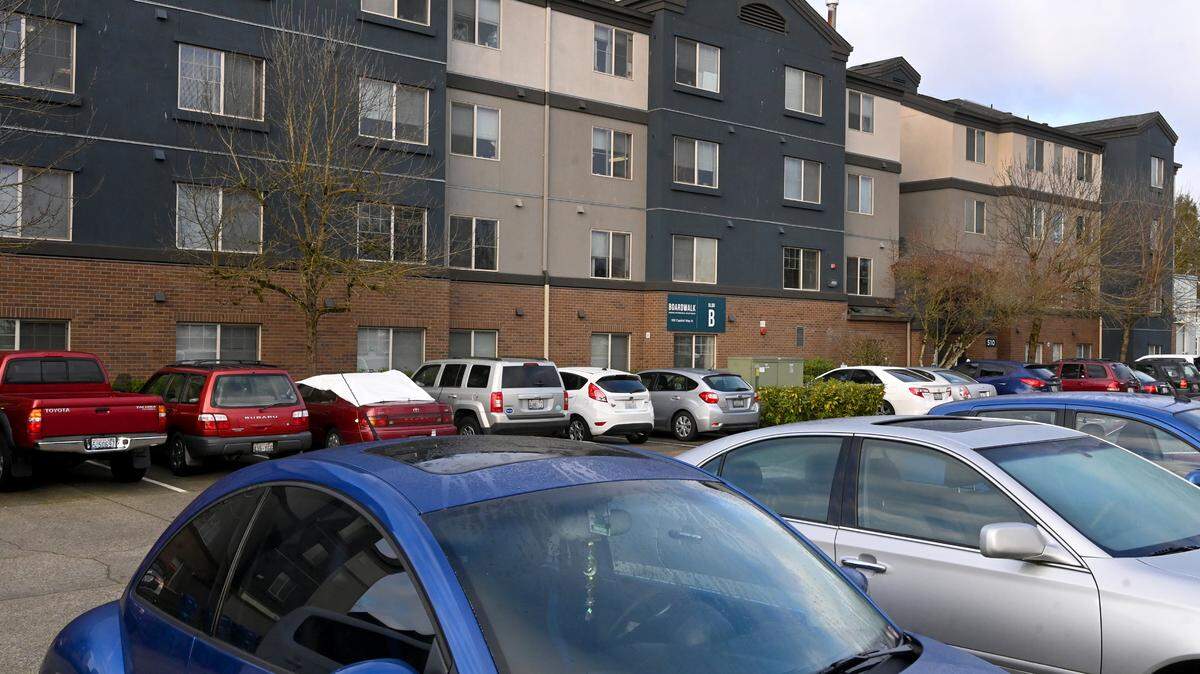
Washington lawmakers this session are working on ways to fix the state’s housing problem. One possible supply-related solution? Parking reform.
During a public hearing on Jan. 24, some 30 people spoke in support of Senate Bill 5184, sponsored by state Sen. Jessica Bateman. The Olympia Democrat who chairs the upper chamber’s housing committee said the bill is designed to help boost Washington’s housing supply.
“Our minimum parking requirements are outdated and archaic,” Bateman said Jan. 24, “and they’re getting in the way of building the housing that our communities desperately need.”
She later added: “This is about right-sizing parking for where you need it, when you need it.”
Senate Bill 5184
The Parking Reform Act is meant to offer builders greater flexibility when creating parking for their projects. No one would be forced to build in any given way, Bateman said in a news release. Rather, the bill would work to grant them more options “so we can get more affordable buildings on the market.”
In some places, it might make sense to have tons of spaces for parking, she said. In others, that amount of parking wouldn’t be necessary; it may even be counterproductive.
“Too many cities currently require more parking than they really need, and this bill prevents those overly broad requirements that force builders to pave more parking spots than the people who live, work, and shop there really need,” Bateman said in the release.
Nearly 60% of renter households in Washington have just one car or none at all, Bateman’s news release says. Yet in most counties and cities, builders aren’t allowed to offer just one parking spot per home.
The release also says about 25% of the state’s homeowner households own either one or no cars. The vast majority of jurisdictions, however, call for at least two off-street spaces per single-family home.
The bill would, in part, bar cities and counties from “requiring more than 0.5 parking space per residential dwelling unit.” It would also prohibit them from mandating more than one spot per 1,000 feet of commercial space.
Support for parking reform
Most of the people who signed up to speak about the bill at the Jan. 24 hearing were supporters.
Nicholas Carr, senior policy adviser for housing in Gov. Bob Ferguson’s office, noted that two of the governor’s top priorities are housing and affordability: “And this bill addresses both.”
Developers don’t stop constructing parking if mandates are nixed or lowered, Carr said. That just allows more leeway to properly match parking needs to the project at hand.
Representatives of cities such as Vancouver and Spokane testified in favor of the measure. So did Bellingham City Council member Jace Cotton, who said parking minimums are arbitrary and the single greatest barrier to construction, particularly to middle housing.
The Bellingham City Council recently approved a year-long pause on minimum parking requirements for new builds.
“While I’m thrilled that more cities like mine are stepping up to the plate of parking reform, we still need state leadership,” Cotton said, adding that in many places, a small number of vocal opponents “hold disproportionate sway. And your leadership can help make sure that we meet our housing goals statewide and have an equitable approach for all of our communities.”
Amy Anderson with the Washington Childcare Centers Association gave an example of why she thinks parking reform is needed.
Anderson said on Jan. 24 that building plans for one child-care project had to be scrapped because of excessive county parking requirements. That, she said, led to the loss of a center that could have served 130 kids and employed 20 staff.
Other speakers noted that the bill could effectively help to retain urban tree canopies and assist in other sustainability goals.
Wes Stewart with the Washington chapter of the Sierra Club said parking-minimum requirements undermine public-transportation investments. They also add ever-more concrete in areas grappling with the heat island effect, a term used to describe when urban areas are hotter than rural ones due to an abundance of pavement and other heat-retaining surfaces.
“What would be productive land in the center of our most critical urban and community centers is left barren or partially utilized in order to house empty vehicles,” Stewart said. “We do not have a parking crisis. We have a housing crisis.”
Criticism of the proposal
But other speakers raised concerns about the measure.
Mariya Frost, transportation director at Kemper Development Company, said that if sufficient parking isn’t provided with new development, drivers will look for it on the street or someone else’s property. That could potentially lead to greater traffic congestion in downtown cores as they circle to find available spaces, she said.
State lobbyist Amina Abdalla noted that the city of SeaTac has “unique community needs that differ from other areas of the state.” The airport is a big employment hub for SeaTac residents, she said.
“The city has a large number of professional drivers who drive for Uber, Lyft, taxis, limousines and other shuttles,” Abdalla said. “Their car is their business and livelihood. Parking is essential for these workers.”
Others worry that the bill could inadvertently lead to a reduction in accessible parking spaces in compliance with the Americans with Disabilities Act.
House Republican Floor Leader April Connors told McClatchy that she has been in the real estate industry for more than 30 years. To her, housing supply has always been important.
Connors said she recently spoke with the mayor of Kennewick, who’s also a builder with concerns about a “one-size-fits-all approach to parking.” Eastern Washington is more spread out than the western part of the state, she said.
“We still have a little bit of land available through our urban-growth boundaries to expand our cities, whereas cities like Seattle — King County, Pierce — it’s harder for them to expand, so they’re actually building up more,” Connors said. “So having less space for parking for them is maybe not as much of a problem as it is for Eastern Washington.”
Connors added that Eastern Washington doesn’t have the same public transportation systems as Western Washington. Seattle, for instance, has ample public-transit options such as the light rail.
Senate Republican Leader John Braun also has some concerns.
The Centralia Republican told McClatchy he appreciates that Bateman is looking for ways to make building housing less expensive. But limiting parking could hamper the creation of housing that suits people’s needs and job opportunities, he said.
“The notion that renters don’t have cars so we don’t need so much parking, I think that’s a bit of a chicken and egg,” he said. “Do they not have cars because there’s not parking, or should we not build parking because they don’t have cars? I think it’s more the former than the latter.”
This story was originally published January 29, 2025 at 5:00 AM.
.jpg)