
Gov. Bob Ferguson calls Dems’ new tax plan ‘too risky’ amid federal uncertainty
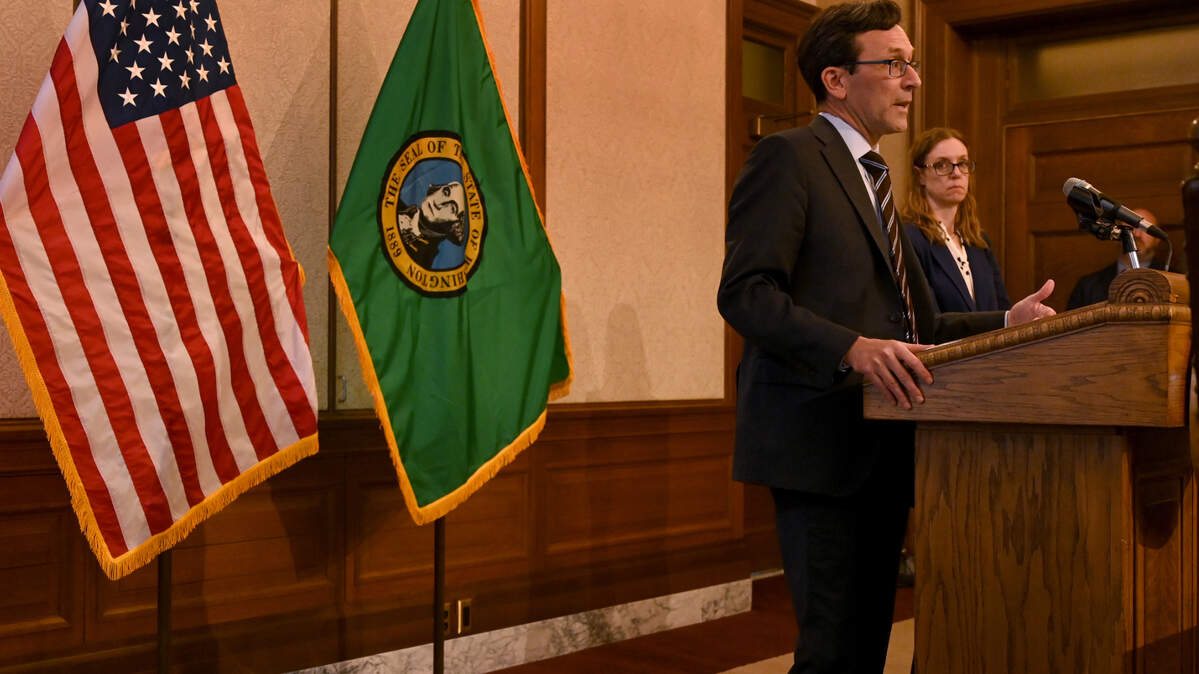
Gov. Bob Ferguson said Thursday that House and Senate Democrats’ latest revenue proposal, which would raise roughly $12 billion over four years, is “too risky.”
The governor said in his view, the new plan fails to prepare Washington for an impending crisis as the administration of President Donald Trump continues to make sweeping cuts to federal funding, programs and jobs.
“I thank legislators for their hard work as we balance a budget with a $16 billion shortfall,” he said in an April 17 statement. “While our budget situation is currently challenging, it may soon become dire with additional cuts and chaos from the Trump Administration. We must defend Washington in the face of that.”
Earlier this month, Ferguson said he wouldn’t sign off on House and Senate lawmakers’ initial budget proposals because of their over-reliance on added tax revenue.
Washington Democrats this week revealed an updated tax pitch. Although Ferguson had shot down their initial “untested” wealth-tax measure — a key component of their initial budgets — the new revenue proposals still target the state’s wealthiest residents by pushing to make capital gains and estate taxes more progressive.
Their budget plans also include other tax ideas, including some focused on increasing business and occupation and property taxes.
Republicans have long insisted that the budget problem could be fixed without more taxes, and business leaders argue that the majority party’s proposals would drive out innovation and jobs.
But progressive-revenue supporters contend that the state’s tax code is at once archaic and unfair. They say that the tax burden should be shifted from the shoulders of the working class onto those of the state’s richest residents.
Ferguson said Thursday that 28% of Washington’s budget is composed of federal funds, including billions of dollars for K-12 education, Medicaid, disaster recovery, child welfare and more. Funding continues to be denied, frozen and canceled by the president’s administration and special government employee Elon Musk of the Department of Government Efficiency, he said.
Just last week, the Federal Emergency Management Agency denied Washington’s federal-aid request to help repair damages cause by November’s bomb cyclone, he noted. The federal department didn’t give a reason for the denial, even though the state met the criteria.
He also cited the Trump administration’s attempt to slash $160 million in public-health dollars, as well as impose tariffs, which Ferguson said will hit trade-dependent Washington particularly hard.
“We must ensure Washington is in the best possible financial position to weather more cuts and damaging economic policies from a Trump Administration that weaponizes funding to punish those it disagrees with and forces them into compromising their values,” Ferguson said in a statement. “We need a balanced approach, using a reasonable amount of progressive revenue and adopting solutions to reduce our spending.”
Ferguson did offer lawmakers a bit of encouragement, though. He said they’ve made progress in their new pitches and worked to shift the state’s regressive tax system, and he acknowledged that they’ve stepped away from the original wealth-tax proposal.
But Ferguson remains tight-lipped about which, if any, tax ideas he’d support. He also hasn’t said if there’s a revenue number, ostensibly one lower than $12 billion, for which they should aim.
Both Democratic and Republican leadership also seem to have been kept in the dark.
Earlier on Thursday afternoon, House Speaker Laurie Jinkins said that she hadn’t spoken with the governor or his office about the Democrats’ tax plans, but that they had a meeting scheduled for later.
“So I expect I’ll hear about it from him then,” the Tacoma Democrat said. “My hope is that he has things that he likes, things that he doesn’t like. But I’ve been waiting to hear something he likes when it comes to revenue, so I’d love to hear some.”
Senate Minority Leader John Braun of Centralia said Thursday morning that Ferguson hasn’t indicated where he’d land on the tax proposals in talking with Republican leadership: “He’s really not telling us anything privately that he’s not saying publicly.”
Braun said it isn’t clear to him that the governor is comfortable with the level of taxation the Democrats put forward.
“I can’t say where the governor will come down eventually,” Braun said.
Senate Republican budget leaders agree with Ferguson’s calculation that the $12 billion tax package is still too large. Sen. Chris Gildon of Puyallup, Senate Republican budget leader, said in a statement that that would be the case regardless of who’s president.
“If we truly want our state to be ready for any sort of fiscal turbulence, let’s have a new budget that avoids tax increases completely — whether they’re ‘progressive’ or not,” he said.
Gildon added that his caucus’ proposal, the “$ave Washington budget,” is the best answer to Ferguson’s concerns, in part because it doesn’t hike taxes while also preserving the state’s rainy-day fund.
Assistant Senate Republican budget leader Sen. Nikki Torres called Ferguson’s remarks “right on time.” She respectfully disagrees, however, that progress has been made on Washington’s regressive tax system, noting Democrats’ suggested property- and sales-tax increases.
“To us, any new taxes would be risky,” the Pasco Republican said. “The question now is whether the Democrat legislators will heed the governor’s words or continue going back and forth with him.”
There are 10 days left in the 2025 legislative session. Lawmakers will need to pass a revenue package and underlying budget before adjourning April 27.
.jpg)