
WA child fatalities, near-deaths triple in first quarter of 2025, state data show
AI-generated summary reviewed by our newsroom.
- DCYF reported 27 critical incidents in Q1 2025, tripling last year's Q1 total of nine.
- Opioid exposure caused 87% of critical cases among children ages zero to three.
- State budget cuts led to loss of funding for the Pediatric Interim Care Center in Kent.
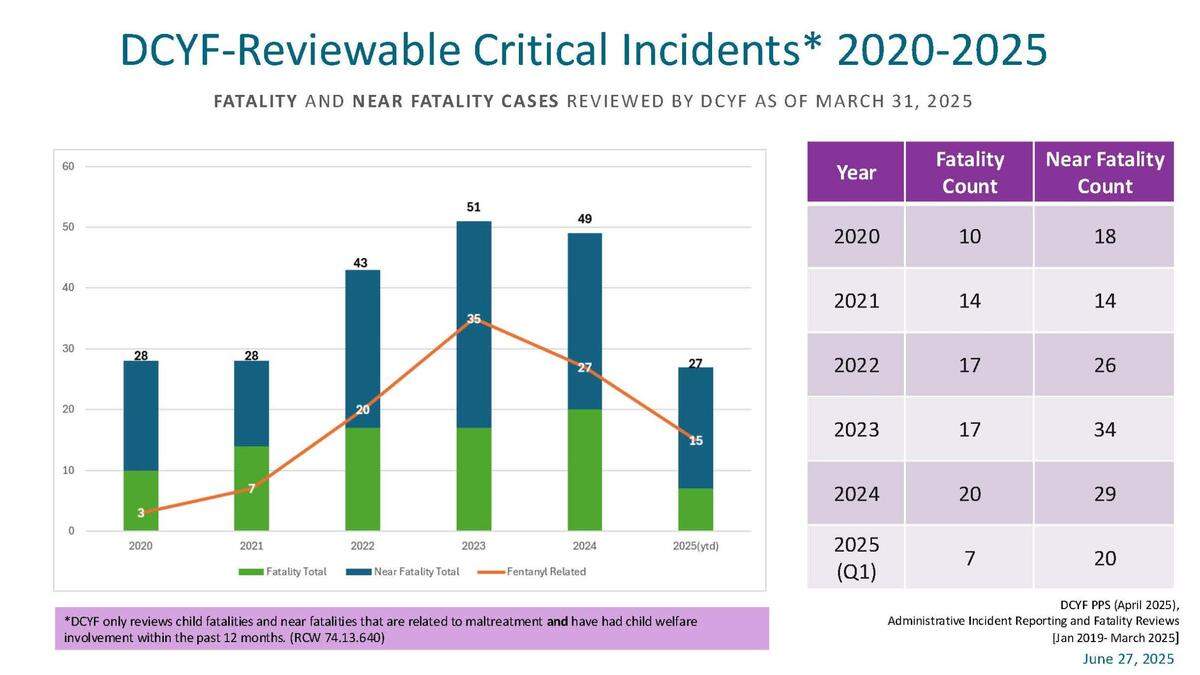
During the first quarter of 2025, the number of children under state supervision who died or nearly died has tripled compared with the same period last year, according to new data.
The Department of Children, Youth and Families (DCYF) told reporters that from Jan. 1 through March 31 this year, there were 27 DCYF-reviewable critical incidents. Over the same time span last year, nine such incidents occurred.
Seven of the children died, and 20 of this year’s cases were near-deaths.
DCYF Secretary Tana Senn said those numbers represent young people who’ve had some interaction with DCYF at any point in the past year.
“Anytime there’s a fatality or near fatality of a young person, absolutely — it is tragic,” Senn said. “Reading the cases every time is heartbreaking. So it hits you personally every single time.”
Of the cases that involved babies and children up to 3 years old, about 87% — or 13 in 15 — were related to opioids.
KING 5 reported that in many instances, an infant might have put a straw or foil used to smoke fentanyl into their mouths. Other times a toddler may have accidentally ingested a pill that looked like candy.
But multiple factors are to blame for the spike in deaths and near deaths, DCYF reports.
The agency is still examining data, but initial analysis has identified four primary drivers: parental stress, more high-needs families, complex cases and involved systems — plus the High Potency Synthetic Opioid epidemic. Fentanyl is an HPSO.
Senn, a former Democratic state representative, said that the rise in parental stress coincides with a decrease in the financial support provided to families since the pandemic. She said the agency is responding to the issue, including by increasing certain case-worker trainings and conducting information-gathering sessions with front-line staff about cases involving drugs.
State lawmakers passed the Keeping Families Together Act in 2021 in an effort to cut back on the number of kids put into foster care, decrease racial disparities in the child welfare system and help support the relatives who care for children removed from their home for safety reasons.
But critics of the law argue that, although well-intended, it has prioritized keeping families intact over protecting children’s health.
State Rep. Travis Couture is among that law’s fiercest detractors. He said that DCYF’s family-reunification model has led to a dramatic increase in critical incidents and called the latest data “heartbreaking and tragic.”
“This is, sadly, a predictable outcome,” the Allyn Republican said in a June 30 call, adding: “I knew it was going to get worse, but not this bad.”
Guidance revised last month by the Washington State Department of Health notes that deaths tied to overdoses, especially fentanyl, also rose among adolescents and young adults ages 15 to 20 between 2019 and 2023, aligning with national trends.
PICC in Kent loses state funding
In a June 27 letter, Couture and five other state House Republican leaders urged Gov. Bob Ferguson and Senn to stop the imminent closure of the Pediatric Interim Care Center in Kent. The facility has helped stabilize infants exposed to drugs for 35 years, the lawmakers wrote.
Only $100,000 in state funding was set aside for PICC this year amid a multi-billion-dollar budget shortfall, which already represented a sizable cut, but Ferguson vetoed that funding in May as a cost-saving measure.
“On behalf of the most vulnerable Washingtonians — newborns born into addiction, trembling through withdrawal in their first hours of life — we ask you to recognize the cost of inaction and take immediate steps to safeguard these fragile lives,” House Republican lawmakers said in the letter.
Couture authored an opinion piece for The Seattle Times arguing for PICC to remain open.
“Even after the veto, PICC might have survived,” Couture wrote. “But the Department of Children, Youth, and Families terminated PICC’s contract — the agreement that allows hospitals and state services to place infants there. Without it, PICC can’t take babies, regardless of how many beds are open or how urgent the need.”
DCYF is ending the contract with the Kent PICC because there isn’t additional funding provided by the Legislature for the department to renew it, Senn said.
In a follow-up statement, the agency cited the state’s budget deficit and said that current funding going to the center wasn’t cost-effective.
The statement said PICC received state funding for 13 beds regardless of the number of children it served; the department said that number hovered between one and three per month. The Kent facility also did not meet the requirements to draw down Medicaid funding.
The department isn’t shutting down the PICC in Kent, DCYF said.
“They can still accept referrals from hospitals and have informed DCYF on multiple occasions that they have sufficient charitable funding to continue serving children,” the statement continued.
Barbara Drennen, PICC’s founder and executive director, said in a call that the center’s last baby left on June 30. PICC was told it can’t accept any more, she said, adding that she wants the governor to step in and reverse course.
Drennen argued that the cost difference to the taxpayer is significant: When a child is in the hospital’s neonatal intensive care unit, it costs thousands of dollars, she said. But it’s only about $160 per day when a baby stays at PICC, she said.
Typically babies who come to PICC from the hospital stay for about 30 days, Drennen said. Looking ahead, the center will stay open in the hopes it will get money in the supplemental budget next year.
“Whether we can do that or not, I don’t know,” she said. “But the babies need us, and they need the protection that the state provides.”
This story was originally published July 3, 2025 at 5:00 AM.
.jpg)