
Historic ‘millionaires tax’ debate ends after more than 24 hours in WA House
AI-generated summary reviewed by our newsroom.
- Debate on SB 6346 has stretched about 23 hours and counting.
- Republicans introduced dozens of amendments; some oral roll calls slowed debate.
- Democrats called SB 6346 the "millionaires tax" and a historic tax overhaul.
It took more than 24 hours.
Washington lawmakers started arguing for and against a controversial income tax bill Monday at about 5:30 p.m. They continued debating well into Tuesday’s early-morning hours and through the afternoon, with no clear end in sight.
Some lawmakers had developed dark circles under their eyes by late Tuesday afternoon.
Republicans argued against the proposed income tax on those earning more than $1 million a year, introducing dozens of amendments. With many of the roughly 80 amendments — some of which were also filed by Democrats — the minority party requested individual oral roll call votes, further slowing down the process.
Likewise, Democrats say that Senate Bill 6346, which supporters have branded the “millionaires tax,” is far too important to not give it their all.
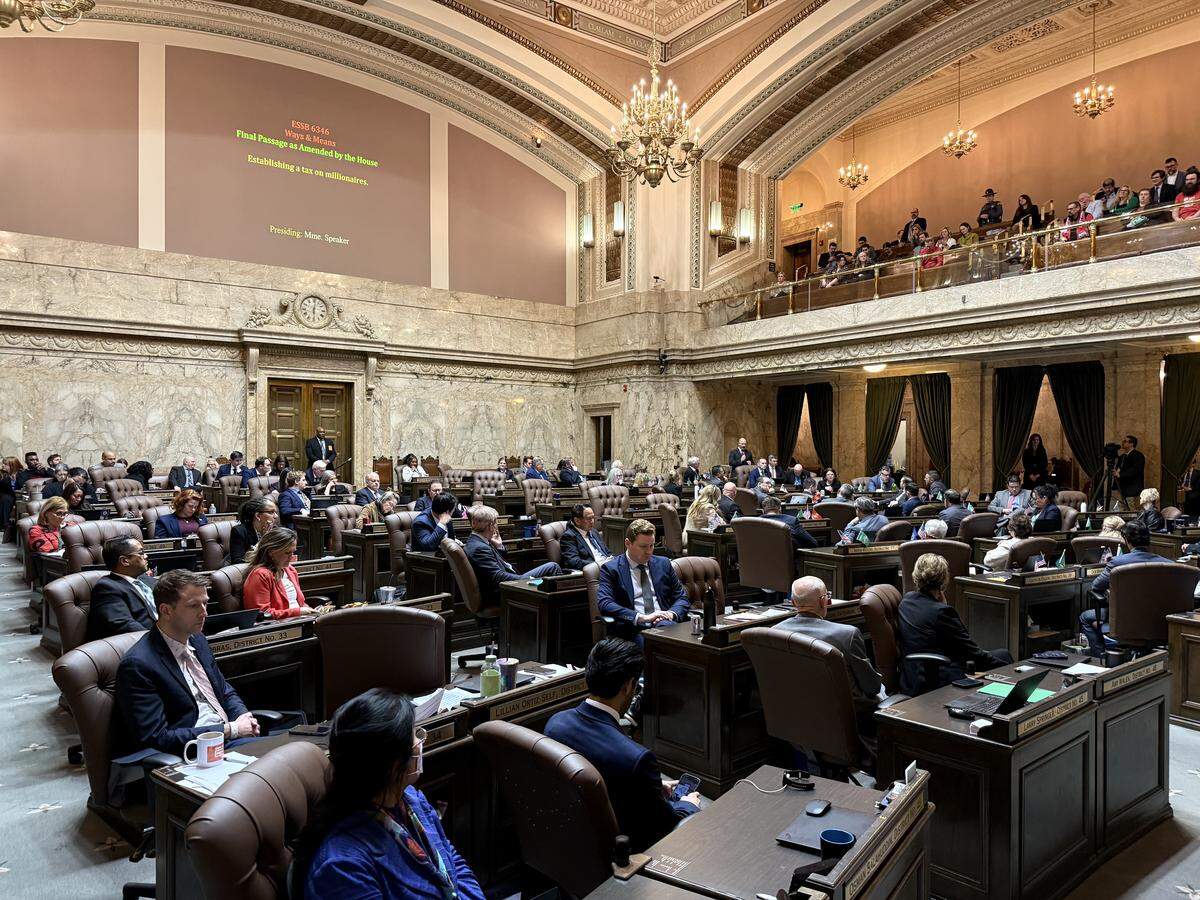
Following moments of passionate rebuttal and, occasionally, brief bursts of delirium by colleagues, multiple local legislators told McClatchy that they believe this debate could be the longest in state history.
House Speaker Laurie Jinkins on Tuesday afternoon called the proposal a “historic, nearly 100-year bill” to remake the state’s tax structure. The Tacoma Democrat said her caucus entered the debate knowing that it’d be lengthy.
Some members were up for 24 hours debating the legislation, she said, remarking on the support they received from constituents.
“All kinds of Washingtonians from all over the place sent us fruit, sent us bagels; somebody brought us tacos,” Jinkins said. “We have been able to get really great sustenance from folks who have said, ‘Keep going.’ And that’s what we’re going to do.”
SB 6346 ultimately passed off the House floor after 6 p.m. March 10 on a 51-46 vote. Gov. Bob Ferguson walked into the chamber minutes beforehand; after passage, people in the wings shed tears, hugged and cheered.
.jpeg "IMG_0649 (2).jpeg")
Ferguson endorsed the House’s revised bill in a statement late last week. The Democrat told reporters that it’s not often votes are “truly historic” like this, that he appreciated the lengthy debate and that it was good for Washingtonians to see.
“Debate wasn’t cut off. I kept getting up in the middle of the night, every couple hours and going to the TV, and they were still going,” he said. “And it’s also an example of what democracy looks like, and I appreciate that.”
Only Democrats supported SB 6346 on its final passage, though eight voted against: representatives Dan Bronoske of Lakewood, Melanie Morgan of Spanaway, Kristine Reeves of Federal Way, Adison Richards of Gig Harbor, Alicia Rule of Blaine, Clyde Shavers of Clinton, Joe Timmons of Bellingham and Amy Walen of Kirkland.
Kennewick Rep. April Connors, the House Republican floor leader, called the debate the “fight of the century.” Its structure kept lawmakers on the floor, she said, leading to relatively few moments of respite. Some members of her caucus were able to sneak in a short nap on a couch.
Connors noted that voters have repeatedly rejected income taxes in the past.
“When we’re fighting back against the biggest bill in history,” she said, “we’re going to do the biggest fight in history.”
Rule said via email that she hadn’t slept more than 10 minutes upright in a chair to ensure she didn’t “miss a word of this debate.” She called the proposal a significant change in Washington state, adding that she takes seriously the community’s trust in her to be their voice.
As for how lawmakers were breaking to eat, Rule said, some folks packed lunches. She said she often loses track of time during these long nights, so sticking to a meal schedule can be tricky. There’s a cafeteria downstairs, and like many offices, “the refrigerator smells a little funky and is overflowing with containers of unknown and unclaimed food.”
“My favorite part is when members bring something special to them to share,” Rule said. One example she cited: Jinkins is known to deliver her mom’s traditional bars or cookies from the Midwest.
Following hours of debate and having examined the budget, Rule said she was opposed to the current bill, arguing that it doesn’t go far enough to give relief to the seniors and working families of her district.
Olympia Rep. Lisa Parshley held a mug of green tea when speaking with McClatchy, noting that Democratic lawmakers would sleep in 20-30 minute shifts. She had about a half-hour of sleep at about 1 a.m. Others hadn’t slept a wink.
“But that’s how committed we are to this,” she said. “I think you see the fire in our bellies.”
The Democrat said that since serving on the Olympia City Council, she’s known that Washington’s tax structure is hurting cities, counties and the state. She backed the tax as a way to ensure fairness and so the state can adequately fund schools, housing and health care amid federal cuts.
Rep. Andrew Barkis, an Olympia Republican, said that lawmakers had a moment when they realized the debate could be potentially historic. He said scores of Washingtonians reached out after checking on the debate upon waking up that morning.
Speaking about amendment after amendment isn’t easy to do, Barkis said, adding that his colleagues offered takes on numerous angles of the bill, with little redundancy.
“That, I think, was really unique to this debate,” Barkis said. “As a result, it created energy, and we fed off that energy — and it’s motivated us, and it’s driven us.”
Richards pulled an all-nighter. He said he’s been “laser-focused on making sure I’m getting the details right and paying attention” to best represent his constituents.
Like Rule, Richards was among a subset of House Democrats with major reservations about the bill. He said Tuesday afternoon that he didn’t plan to vote in favor of the legislation, citing constituents’ concerns about adding on more taxes, and that he wanted to see more on the tax-relief side.
Speaking to McClatchy with a to-go coffee cup in hand, Richards said he’d been sustained by “probably too much coffee.”
“There’s just so much to think about that is keeping my mind buzzing,” he added. “But I know the crash is going to come later.”
After Tuesday’s final vote, Democratic Rep. Mari Leavitt said in a call that the debate may have been long, but she doesn’t see that as a negative. She thought it was crucial for everyone to speak on behalf of those they serve.
The University Place lawmaker said it’s pretty rare that lawmakers stop in the middle of debate once it’s begun. Plus, the final day of session is Thursday, and there’s still lots of other work that lawmakers have to complete before then, like passing budgets.
Leavitt said she’d heard from constituents with serious concerns about the bill; some fear the taxable threshold might be lowered to eventually apply to them. That weighed heavy on her mind, and she wanted to ensure the bill provided those in her district with solid relief. She didn’t take her decision lightly.
Once Leavitt gets home, she said she’d take a shower, pet her dog, say hi to her kids and head to bed.
“We’ve got to be back on the floor at 9 a.m.,” she said.
Editor’s note: This article has been updated with additional comments from lawmakers, the governor, and the results of the final vote.
This story was originally published March 10, 2026 at 5:29 PM.
.jpg)