Reykdal faces challenger David Olson in race to lead WA schools. Here’s how they differ
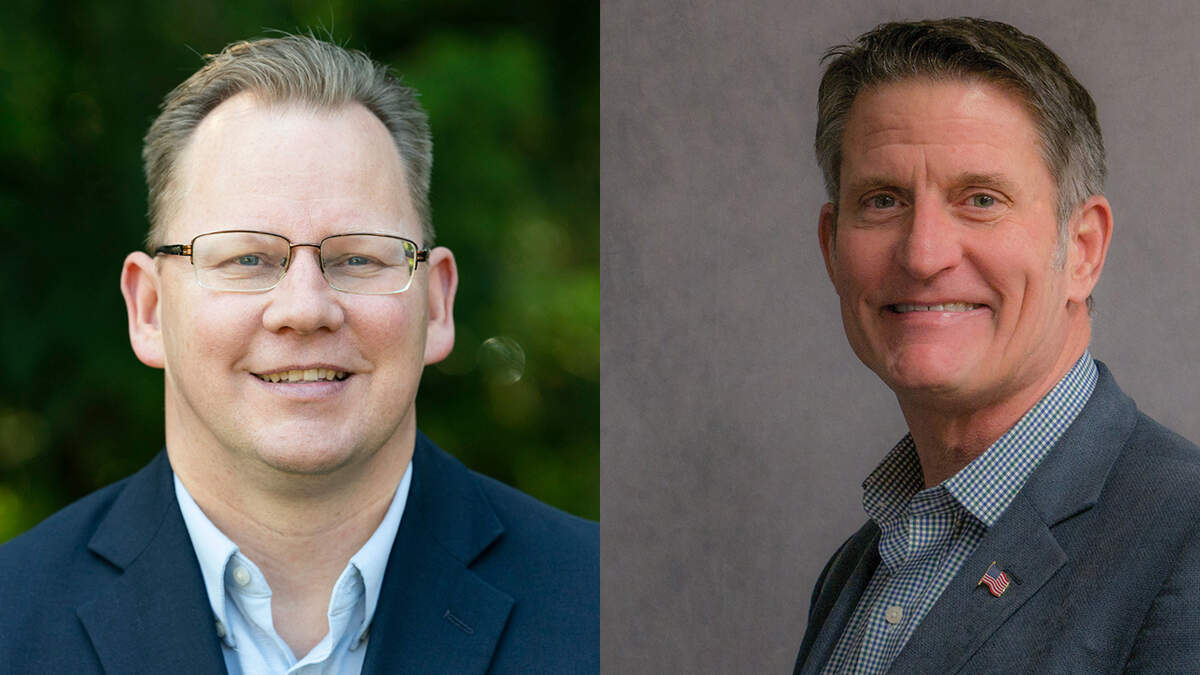
The similarities between the candidates for Washington’s next public schools chief, Chris Reykdal and David Olson, are few.
Incumbent Reykdal credits public education as the “great equalizer” that helped him, a first-generation college student, access opportunities otherwise out of reach. He’s served as the state’s superintendent of public instruction for two terms after he was elected in 2016.
Olson, a retired Navy officer, states the chance to give his kids a high-quality education was a powerful draw for his family to move to the Peninsula School District in the Gig Harbor area, where he has served since 2013 on the school board.
The two agree on several of the problems facing Washington’s K-12 school districts. The Office of the Superintendent of Public Instruction oversees 295 districts total, plus six schools run by American Indian tribes via state agreement.
Both candidates on the ballot Nov. 5 say the state isn’t adequately funding public education. They also say students are increasingly struggling with their mental health and that there’s a critical shortage of school staff, especially paraeducators and bus drivers needing higher wages.
They disagree on other points.
Here’s a snapshot comparing their views on managing public funding, student achievement in the state and parental rights in education.
On funding education
It’s a constitutional duty for the state to fully fund “basic education.” The state Supreme Court ruled in the 2012 McCleary case that the state Legislature wasn’t doing its job. The court lifted sanctions after the state increased its funding to be in compliance for the 2018-19 school year.
Reykdal and Olson believe schools still aren’t getting enough funding in 2024. The percentage of the state’s general fund budget dedicated to K-12 education funding declined from 52.4% in 2019 to 43.1% in 2024, according to OSPI data. Combined with inflation and the drying up of federal aid dollars schools received during the COVID-19 pandemic, some school districts are facing serious financial challenges. These include districts in Seattle, Marysville and Moses Lake.
OSPI doesn’t have the authority to change how much funding school districts receive from the state or federal government, or how school districts choose to spend their money. The office does make legislative budget requests and carries out the actual allocation process.
Olson says he would push the state Legislature to fully fund student transportation and special education as well as update the formula for distributing money to school districts so that it better reflects students’ needs. Washington follows a “prototypical school funding model” that distributes money to schools based on the recommended number of staff for a given number of students.
He gave an example from his own district to show why he believes that formula is broken: Peninsula School District has about 9,000 students, but it only qualifies for one state-funded psychologist.
“That’s ridiculous,” Olson said. “We hire 13. The additional 12 psychologists we hire comes from our levy. But the levy isn’t meant to do that.”
To achieve this change, Olson said he would “bring educators, school superintendents and experienced board members to the table and sit down with our state legislators and say: ‘Let’s work this out together.’”
He also believes that some districts haven’t managed their budgets wisely and says he would help districts better manage their money. If elected, he said he would require all school board members to take a basic course on how to read public finance documents within six months of their election, as well as require them to participate in budget discussions and listen to monthly budget updates.
According to an OSPI report, the office doesn’t “have direct authority over the day-to-day operations of individual schools and school districts,” but does provide “support and information for these activities.”
Olson said he’s qualified to help districts become more fiscally responsible because he’s able to understand complex budgets with his career experience in banking and because of his district’s financial record in the last four years. The Peninsula School District built four new schools “on time and on budget” during the COVID-19 pandemic and didn’t misuse their federal pandemic relief funds, didn’t close any schools and didn’t lay off any teachers, he said.
The News Tribune reported that the district did estimate it would face a $12 million budget deficit if it didn’t decrease staffing and programming in April 2023. The projected deficit forced it to make reductions or cuts to the equivalent of 40 full-time non-teaching positions in the following school year, The News Tribune reported.
Current Superintendent Reykdal submitted his approximately $3 billion budget request for the 2025-27 biennium to Gov. Jay Inslee last month. In his letter to Inslee describing the request, Reykdal’s asks include for the state to fully fund special education and transportation, cover costs for district materials, supplies and operations and support living wages for school staff. It also asks the state for more funding for high-poverty schools and continued support for student mental health services.
Reykdal told The News Tribune his budget request, if approved by the state, would help mitigate the severe toll that inflation has taken on districts’ spending power.
“Just to pay insurance bills to keep the doors open, districts are having to compromise programs, right?” Reykdal said. “Because the first obligation is to make sure the school is available for kids, but inflation is eating up student programs in order for districts to pay the essentials.”
Reykdal said he thinks districts consistently balance their budgets well. Where they have started to see problems, he said. is in districts where they failed to pass their levy, sending them into a crisis. OSPI is working with a few districts in that crisis stage to provide technical assistance and make sure they make the cuts necessary to balance their budgets, he said.
He also said some districts, like Peninsula, were able to manage their federal COVID-19 recovery funds more easily because they received less of it based on the poverty-based formula that gave more funding to poorer districts. Poorer districts “had to be a lot more careful around both spending it on time, but also spreading it out over the three-and-a-half years to support their kids for this moment,” Reykdal said.
In order to keep existing levels of revenue for schools, Reykdal said voters will need to maintain the capital gains tax, which helps fund early learning and school construction, and the carbon tax, which helps fund electric buses and school infrastructure. Initiatives to repeal both are on the ballot this November.
On declining student outcomes
In recent years, academic performance as measured on standardized tests has declined among Washington state students.
Reykdal has repeatedly denied that students are falling behind academically relative to other states, though he acknowledges students’ scores have declined nationwide on the Nation’s Report Card.
“I don’t buy any of the idea that Washington has slipped,” Reykdal told The News Tribune.
He emphasized the Report Card uses statistical significance to determine how states stack up against each other, meaning Washington’s fall in the ranks may not be as drastic as some suggest. A state with an average score of 230 and another with 231 on a 500-point scale would be considered virtually the same if the difference between them falls within the margin of error, he said.
“I want to acknowledge that we have to really make improvements there, but what I don’t accept are people who try to use (that assessment) as a ranking system and say that in fact, there are fewer states today that are statistically outperforming us than when I started in both math and ELA (English Language Arts),” Reykdal said.
A few of the rankings in question show that in 2017, Washington had an average fourth grade math score of 242 on the National Assessment of Educational Progress, according to the Report Card data. Eleven states and the Department of Defense Education Activity (DoDEA), which operates schools for children of military servicemembers, had higher average scores that year. In 2022, Washington’s score was 235, surpassed by 25 states and DoDEA.
Reykdal pointed to the record-high graduation rates the state has seen during his time in office. An OSPI news release in December said that the four-year graduation rate for the class of 2023 reached 83.6%, the highest it has ever been in the state. The news release also cited data from the Washington State Education Research and Data Center (ERDC) showing an increasing trend in students taking dual credit courses and a decreasing trend in students needing to take pre-college or remedial courses when they start college.
Olson said declining student performance and the fall in Washington’s rankings relative to other states was one of the reasons he decided to run for office.
He emphasized that if the state fully funded special education, school districts would be able to hire more paraeducators, counselors, psychiatrists or psychologists, and provide extra support for struggling students. This would lessen the burden on teachers already overwhelmed with teaching and lead to better outcomes for these students, according to Olson.
His campaign website says he would work to maintain highly capable programs and Advanced Placement courses for high-achieving students, and address the issue of chronic absenteeism by encouraging school districts to enforce policies that couple attendance with a grade or other consequences.
Olson came under scrutiny recently for comments he made at the Washington State Republican Party Convention, when he seemed to discourage high school graduates from going to college and instead pursue the skilled trades. If every graduate did so, universities “could all go bankrupt and that would save America,” he said at the convention.
He later told The News Tribune his comment requires context, and that he has multiple family members with college degrees.
“I absolutely don’t advocate for getting rid of higher ed,” he said.
He said he was being facetious at the convention and probably shouldn’t have made the comment in question. Supporting the skilled trades is one of his campaign priorities and stems in part from his career background as a Navy electrician, underwater welder and diver.
On parental rights and DEI
When it comes to the role parents should play in their children’s education, Olson said in an email to The News Tribune that they: “are the ‘primary stakeholder’ in their children’s lives — not the school districts. I believe schools should partner with and collaborate with parents and guardians to make sure their children get the best educational experience possible.”
Asked about the role schools should play if students feel unsafe telling their parents about questions of identity, including around gender, that they may be facing, Olson wrote that he believes most parents care about and support their children and want what’s best for them. If there’s a risk of abuse or a situation that would require a school to contact Child Protective Services or the police, those students need to be protected, but in most cases the school should notify the parents so they can work together to support the student, he said.
Reykdal’s office released guidance after Initiative 2081, called the “Parents’ Bill of Rights,” was passed into law earlier this year alerting districts to possible conflicts between the law and existing student privacy rights protected by federal law. Initiative 2081 gives parents and guardians several rights that include permission to view their children’s textbooks, access academic and medical records, and opt their children out of certain surveys or activities.
He also believes in “keeping our public schools public,” and believes that taxpayer dollars should not go to religious and for-profit schools, according to his campaign website.
The two candidates also differ on their approach to diversity issues in schools.
At the Washington Republican convention, Olson said he’d led “the first school board in the state to ban controversial social issues like critical race theory, DEI and all that horrible stuff.”
Asked about his opposition to critical race theory and DEI, which he also expressed at the convention, Olson said the Peninsula school board passed a resolution that said the district doesn’t teach critical race theory. That doesn’t mean they aren’t committed to teaching an honest and accurate history of the United States, including the history of slavery and women’s suffrage, he said.
Reykdal’s campaign website says that one of his priorities is to protect LGBTQ+ students.
“We must continue to teach our students the importance of gender diversity, whether it be through direct lesson plans or by lifting up classroom materials and books that feature LGBTQ+ characters,” he wrote.
This story was originally published October 21, 2024 at 5:00 AM with the headline "Reykdal faces challenger David Olson in race to lead WA schools. Here’s how they differ."