
The first live Asian giant hornet was caught in Washington. State is still hunting its nest
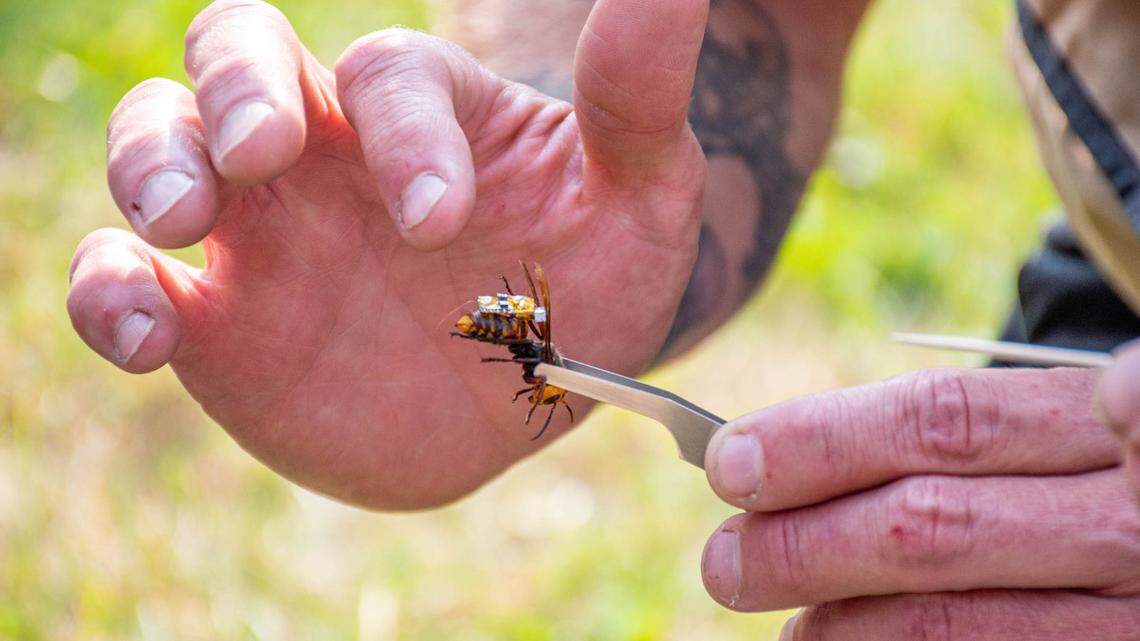
The Washington State Department of Agriculture caught a live Asian giant hornet in a net this week southeast of Blaine but efforts to glue a radio tag on it to track it back to its nest were unsuccessful.
The live capture on Tuesday, Sept. 29, and the tracking effort were firsts for Washington state.
So why didn’t the tracking effort work?
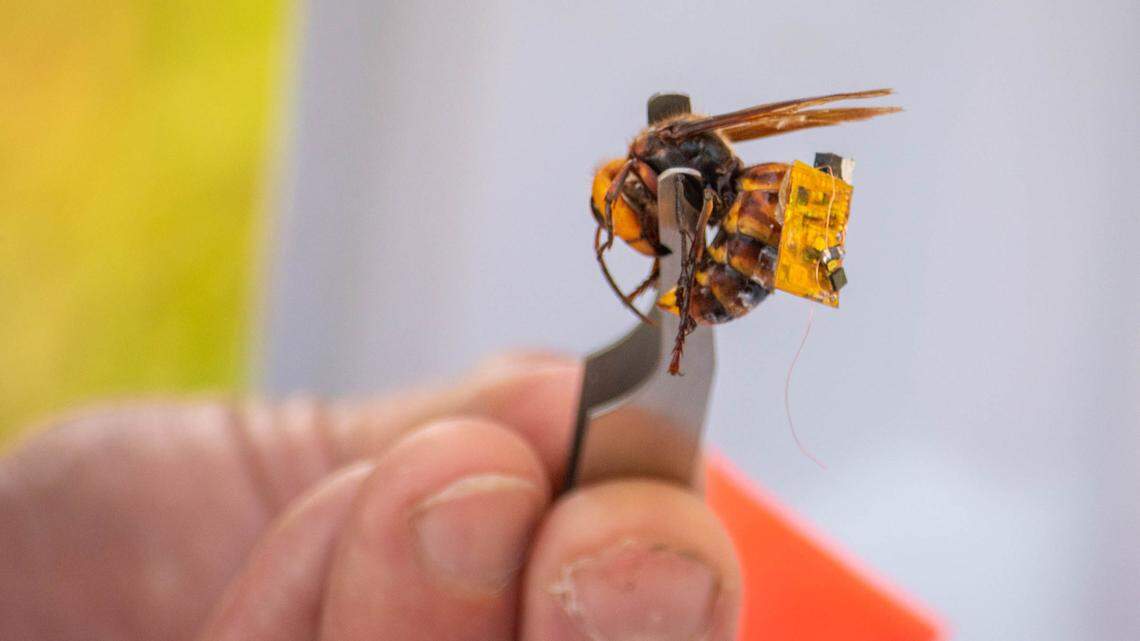
Partly, because such tracking tags are usually glued on honeybees, bumblebees or other insects that have more hair on them. Asian giant hornets aren’t as hairy so getting the tag to stick on a wiggling hornet with glue that didn’t dry fast enough was an issue.
The tag slid off the hornet as Washington State Department of Agriculture officials were waiting to release it and its wings came into contact with the glue so it couldn’t fly and lead the agency’s entomologists back to its nest, officials said during a virtual briefing on Friday, Oct. 2, on the state’s efforts to keep the pests, popularly known as “murder hornets,” from becoming established in Washington.
Asian giant hornet nest nearby?
Given that live capture and other reports of Asian giant hornets found and captured on camera in the area in recent days, Sven Spichiger, managing entomologist for the state agency, believes there’s an Asian giant hornet nest in the area.
He said they hoped to find the nest within a couple of weeks at the latest and destroy it as part of the effort to prevent the invasive hornets from becoming established in Whatcom County and, by extension, Washington state and the U.S.
New sightings in recent days bring to 15 the total number of Asian giant hornets found in Whatcom County since winter 2019, officials said on Friday.
Up to 2 inches long, the Asian giant hornet, or Vespa mandarinia, is the world’s largest hornet species. They are identifiable by their large yellow/orange heads.
The hornets are known for their painful stings. They will attack people and pets when threatened. People should be extremely cautious near them, agriculture officials said, and those who have allergic reactions to bee or wasp stings should never approach an Asian giant hornet.
Their native range is Asia. They also are known as the Japanese hornet, yak-killer hornet and the giant sparrow bee.
Threat to honeybees
They are feared for the threat they pose to honeybees — they can decimate hives quickly in what’s known as their “slaughter phase,” which they enter into around fall — and, by extension, the valuable crops in Washington state that the bees pollinate.
Honeybees are themselves an introduced, or non-native, species, with hives originally brought to the U.S. by European settlers.
One of the sightings in Whatcom County this week included a door-camera photo that showed an Asian giant hornet on a wasp nest, which concerned Spichiger.
“They’re also attacking some of our native pollinators,” he explained. “They’re going to have an impact on our ecosystem.”
Additional details from the Friday briefing included:
▪ Chris Looney, entomologist with the Washington State Department of Agriculture, was the person who caught the Asian giant hornet in a net near Burk Road southeast of Blaine. He was talking to a man who captured and killed two of the hornets — one in a bottle trap that members of the public have been putting up — on Sept. 21 and Sept. 25, after repeatedly seeing them at a paper wasp nest in an eave of his house, according to Spichiger.
As Looney was talking to the man, an Asian giant hornet flew by and Looney caught it in a net on Sept. 29. That started the unsuccessful tracking effort.
As for tracking efforts, Spichiger said that officials will have to experiment more before the next attempt.
▪ The next day, as state agriculture officials came to the area for the tagging effort, agency spokeswoman Karla Salp found a dead Asian giant hornet in a street lamp.
▪ About 30 traps have been hung in the area to try to capture more live hornets. The traps are clear bottles with an orange juice solution with mesh above it to keep captured hornets from drowning.
Beekeeper advice
▪ An emergency line has been set up for Washington state beekeepers to immediately call when they see their hives being attacked by Asian giant hornets. That phone number is 360-902-1880. Spichiger said a person will pick up, and asked beekeepers to note which direction the hornets are flying to increase the chances of finding, and destroying, a nest.
Even though beekeepers will want to protect their hives, Spichiger urged them to first call the phone number, adding that the state’s motto is “track it, don’t whack it.”
When Asian giant hornets are in their slaughter phase, which they’re entering now, they mark a honeybee hive, attack it, use their powerful jaws to decapitate the bees, and take the bees’ young to feed their own. They can destroy a hive within hours.
▪ Six sentinel honeybee hives have been placed near Blaine, Birch Bay and Custer, where previous Asian giant hornets have been found, to lure live Asian giant hornets from at least one other nest that might be in the area.
They’re fitted with what’s called a hive exclusion device, which looks like mesh grating that is small enough for bees to get through but not the larger hornets. They have been used in Japan for many years, according to Spichiger.
Public help important
▪ Spichiger thanked the public for reporting their sightings, including the man who did so near Burk Road, saying that was on the outer edge of the grid that agriculture officials have been running this year.
“We can’t thank enough the public effort,” he said, urging people to continue to report their sightings.
To do so, go online to the department of agriculture’s Hornet Watch Report Form.
Provide as much detail as you can about what you saw and where. Get a photo, if you can safely, and submit it to help with identification. If you find a dead Asian giant hornet, keep it for potential testing.
The form is the preferred way to report hornet sightings. People also can email hornets@agr.wa.gov or call the hotline at 800-443-6684, although the department said the hotline is backed up and people will get a quicker response if they email.
Learn more at agr.wa.gov/hornets.
This story was originally published October 2, 2020 at 3:35 PM with the headline "The first live Asian giant hornet was caught in Washington. State is still hunting its nest."
