
Good luck getting solar any time soon. Here’s how Bellingham, Whatcom colleges plan to help
Markus Virta wants to add six more employees to the 13-person solar installation team at Western Solar — now.
The Bellingham-based business, where Virta works as director of sales and business development, is seeing the longest wait times for rooftop solar installations in the company’s history. Call Western Solar today and you might be able to get solar panels installed on your roof by January 2023, at the earliest.
“We’ve got a lot of work to do in the industry,” Virta said, noting that he’d much rather see wait times to the tune of two months. “We need to keep adding more jobs.”
A colossal transition off polluting fossil fuels and toward clean energy is coming to Washington and the world — or at least scientists warn it needs to if humanity is going to avoid worsening climate change that endangers communities and ecosystems.
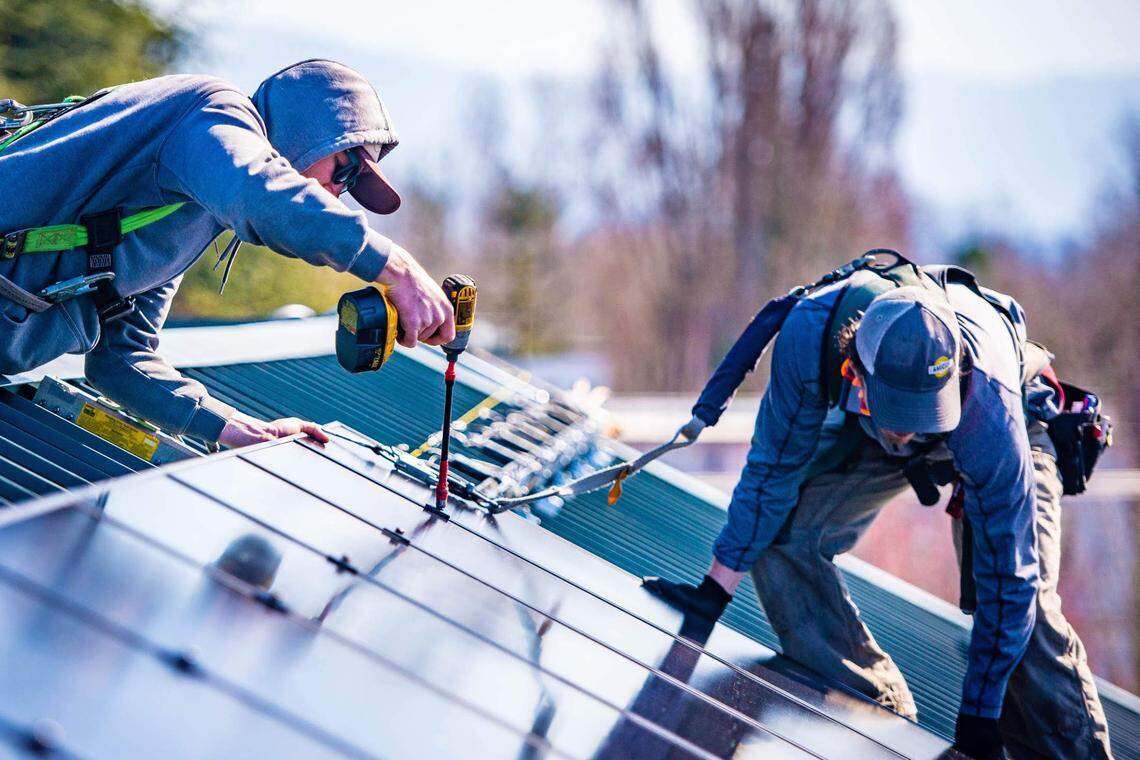
But the infrastructure to support this transition, such as solar panels, doesn’t just materialize out of thin air: It requires workers who know what they are doing.
“We need a lot of good people skilled in the necessary trades to pull a clean energy transformation off,” said Dana Brandt, founder of Bellingham-based Ecotech Solar. “From where I stand, it seems pretty clear that we don’t have the electrical tradespeople necessary to do a massive infrastructure overhaul.”
Local leaders, educators and businesses are wrestling with the question of how to develop that workforce quickly.
“Jobs really do loom large in this conversation here,” said Bellingham’s Climate and Energy Manager Seth Vidaña in a presentation to city council on April 11, discussing the city’s electrification and energy efficiency goals. That entails work installing electric heat pumps and lowering energy use in buildings. Vidaña’s presentation focused on potential uses for the city’s proposed Climate Action Fund.
“If we do move forward on making investments in local solar, we may need to invest in workforce development and could see some increased jobs locally from that effort,” Vidaña said.
Solar is a young enough industry that the lack of workers with installation experience makes it difficult for local companies to quickly scale up operations when demand is high, Ecotech Solar’s Brandt said.
“It would be impossible for me to hire several qualified, experienced tradespeople and have another crew,” he said. Ecotech does all its training in-house, which means there is a “big lag time between when you hire someone and when they are ready to go,” Brandt said.
“If you are at all interested in becoming a licensed journey-level electrician, it is well worth your time,” said Laura Wurth, instructor of engineering technology and clean energy at Bellingham Technical College. “(The energy transition) has given them a huge job niche that likely will be sustained over time.”
Community colleges build programs
There’s one ingredient absolutely necessary in building a robust solar and clean energy workforce: Time.
What Wurth said many people don’t realize is that trades training can be equally as rigorous as a four-year bachelor’s degree program. To become a journey-level electrician, you spend a couple years at Bellingham Technical College learning the basics before moving on to an apprenticeship while continuing to take classes. You don’t get credentials for a few years, Wurth said.
The clean energy transition requires tradespeople to have higher base levels of technical expertise than they previously did, Wurth said, citing conversations with those in the trades. At the same time, there is a waning need for unskilled laborers, or those with no formal training, said Wurth, who uses the pronoun they. Someone hauling panels onto a roof is more valuable if the person can also function as “an electrician’s assistant, rather than just muscle,” Wurth said.
Renewable energy is moving swiftly, they said, with rapidly advancing technology meaning critical changes annually and new business emphases as often as every three months.
“We need to be in a dynamic state with local and state businesses and say ‘OK, what do you need now? What are the basics you know you are always going to need, and what are the new tweaks?” Wurth said.
What the community college requires from local governments and businesses is data and vocal support proving there is a need for workers the school is capable of producing, Wurth said.
“Without a job role we can tag to something we could justifiably teach, the state goes ‘Ah, they don’t need anything, they are good.’ But we are not good,” Wurth said.
Wurth asks employers to be specific in online job postings about what skills a worker needs and if someone with two years of training can meet that need.
“Are you willing to step out of the traditional job roles and maybe create something that meets a need and allows more on-the-job training?” Wurth said. “Things are moving fast enough that we can’t produce someone who can walk in the door and do everything. Would you trust anyone who could?”
Bellingham Technical College is currently working to identify which skill sets are needed by almost all businesses in the clean energy space.
“If you are going to walk in the door to a green building firm, a solar installer, one of the big civil firms revamping portions of the transmission lines, what does everyone seem to need from someone with two years of training?” Wurth said.
At Northwest Indian College, solar workforce development brings the Lummi Nation a step closer to energy sovereignty, said Stephanie Bostwick, the college’s engineering department chair. The Tribe eventually plans on fully detaching from Puget Sound Energy and owning all of its energy generation and transmission, Bostwick said. A capable renewable energy workforce is a key part of reaching that goal.
The college is currently building a grant-funded “mock roof” on the ground — students can practice installing solar panels without worrying about safety equipment. The college plans on partnering with Western Solar to allow students who have completed online training and practiced on the mock roof to go out with professional crews. The hope is that many of these workers will bring that skill set back to their community, Bostwick said.
“Traditionally, someone has the option of going off the reservation for a really good job or staying and doing something they are overqualified for because the jobs aren’t there,” Bostwick said. “We are aiming to educate our populations in ways where they can stay within the community.”
Bellingham: A clean energy jobs hub?
Virta at Western Solar believes solar and clean energy workforce development can start much earlier than college. He’d like to see the city orchestrate programs that give children experience in the trades as early as primary school. This would allow young people to better assess their options after high school without a stigma between the technical route and attending a four-year university, Virta said.
“We really need to look hard at how we are educating the next generation, top to bottom,” he said.
Virta, who was born and raised in Bellingham, dreams of Whatcom County becoming a hub for clean energy jobs. His frustration with Bellingham is that although it’s “an incredible community immersed in the outdoors,” it’s “always been hard to find a career job” here. He sees clean energy development and the trades as part of the solution to this problem.
“It’s important to recognize we can’t all be software programmers, and we don’t need to be,” Virta said. “There are lots of lucrative careers in the trades.”
But it’s not just about the money, he said. Working in the trades leaves people with a sense of empowerment and satisfaction — they walk away having created something tangible that helps combat climate change and power homes.
“It builds the soul,” he said.
This story was originally published April 20, 2022 at 5:00 AM with the headline "Good luck getting solar any time soon. Here’s how Bellingham, Whatcom colleges plan to help."
