
Here’s how a Whatcom company helps prevent potential ‘catastrophes’ at SeaTac airport
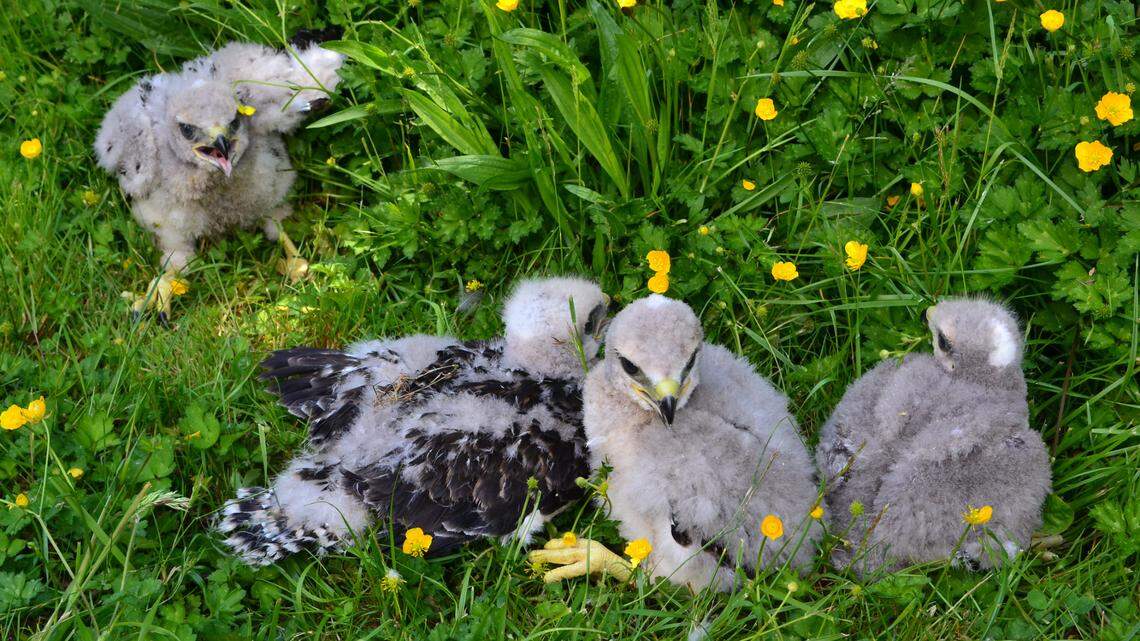
There’s more than luggage stored underneath the airport shuttle buses run by Ferndale-based company Bellair Airporter Shuttle.
For about a decade, the buses have also transported birds of prey, or raptors, from Seattle-Tacoma International Airport to Burlington, where they are released nearby. Bellair does this at no cost to the airport in order to support its raptor strike avoidance program, which captures large birds at risk of being hit by airplanes during takeoff and landing. The company’s contribution earned it the Port of Seattle’s 2022 Sustainable Century Award for outstanding environmental accomplishments.
There are roughly 100 bird strikes reported each year at Seattle-Tacoma International Airport, and they typically result in no damage to the airplanes, said the airport’s wildlife biologist Steve Osmek. But when these events cause damage, the results can be catastrophic.
“When aircraft move so fast on approach and landing, it can be pretty severe damage,” Osmek said. “If any bird is ingested in an engine, it can create some major problems.”
For example, an airplane striking a flock of geese caused the “Miracle on the Hudson” crash landing, a 2009 event in which a plane went down on New York’s Hudson River.
Wildlife, including large birds, are drawn to airports because they have expansive, clear zones where planes approach and depart, Osmek said. In urban areas, these swaths of land are some of the last remaining habitats.
The program tracks and relocates about 16 species of raptors, but the most common, hazardous species is the red-tailed hawk, Osmek said. This bird is the most widespread large hawk in North America, thriving in areas with open ground for hunting and high perches, according to the National Audubon Society.
From the airport to Burlington
Here’s how the raptor strike avoidance program works: The team sets up “Swedish Goshawk Traps,” which resemble small A-frame houses. At the bottom of the trap is a cage for bait birds, typically rock pigeons. When a bird of prey lands on a “trigger stick” resting near the top of the trap, it falls about 8 inches, the doors closing above its head.
Osmek and his team get a notification via text and email when a trap closes. They “hood” the bird and move it into a pet carrier. Birds are very “visually oriented” and remain much calmer when they have a hood blocking their vision, Osmek said. Oftentimes, you can put a hooded bird on its side and the animal will not stand up until minutes later.
The birds are loaded onto the next available Bellair shuttle bus transporting passengers from Seattle-Tacoma International Airport to Burlington.
“Our raptor program wouldn’t be the same without Bellair,” Osmek said. “We’d be shipping birds out one or two days a week because we’d have to find drivers. The shuttle is 365 days a year. It decreases our handling time.”
He said the partnership with Bellair also cuts greenhouse gas emissions, which contribute to global climate change. Transporting the birds in tandem with passengers and luggage has avoided 70 metric tons of carbon dioxide emissions over 10 years, Osmek said.
In Burlington, a contractor measures the birds, outfits them with a U.S. Fish and Wildlife Service leg band and releases them near Bow, a town in Skagit County. This area is good raptor habitat because there is a high density of prey in the wide-open agricultural fields, Osmek said.
Red-tailed hawks are also given a wing marker. Yellow wing markers are given to hawks suspected to be breeding and nesting at the airport — these birds often return, but the team is more tolerant of their presence because they are less likely to be struck by planes. Other hawks, such as those that are juvenile or just passing through the airfield, are given blue tags. It’s very unlikely for blue-tagged birds to return to the airport, Osmek said.
“The return rate is less than 10 percent for all groups,” he said. “We know we are decreasing the number of red-tailed hawks at the airport with this program.”
Dealing with bald eagles
Bald eagles are another story. While the presence of bald eagles at the airport has increased by roughly tenfold over the last five years, the raptor strike avoidance program is limited in its ability to relocate these very large, “gregarious” birds, Osmek said.
His team can’t currently get a permit from the U.S. Fish and Wildlife Service to catch and relocate these highly protected birds, and they must immediately release the eagles if they are captured.
Osmek’s team must rely on “harassment” techniques such as pyrotechnics and sirens to deter bald eagles from sticking around the airfield. He hopes the team will soon obtain a permit allowing them to release bald eagles five miles from the airport.
Osmek urges members of the public to reach out by email at wingtaggedhawks@portseattle.org if they spot a tagged red-tailed hawk.
“We love to know the status of these birds after they are released,” he said. “We had one bird move as far as eastern Washington and another as far down as Sacramento in California.”
Richard Johnson, president of Bellair, extended gratitude to the company’s bus drivers and Burlington staff for their contributions to this work. He said it is extraordinary to see the raptors when they are being transported.
“I’ve seen a number of the birds up close in the cages,” Johnson said. “You can’t get the true feeling through a video of the intensity of the birds’ eyes. They are just hunters, beautiful animals.”
This story was originally published May 8, 2022 at 5:00 AM with the headline "Here’s how a Whatcom company helps prevent potential ‘catastrophes’ at SeaTac airport."
