
Will a half-built, multi-billion-dollar nuclear waste plant in Eastern WA ever get used?
A massive building, already partially built at the Hanford nuclear reservation’s vitrification plant, may not be needed after all.
The facility was expected to prepare the site’s most radioactive waste to be treated for disposal.
Now, a long-awaited Department of Energy analysis proposes other options for preparing that waste, which could change plans made more than 20 years ago based on the state of technology then.
The analysis was started after it became apparent that a court-enforced deadline for treating the waste was highly unlikely to be met.
The Hanford site near Richland in Eastern Washington has 56 million gallons of radioactive and hazardous chemical waste stored in underground tanks from the past production of plutonium for the nation’s nuclear weapons program from World War II through the Cold War.
Currently the nasty mix of high level and low activity radioactive waste is being held in aging underground tanks at the Hanford site, with plans to glassify much of that waste at the vitrification plant to prepare it for disposal.
Construction stopped in 2012
When construction began in 2002 on the vit plant, the largest of the plant’s planned four main buildings, the Pretreatment Facility, was to be used to separate radioactive and hazardous chemical waste from the tanks into separate streams of highly radioactive waste and low activity waste.
The waste will be treated and disposed of separately, with high level radioactive waste required by law to go to a national repository such as the one once proposed at Yucca Mountain, Nev.
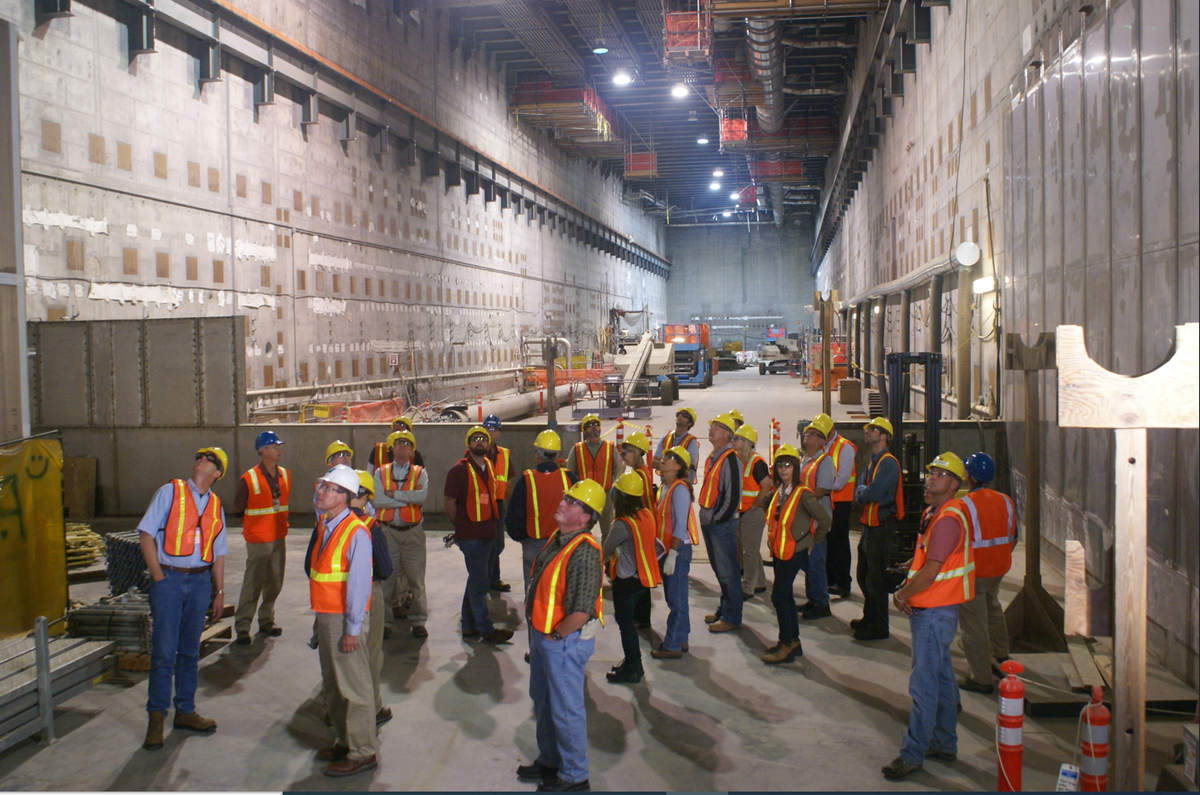
Today the unfinished Pretreatment Facility stands 119 feet high. It’s wider than a football field and about 1.5 times longer.
But most construction on the building halted in 2012 when technical issues were raised on how it would handle the most potent waste. A Government Accountability Office report last year said $8 billion would be needed to finish the facility.
As of late spring 2022, $13 billion had been spent on the vitrification plant, according to the GAO.
As work halted on the Pretreatment Facility in 2012, work proceeded on other vitrification plant buildings needed to treat low activity radioactive waste, including the Low Activity Waste Facility and a laboratory.
Facility not being used for other waste
DOE turned to a different way to separate low activity waste from the stew in underground tanks, using a method that was successful in cleanup efforts at the Fukushima disaster in Japan to bypass the Pretreatment Facility.
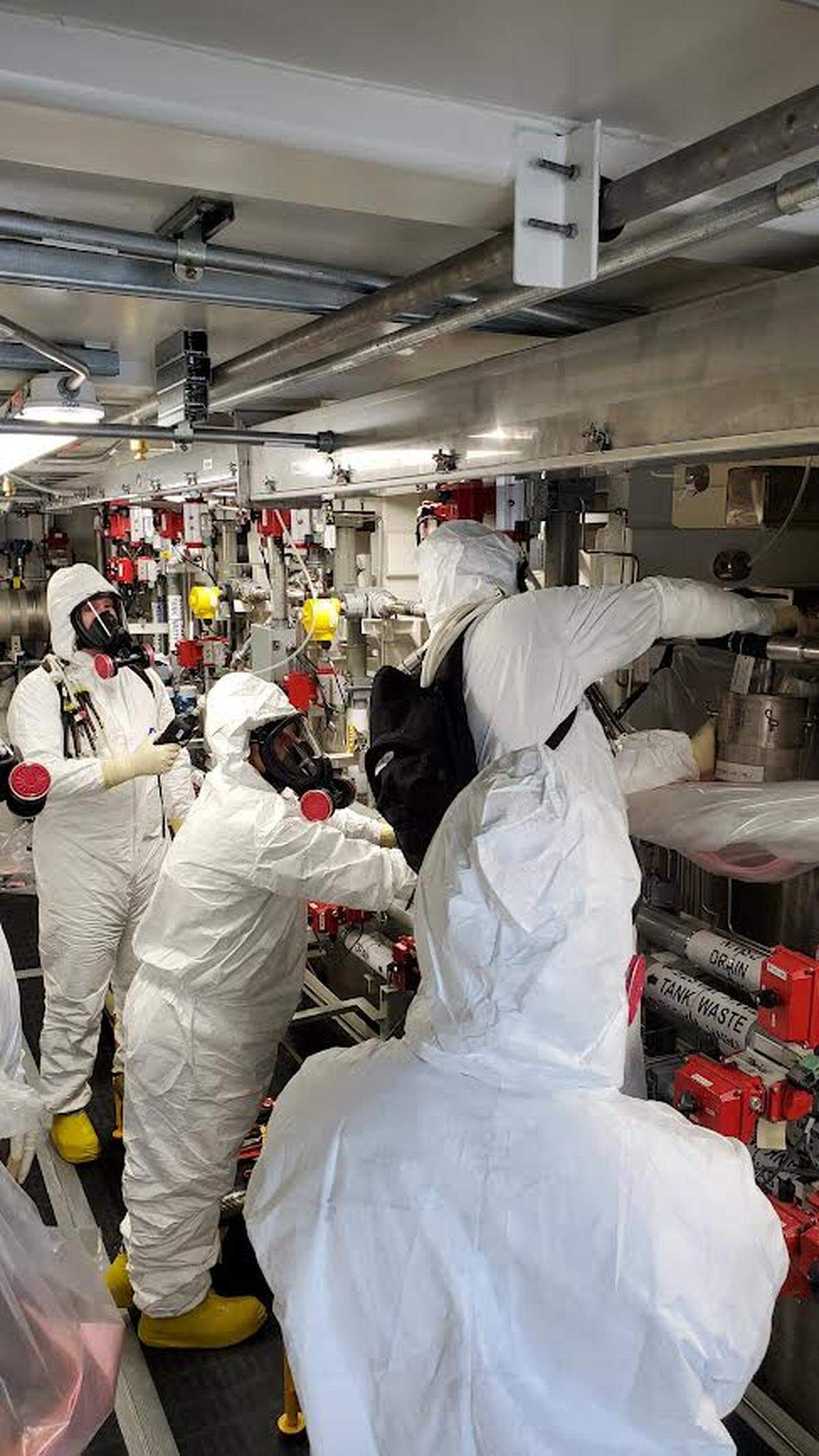
A new, much smaller system — the Tank-Side Cesium Removal or TSCR system — was built as a pilot plant to separate the low activity waste out of the tanks.
It fit in three enclosures placed near one of Hanford’s underground waste tanks. The largest enclosure is the size of a land-sea shipping container.
TSCR began operating in early 2022 allowing some of the low-level waste to be removed from underground tanks and prepared for treatment at the vitrification plant without using the unfinished Pretreatment Facility.
And DOE now appears to be leaning toward continuing to separate out low-activity waste from the tanks without using the pretreatment plant.
DOE is working toward a goal of starting to glassify low-activity waste at the vitrification plant as soon as the end of this year.
But DOE must also start treatment of high level waste by 2033 to meet a federal court consent decree order.
Only about 10% of tank waste is believed to be high level, but it holds up to 97% of the waste’s radionuclides, including plutonium.
11 ways to prepare high level waste
The new analysis of alternatives for high-level waste treatment, made public late last week, considers how high level waste also can be prepared for treatment at the vitrification plant.
DOE ordered the analysis in 2019 when it became clear, with construction still not resumed on the Pretreatment Facility, that DOE was highly unlikely to meet federal court deadlines for Hanford’s most radioactive tank waste.
Construction on the vitrification plant’s High Level Waste Facility, which will glassify the high-level radioactive waste, also was halted in 2012 but some limited construction on it has been done since then.
The recently completed analysis narrowed the alternatives for preparing high-level waste for treatment and associated work from about 20 to 11.
Just two of those alternatives rely on the Pretreatment Facility.
The Department of Energy and its regulators, the Washington state Department of Ecology and the Environmental Protection Agency, are just starting to evaluate the analysis as one step toward a decision on how to proceed toward treatment of high-level radioactive waste at the Hanford vitrification plant.
“The report is not a decision document,” Hanford workers were told in a memo as the new analysis was made public. “Rather it will inform DOE’s critical decision-making process as well as ongoing negotiations between DOE, the State of Washington and EPA regarding the path forward for the Hanford tank waste mission.”
With the analysis now available, the public is able to learn more about the options analyzed and are encouraged to share feedback, said DOE and the state in a joint statement.
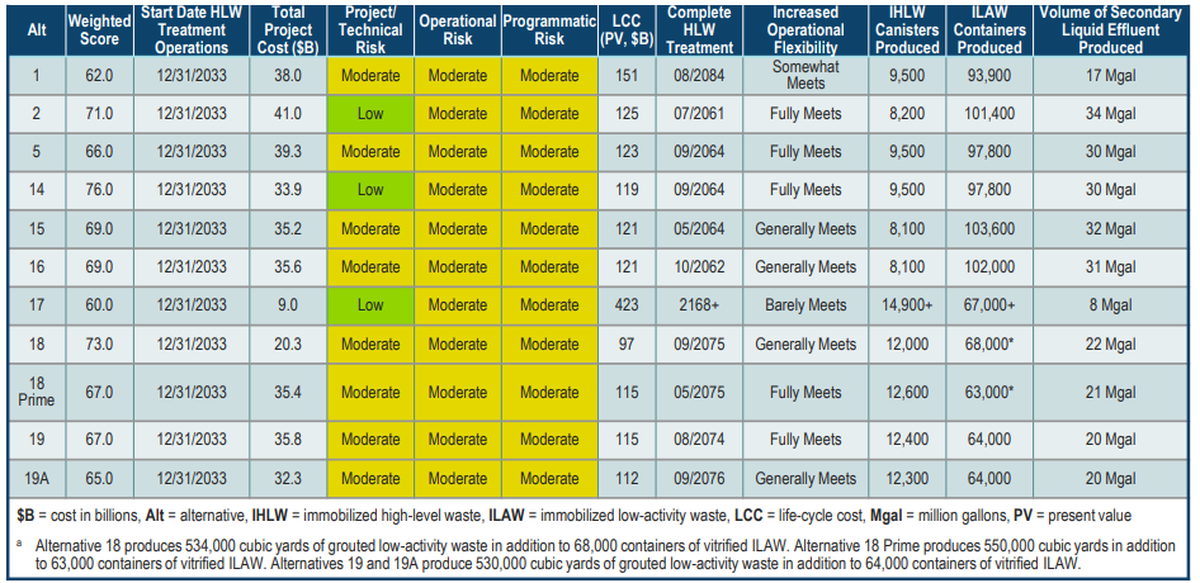
The alternatives vary in cost, technical risk and when all high-level waste could be treated.
All of them call for the start of high-level treatment by the federal court deadline at the end of 2033.
2 options use pretreatment plant
One alternative calls for finishing the Pretreatment Facility largely as originally planned, but with some changes to address technical issues. It has an estimated project/capital cost of $38 billion and then a total lifecycle cost of $151 billion.
It would require construction of one new facility to characterize and stage tank waste before it was sent to the Pretreatment Facility.
Treatment of high-level waste would not be completed until 2084 under that option, according to the analysis.
The analysis also proposed another option that would repurpose or downsize the Pretreatment Facility with a project cost of $39.3 billion and a lifecycle cost of $123 billion. High-level waste treatment would be completed in 2064.
However, those two alternatives appear to be too costly, requiring more than $2.5 billion in spending in some years.
Now, DOE receives a little over $2.5 billion a year for all the work needed for cleanup of the Hanford site, which includes contaminated buildings, soil and groundwater and radioactive and chemical waste in addition to that stored in tanks.
Other options in the analysis would bypass the pretreatment plant and instead call for building a new Feed Preparation Facility, a new Effluent Management Facility or a combined facility for their functions.
To allow pretreatment of low-activity radioactive waste without the Pretreatment Facility, an Effluent Management Facility processing building was built at the vitrification plant. It handles liquid captured during treatment in an off-gas system.
Highest scoring option for waste
The 11 options analyzed include weighted scores as one subjective criteria to assess options.
The option with the highest score proposed pretreatment of waste in a new Feed Preparation Facility and also building a new Effluent Management Facility.
The project cost would be $33.9 billion, and the high-level waste treatment would be completed in 2064. The risk was ranked as low.
However, other options that would not use the pretreatment plant and phase in construction work appear to have lower costs and could be more practical.
They would drop the project cost to as low as $20.3 billion and the lifecycle cost to as low as $97 billion, but would require treatment to continue for about another decade or to about 2074-2076.
Some options that would grout some low-activity radioactive waste rather than glassify all of it, also were analyzed in relation to how they would fit into the high-level treatment work.
The public is invited to comment on the analysis by emailing HLW_AOA@rl.gov or by sending mail to Attn: Jennifer Colborn; U.S. Department of Energy, P.O. Box 450, H5-20, Richland, WA 99352.
Links to the analysis of alternatives and fact sheet are posted at hanford.gov under Jan. 19 of the event calendar.
This story was originally published January 24, 2023 at 5:00 AM with the headline "Will a half-built, multi-billion-dollar nuclear waste plant in Eastern WA ever get used?."