
Seeking a college scholarship in WA? A guide to programs, resources, tips for applying
It’s college application season, and with the price tag of a college education steadily going up, students should know what scholarship and financial aid options are available.
According to a College Board report, the average in-state tuition at four-year public colleges nationwide has increased from $8,530 to $11,610 over the past 20 years, after adjusting for inflation. Private schools, meanwhile, have seen inflation-adjusted tuition increase from 33,340 to 43,350 over the same time frame. Washington’s in-state tuition is just above the national average, according to the report. The total costs of public college, however, exceed $35,000 in the state once room and board are taken into account, well above the national average.
In Washington, there are several ways students can secure funding and lower costs to attend college, both private and state-run, as well as government resources to help students find scholarship opportunities. And a 2024 law will expand the state’s financial aid program starting in 2026. With too many program to keep track of and a constantly changing list of requirements, here’s everything you need to know.
Public scholarships in WA
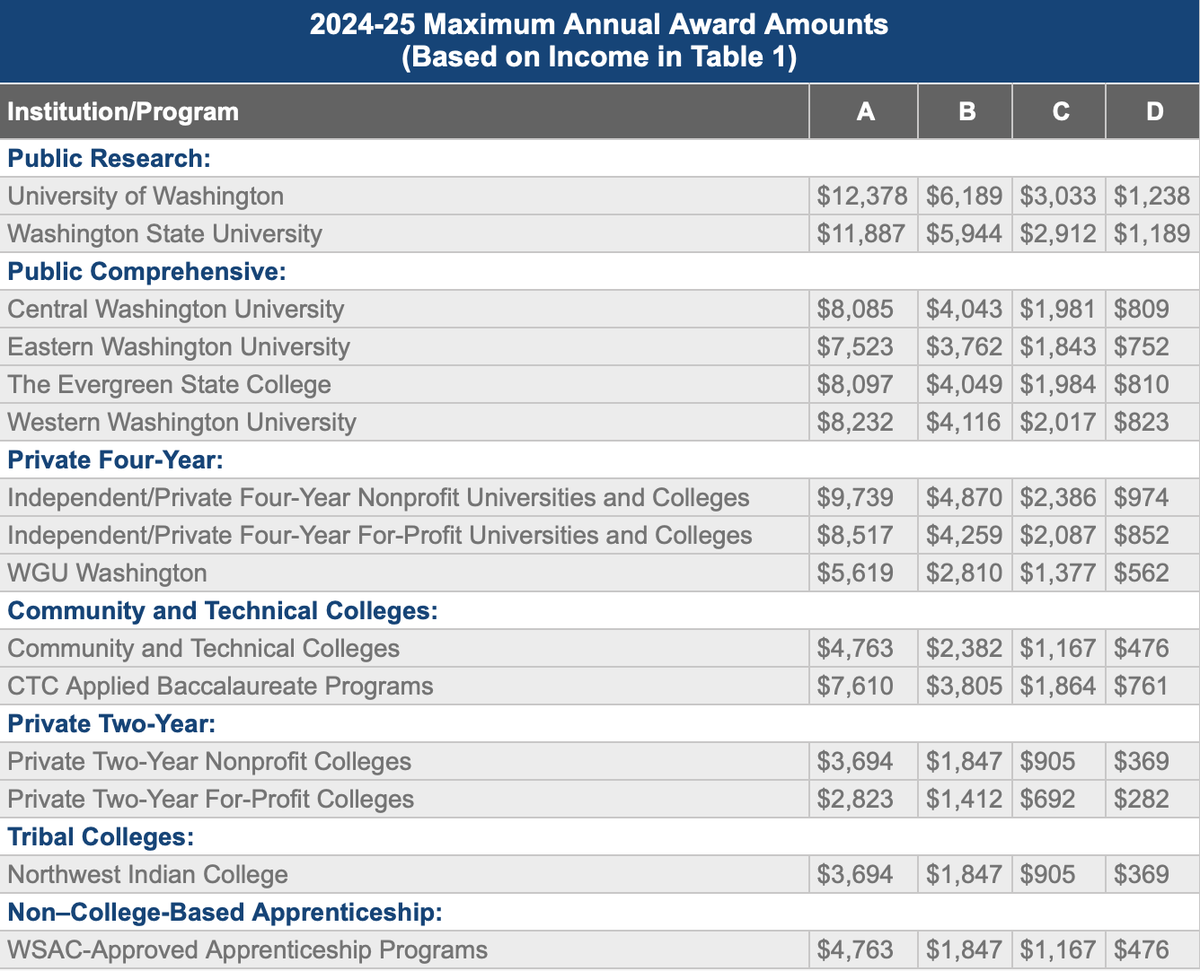
The most notable government-funded scholarship in the state is the Washington College Grant. The program, also known as WA Grant, offers Washington residents close to the full cost of in-state tuition in some cases. Under the program, qualifying students at the University of Washington or Washington State University can get roughly $12,000 in financial aid, depending on family income and size.
At the state’s other public schools, that number drops to roughly $8,000 while at private, and for in-state not for profit colleges it’s set at just over $9,700. Trade and technical school students can receive grants of up to just over $4,750.
Students who are eligible for the program are automatically considered if they fill out the Free Application for Federal Student Aid or the Washington Application for State Financial Aid, the state’s alternative for students whose families aren’t eligible for the FAFSA due to immigration status or defaulted federal loans.
Despite the amount of aid available in Washington, the state has one of the lowest FAFSA completion rates in the country, according to the Washington Student Achievement Council. Starting in 2026, students whose families receive food assistance benefits based on their income will automatically qualify for WA Grant as well.
“The WA Grant is the biggest one that we have available,” said Sam Washington, assistant director of college access and initiatives at WSAC, in a phone interview with McClatchy. “Students will need to go through either the FAFSA application or the WASFA application to be put into consideration for eligibility and award amount.”
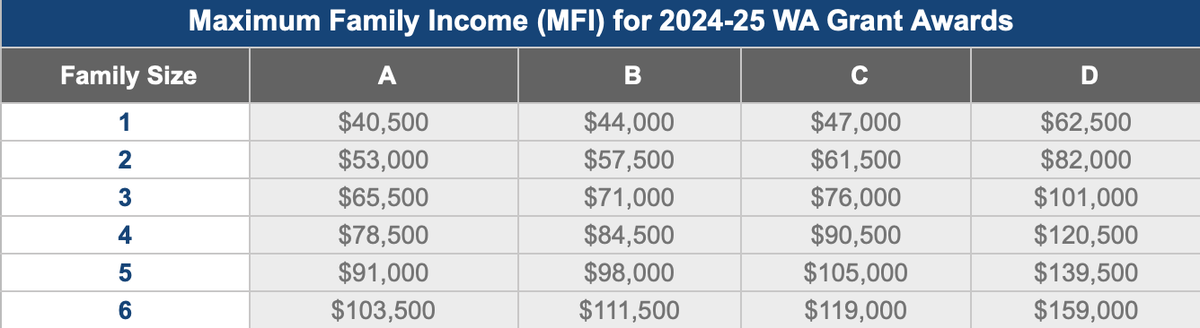
WSAC maintains an online calculator that estimates how much money you’d qualify for under the WA Grant.
While it’s not as widely available as the WA Grant, the state also runs the College Bound program, which provides assistance to students from low or middle-income households. A household of four needs to have a yearly income at or below $78,500 to qualify, while the threshold rises to $108,000 for a household of eight.
“Students [who] signed up for free and reduced price lunch in middle school are automatically enrolled into the program,” Washington said. “Then when they hit senior year, their eligibility is determined by that FAFSA or WASFA application, as well as the College Bound Pledge, which is a handful of requirements that the student needs to meet in order to maintain their College Bound eligibility.”
If students need additional financial aid on top of those programs, the state has a few other options as well.
“There’s also things like state work study that students can be eligible for,” Washington said. “There’s opportunities for youth experiencing homelessness and youth in foster care through the Passport [to Careers] program as well as Opportunity Grant. And then there’s a lot of state-related funding options at the institutions themselves.”
While not technically a scholarship, Washington also offers the Running Start program, which lets high school students take community or technical college classes tuition-free.
Washington school-specific scholarships
Colleges typically offer their own scholarships as well. The University of Washington’s website, for example, lists 60 scholarships offered by the school, ranging from department-specific awards to ones open to the whole school.
You can find more information about school-specific scholarships at UW, Washington State University, Eastern Washington University, Western Washington University, Central Washington University and The Evergreen State College on each school’s website.
Washington’s private colleges typically offer internal scholarships as well, as does private college advocacy group Independent Colleges of Washington.
Private scholarships in WA
Students who need additional help to cover the cost of college outside of state funding can apply for a number of private scholarships.
“We’ve supported a few different ones over the past few years. One of them is an organization called Get Schooled. They provide a lot of college-going support and resources,” Washington said. “There’s also the Washington State Opportunity Scholarship. That’s another great one here in our state, and they have scholarship opportunities that go towards four-year colleges as well as two-year college programs.”
It’s not just education-focused organizations that offer scholarships in the state. Plenty of private organizations and companies offer scholarships as well.
According to Washington, the list of organizations offering scholarships is constantly changing and can be difficult to keep track of. However, credit unions tend to be a good bet.
Washington state’s biggest credit union, the Boeing Employees Credit Union, offers a $2,500 scholarship to at least 64 members each year, while the Washington State Employees Credit Union awards a total of $100,000 in annual scholarships to its members. Several others, including Gesa Credit Union, TwinStar Credit Union and Whatcom Educational Credit Union have scholarship programs as well.
While credit union scholarship programs tend to be relatively consistent, that’s typically not the case for other companies that offer scholarships, according to Washington.
“It’s a very dynamic thing year-to-year where scholarship providers will increase or decrease the amount of scholarship dollars they’re providing, new scholarship providers will pop up where others will go away,” Washington said.
How to find scholarships in WA
To help with that problem, the state maintains a few resources to help students find scholarships they might be interested in applying for.
“At WSAC, we have one resource in particular based around scholarships, called The Washboard,” Washington said. “It can be found at thewashboard.org and it’s essentially a search engine site that’s vetted by our agency, and folks can add to it by submitting to WSAC.”
Students who sign up for The Washboard can receive personalized scholarship recommendations just by entering a few pieces of information about themselves.
“Essentially, students will go on to that website, create their profiles, let the platform know a little bit about themselves – what they aspire to do, different education pathways they may be interested in – and then that will go on and match them with some scholarship opportunities here in Washington state,” he said.
WSAC’s Gear Up Washington State website also maintains a list of scholarships, both local and national, that Washington students might be interested in.
You can also go through your school to search for scholarships. UW maintains an online database of scholarships open to its students, as does WSU.
While each individual scholarship might only go a small way toward covering the cost of college, Washington said if students apply for several scholarships, the money will start to add up.
“The financial aid process is a lot of different sources of financial aid that come together to cover those costs for students – FAFSA and WASFA, putting them in eligibility for a lot of those opportunities at a foundational level, and then scholarships can come in to cover remaining costs of attendance after that,” Washington said.
Tips for applying to scholarships
Washington said that students can be intimidated by how complicated the scholarship process is, but that there are several ways to simplify it.
“There are different tips and tricks that we recommend to students like keeping copies of previous essays, being very familiar with your own story, so that is something that you can share in those essays, making sure those essays are in line with your goals and aspirations,” Washington said.
One of the most common mistakes WSAC sees, he said, is students not leaving enough time to fill out the applications for each scholarship they want to apply to.
“It’s a long process, and we really encourage students to get started even before their senior year,” Washington said.
Washington said it’s important to remember that while each individual scholarship might not seem like it’s worth the effort of applying, if you keep applying, the totals add up in the end.
“It can be pretty tiring, pretty draining on students, especially for the amount of scholarship dollars that are out there,” Washington said. “But they are certainly out there.”
This story was originally published December 18, 2024 at 5:00 AM with the headline "Seeking a college scholarship in WA? A guide to programs, resources, tips for applying."