
Gov. Jay Inslee calls for more taxes to help fill Washington’s $10B-$12B budget hole
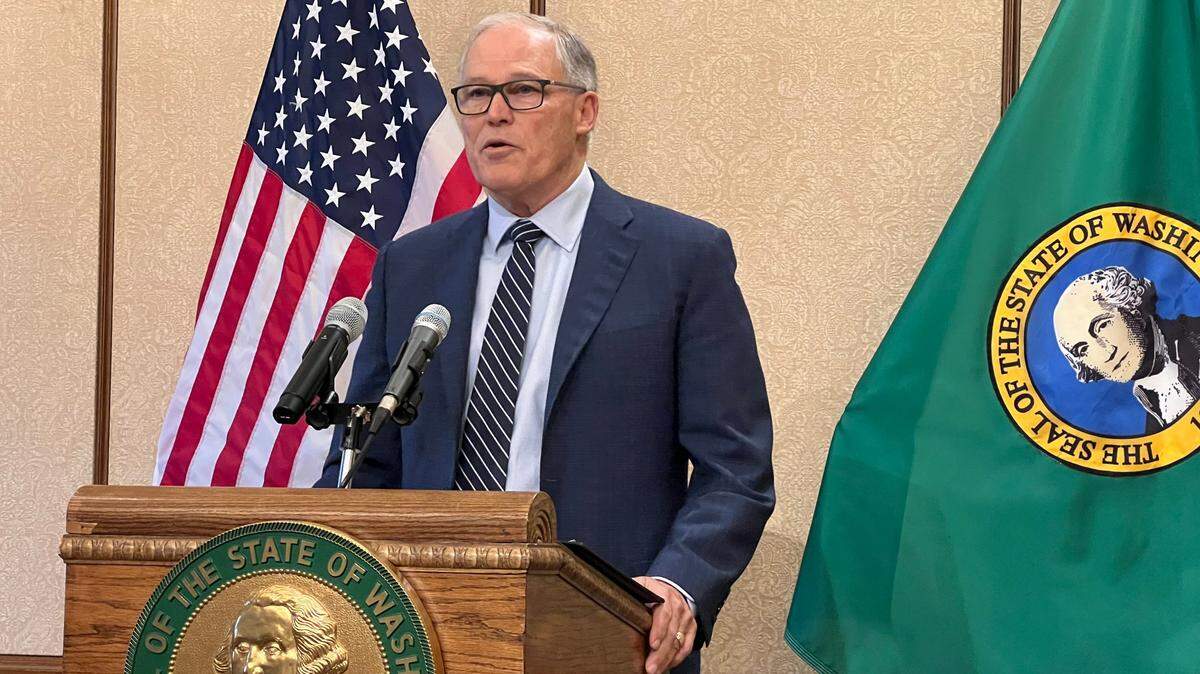
Washington is facing a significant budget hole — one in the multi-billion dollar range — and outgoing Gov. Jay Inslee on Dec. 17 unveiled his ideas to help fill it.
One major suggestion: imposing a new wealth tax.
Such a tax would affect some 3,400 of the state’s uber-wealthy residents, according to Inslee’s proposed 2025-27 budget. They would be expected to pay a 1% tax on wealth over $100 million.
Similar thoughts have previously been floated in the state Legislature but haven’t been popular among Republicans.
State Rep. Chris Corry of Yakima has argued that a wealth tax could ultimately lead investors and innovators to flee the state, according to FOX 13.
Inslee told McClatchy on Dec. 17 that he was faced with a choice: Should he propose a budget, for instance, that would reduce parents’ ability to receive services like mental-health treatment for their struggling child? Or should he ask billionaires to chip in a bit more?
“That’s the kind of decision that I had to make in this proposal,” Inslee said. He said it wasn’t easy “because no one likes to pay more taxes, but I believe it’s more injurious to the state to deny that family mental health care, and those are the kind of real-term decisions we have.”
Pat Sullivan, director of the Office of Financial Management, offered a budget briefing Dec. 17. Asked to respond to wealth-tax critics, he replied that the proposal is an attempt to create a fairer tax system.
“In this budget, we could have increased the sales tax,” Sullivan told McClatchy. “We could have put more of an emphasis on, you know, that working mom who’s got two jobs, who’s already paying their greater share of the tax burden — but our decision was to try to make our tax system more equitable.”
The budget also contains a proposed business and occupation tax increase on establishments earning more than $1 million annually in the “services and other activities” category, according to the proposed 2025-27 budget. Some 20,000 establishments would be impacted; it would not pertain to most small businesses.
The wealth-tax proposal would rake in $10.3 billion in revenue over four years, while the B&O tax increase would generate $2.6 billion over that same span. That adds up to $12.9 billion.
Other proposed adjustments include closing the Mission Creek Corrections Center for Women in Belfair, the Rainier School in Buckley and Yakima Valley School in Selah.
Responding to a question about job cuts, the state’s budget office said that 924 full-time equivalent positions — including at the facility closures — would be eliminated.
Cuts and reductions would also be made to funding for programs that don’t “affect essential services for vulnerable communities,” per the governor’s budget. Over four years, the suggested general government budget features $136.5 million in savings in the general fund, thanks partly to reductions or eliminations of certain grants.
The governor in November estimated the shortfall through the next couple budgets at between $10 billion and $12 billion. Add in new public employee contracts and it would inch up to roughly $15 billion.
Earlier this month Inslee declared a freeze on nonessential hiring and spending because of the budget deficit.
Responses to Inslee’s plan
State Rep. Travis Couture, the new House Republican ranking member on the House Appropriations Committee, decried the proposal, citing the nearly $13 billion tax hike. The Allyn Republican told McClatchy the budget is “wildly out of touch” with the financial burdens faced today by Washington families.
Asked what spending he’d like to see pared down, Couture said the Republican budget team is going to pore over thousands of line items of potential cuts before proposing a Republican budget alternative in the coming weeks.
Couture noted the departure of Amazon kingpin Jeff Bezos following the passage of the state’s capital gains tax. If the proposed Washington wealth tax were to pass, he thinks it would lead to more “capital flight.”
“That could harm jobs, that could harm innovation, it can harm a lot of even potentially local governments and their revenues if people with large property tax bills move out,” he said. “And so at the end of the day, I don’t see how that is a viable pathway to a sustainable future for Washington.”
Inslee’s successor will also be wading into the choppy budget waters.
Gov.-elect Bob Ferguson, a Democrat, declined during an interview with The Seattle Times to say whether he would support a proposal to tax the ultra-rich. He did, however, vow to search for ways to slash government spending before mulling more taxes.
The Senate Republicans’ budget leader, state Sen. Chris Gildon of Puyallup, criticized the governor’s plan. He said in a statement Dec. 17 that the deficit is due to overspending, not a revenue drop nor a recession.
Inslee could have created a budget “that lives within the additional $5 billion in revenue that is anticipated,” Gildon said. Instead he wants to spend more and pile further taxes onto the state’s employers to bridge that difference.
“When the cost of doing business goes up, consumers feel it too,” Gildon said in a statement. “His budget would make living in Washington even less affordable.”
Democratic state Sen. June Robinson, chair of the Senate Ways & Means Committee, called the proposal a “strong starting point” for work in the upper chamber.
State Sen. Yasmin Trudeau, vice chair of the Senate Ways & Means Committee, described the suggested budget as an “important foundation” for lawmakers’ budget work this session.
This story was originally published December 17, 2024 at 11:42 AM.
.jpg)