
WA observatory at risk from Trump cuts helps make stunning black hole discovery
AI-generated summary reviewed by our newsroom.
- LIGO Hanford detected record-setting black hole merger, challenging current knowledge.
- Merged black holes spun near general relativity’s limit, baffling scientists.
- Funding cuts threaten U.S. observatories despite essential role of both in discovery.
The LIGO Hanford Observatory near the Tri-Cities and its twin in Louisiana detected ripples of time and space passing through Earth from the most massive collision of black holes ever observed, a coalition of the world’s four gravitational wave observatories announced Tuesday.
The gravitational waves were confirmed by comparing signals from space that were detected by both U.S. LIGO observatories despite lasting only a 10th of a second.
“This is the most massive black hole binary we’ve observed through gravitational waves, and it presents a real challenge to our understanding of black hole formation,” said Mark Hannam of Cardiff University in Wales, who is a member of a coalition of the world’s gravitational wave observatories, in a statement.
In addition to the large mass of the merging black holes, they also were spinning more rapidly than any previously detected black hole, approaching the limit allowed by Einstein’s theory of general relativity.
The international coalition, the LIGO-Virgo-KAGRA collaboration, described the detection in a fact sheet as an event “both extraordinary and puzzling to interpret.”
It is “a potent reminder that the cosmos still holds many surprises, and we are only just beginning to uncover them,” it said.
The interpretation of the data and the announcement came as the future of at least one of the U.S. LIGO observatories is in jeopardy as deep cuts to science programs are proposed by the Trump administration.
Gravitational waves are caused by cataclysmic events in space, such as colliding black holes, merging neutron stars, exploding stars and possibly even the birth of the universe itself, according to CalTech, which is a joint operator and manager of the two LIGO observatories under an agreement with the National Science Foundation.
Since the U.S. Laser Interferometer Gravitational-wave Observatories made scientific history in 2015 with the first-ever direct detection of gravitational waves, or ripples in space and time, from a black hole merger, about 300 more black hole mergers have been detected.
The U.S. LIGO’s have collaborated on discoveries with Italy’s Virgo gravitational-wave observatory since 2007 and Japan’s KAGRA observatory since 2019.
Massive black hole
The black hole collision detected on Nov. 23, 2023, in the United States, during an international observing run, produced a final black hole about 225 times the mass of Earth’s sun. The two black holes that merged had individual masses of about 100 and 140 times that of the sun.
“It looks like we are seeing mergers of mergers,” which could lead to new information about steller evolution, said Michael Landry, head of the LIGO Hanford Observatory.
Current stellar evolution models don’t account for black holes so massive, which raises the possibility that what was detected was the merger of black holes, at least one of which had already merged to form a larger black hole, according to Hannam.
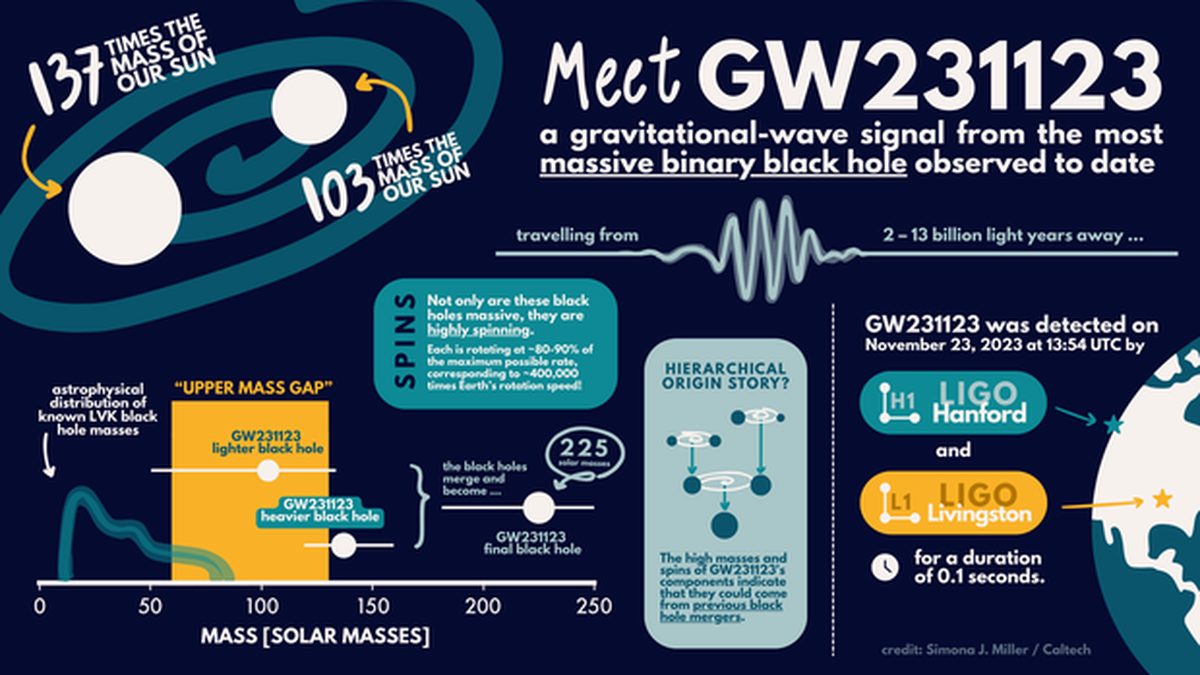
The black holes could come from an extremely dense astrophysical environment, such as a nuclear star cluster or an active galactic nucleus, where black holes are more likely to collide, according to the LIGO-Virgo-KAGRA collaboration fact sheet.
Now theories of steller evolution suggest that black holes with masses between about 60 and 130 solar masses, such as one of those in the detection announced Tuesday, should be rare or not even exist, according to the LIGO-Virgo-KAGRA collaboration.
The initial merger detected in 2015, confirming Einstein’s theory of relativity, had a final black hole mass of 62 times that of the sun. And until the one announced Tuesday, the most massive black hole merger detected was 140 times the mass of the sun, the same as the larger of the merging black holes in the new detection.
“This observation once again demonstrates how gravitational waves are uniquely revealing the fundamental and exotic nature of black holes throughout the universe,” said Dave Reitze, the executive director of LIGO at CalTech
The high mass and extremely rapid spinning of the black holes that merged push the limits of both gravitational-wave detection technology and current theoretical models.
Confirming LIGO detection
The two black holes that collided were so incredibly heavy, that the signal they sent was lower in frequency and shorter compared to other detections, Landry said.
In order to confirm that the the detection was from gravitational waves from space and not something on Earth, data from two or more sources was needed, in this case the Hanford and the Livingston, La., LIGOs, Landry said.
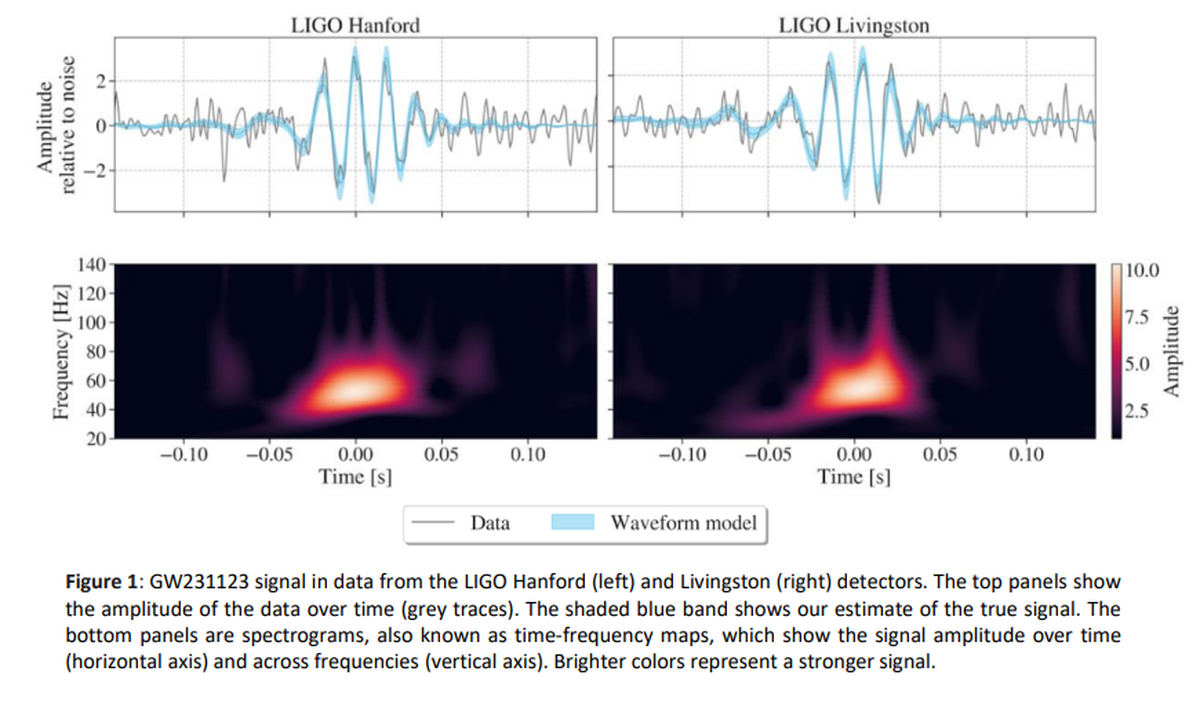
Although just a tenth of a second long, the signal was 20 times louder than the typical detector noise, and a graph of the detections at both LIGOs closely match.
They give a particularly clear view of the merger’s grand finale when the newly formed black hole radiates energy through gravitational waves, vibrating and finally settling into a stable state, according to the LIGO-Virgo-KAGRA collaboration fact sheet.
Extracting accurate information from the signal to make sure it was not a random blip in the data required the use of models that simulate what a signal would look like for different black hole pairs, accounting for the intricate dynamics of highly spinning black holes, according to the fact sheet.
The modeling found that the probability of random noise mimicking the detection was less than once in 10,000 years.
“This gives us extreme confidence in the non-terrestrial origin of the signal, and thus in the reality of this gravitational-wave signal,” according to the fact sheet.
The detection was from the fourth observing run of the collaboration and of the four international observatories that began in May 2023. Additional observations from the first half of the run through January 2024 will be published later this summer.
Proposed LIGO closure
The confirmation of the discovery of the heaviest black hole ever detected comes as the Trump administration’s proposed budget for fiscal 2026 calls for closing either the Louisiana or Hanford LIGO. It is part of a 57% cut proposed by the administration for the National Science Foundation.
The proposal has been given to Congress, which is working on bills now in the House and the Senate to set budgets for the National Science Foundation and its projects. Sen. Patty Murray, D-Wash., has included funds for both LIGOs in a Senate appropriations bill.
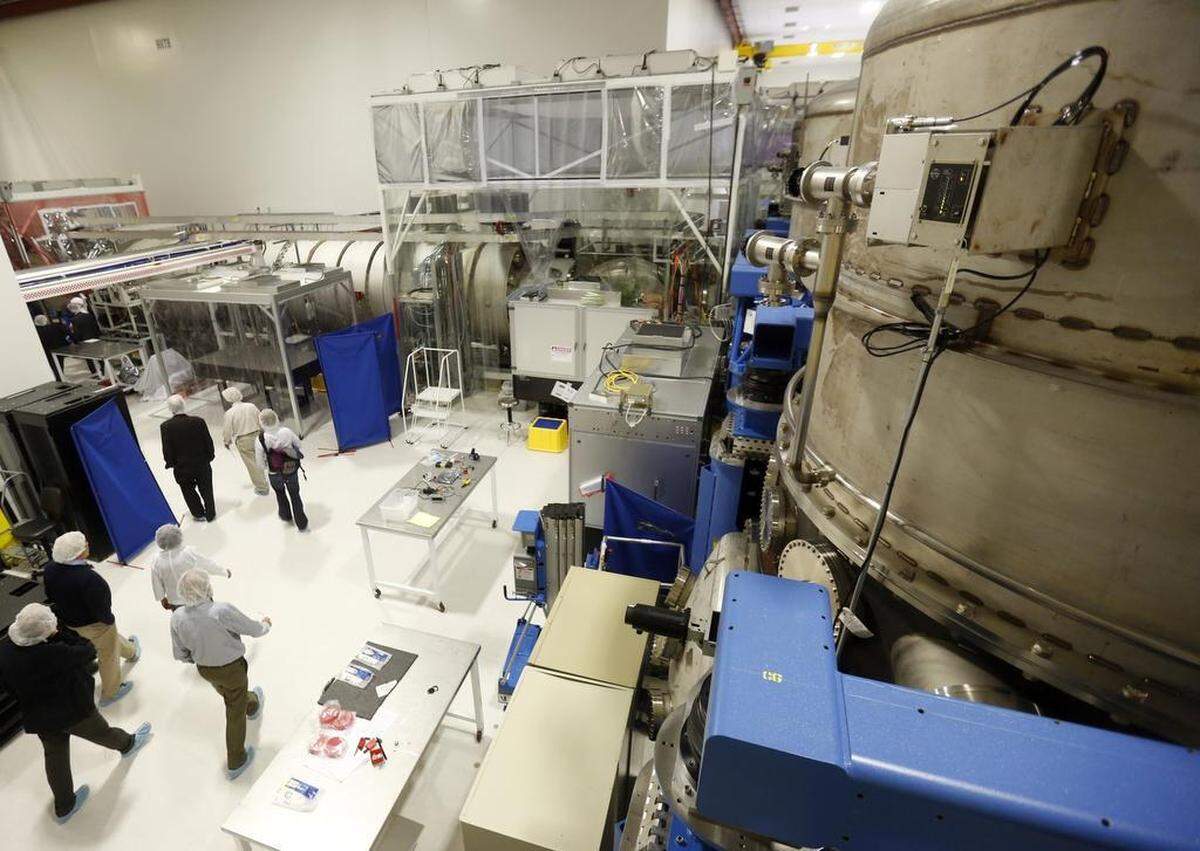
According to LIGO CalTech, it is rare that a signal is so strong that a claim of detection can be made with just one observatory. Two or more detectors operating in unison are fundamental to LIGO’s ability to contribute to the burgeoning field of gravitational wave astronomy, it said.
To be able to hunt for and also find the visible light or other electromagnetic radiation associated with certain gravitational wave events using more traditional observatories, three or more gravitational-wave observatories are needed for triangulation to locate the region of the sky that contains the source of the wave, according to LIGO CalTech.
To date, just one such source, the first-ever-known neutron star merger, has also been seen by observatories relying on light after a gravitational-wave detection.
“Though LIGO’s mission is to detect gravitational waves from some of the most violent and energetic processes in the universe, the data LIGO collects may also contribute to other areas of physics such as gravitation, relativity, cosmology, astrophysics, particle physics and nuclear physics,” according to LIGO CalTech.
This story was originally published July 16, 2025 at 5:00 AM with the headline "WA observatory at risk from Trump cuts helps make stunning black hole discovery."